


The Quarterly Review
The meeting room on the fourteenth floor had a view of the city and no windows that opened. Marcus, the chief executive, had learned to treat this as a metaphor.
He sat at the head of the table, quarterly reports stacked in front of him. One was from Sofia, his Chief Marketing Officer, the other from Daniel, his Chief Financial Officer.
The three of them were the board. On paper that made them one body. In practice it made them two reports and no shared picture.
Both reports were thorough. Both were accurate. Both were, in some way he could not quite name yet, incomplete.
He started with Sofia.
Marcus: “Tell me about the customers. Not the numbers. The customers.”
Sofia had prepared for this. She always did.
Sofia: “Acquisition is up eleven percent. NPS is stable at 42. Our top segment, mid-market manufacturers, shows strong loyalty. Three accounts expanded scope last quarter.”
Marcus: “And the ones who didn’t expand?”
A pause.
Sofia: “Two accounts reduced engagement. One moved part of their spend to a competitor. No formal churn. They just drifted.”
Marcus: “Why?”
Sofia: “We’re still gathering feedback. Preliminary signals suggest they’re looking for something we do not currently offer. More proactive. More anticipatory. Less reactive.”
Marcus wrote one word on his notepad: anticipatory.
Then he turned to Daniel.
Marcus: “Costs. Margin. Where are we?”
Daniel was precise. He was always precise.
Daniel: “Operating margin improved 1.8 points year-on-year. The automation initiative delivered a 34 percent reduction in processing time. Cost per transaction down. We are running lean.”
Marcus: “Good. What does that enable us to do next?”
Daniel looked at his report.
Daniel: “We’re positioned to reinvest in infrastructure upgrades and expand the automation scope to two additional departments.”
Marcus nodded slowly. He looked from Daniel to Sofia and back.
Marcus: “Sofia, do your customers care about our infrastructure upgrades?”
Sofia: “Not directly, no.”
Marcus: “Daniel, does our automation initiative help us offer something the accounts that drifted were looking for?”
A longer pause this time.
Daniel: “That’s not really my domain to assess.”
Marcus put down his pen.
Marcus: “That’s the problem.”
He leaned back and looked at both of them.
Marcus: “You’re both reporting accurately, and you’re reporting backwards. What happened, never what it means.”
He tapped each report once.
Marcus: “Sofia, you see the customer and not the cost of serving them. Daniel, you see the cost and not the value the customer receives. Neither of you tells me what we could be doing and are not.”
The room was quiet.
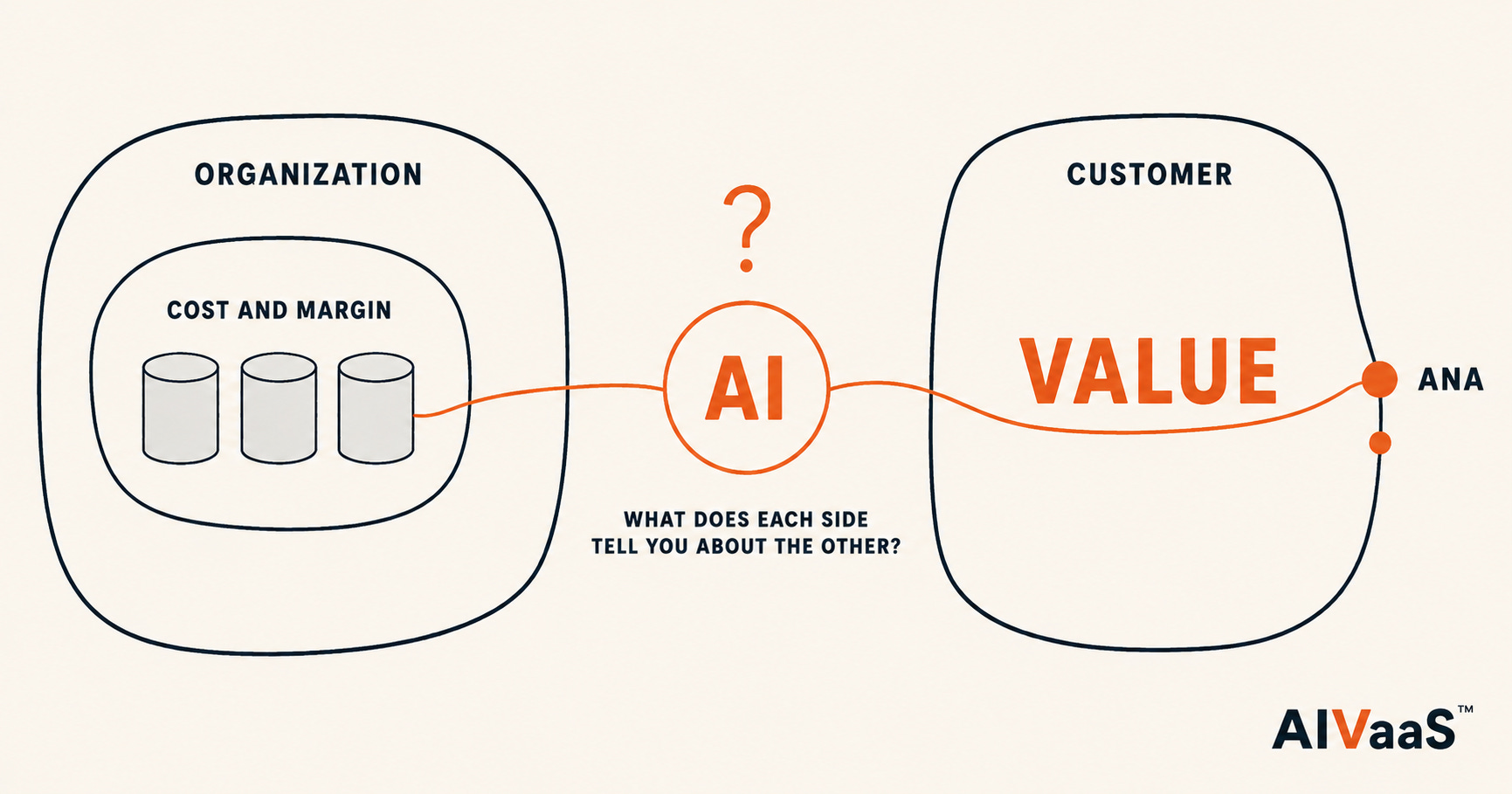
Marcus: “I want one report. From both of you. Together. Not your numbers stitched next to each other. A real synthesis. What does our external picture tell us about our internal choices? What does our internal picture tell us about our external opportunities? And what are we missing?”
He stood up.
Marcus: “Take the AI system. Use it. I want something that shows me the whole picture, not two halves pretending to be a conversation.”
The Hallway
Sofia and Daniel stood in the corridor outside the meeting room, reports under their arms, looking at each other with the particular expression of two people who have just been told to collaborate without being told how.
Sofia: “I don’t know how to start this.”
Daniel: “Neither do I. I can give you the cost structure of every customer segment. But I do not know what that tells you about their future behaviour.”
Sofia: “And I can tell you what customers say they want. But I cannot tell you whether we can afford to give it to them.”
They walked to the smaller conference room where the company’s AI system was accessible, a shared workspace tool they had both used individually but never together for something like this.
Sofia: “Let’s just tell it what we’re trying to do.”
The Session With the AI
They opened a shared session and started typing.
Daniel: We need to prepare a joint strategic report for our CEO. I am the CFO, she is the CMO.
He wants us to connect our external picture, meaning customer value, market position and what customers need, with our internal picture of costs, margin and operational efficiency. He also wants us to identify opportunities we are currently missing. Where do we start?
AI: Before we build the report, let me give you a framework for thinking about this, because the gap you’re describing isn’t a reporting problem. It is a structural one.
Value has two pictures. The external picture asks what your customer needs and what they are willing to pay for. The internal picture asks what activities you perform, what they cost and how much margin they generate.
Most organisations run these two pictures separately. Your CEO is right that they need to be connected.
Here is the connection. Your internal activities only have value to the extent that they produce something the external customer experiences as valuable.
If an internal activity, however efficient, does not trace to customer value, it improves your margin without improving your position. That is useful in the short term and insufficient in the long one.
Sofia read this twice.
Sofia: “That’s what Marcus was saying. We’re optimising internally without asking whether the optimisation connects to what customers actually need.”
Daniel: “But efficiency is real value. If we reduce costs, we protect margin, which protects the business.”
Sofia: Is internal efficiency the same as customer value?
AI: No, and they are connected. Efficiency is a prerequisite and not a destination.
Your margin comes from the difference between the value customers perceive and the cost of producing it.
Reduce costs without changing what customers perceive, and your margin improves while your competitive position stays where it was. Increase what customers perceive without controlling costs, and your position improves while your margin may not.
The strategic question is not either or. It is how your internal choices enable you to offer external value that customers cannot get elsewhere.
The strategic question is not: how do we get more efficient? It is: what value could we offer that we cannot offer today?
Seven Levers
Daniel pulled up the data on his screen: cost structures, margin by segment, automation savings. Sofia pulled up hers: customer acquisition data, NPS scores, the two accounts that had drifted.
Daniel: “Ask it about the levers. The ones we discussed in last year’s strategy session, the value creation levers.”
Sofia: We have seven value creation levers in our framework: Expand Existing Value (1), Strengthen Value Efficiency (2), Create New Value (3), Accelerate Value Realization (4), Stabilize Value Flows (5), Increase Lifetime Value (6), Leverage External Value Creation (7).
Help us understand which of these we are currently activating and which we are missing.
The system did not answer the question as it had been asked.
AI: Before the answer, one correction to the question. Each of the seven can be pulled in two directions, and the direction is a choice you make. It is not a property of the lever.
Pull a lever inward and the gain stays with you, as margin, as cash, as predictability. Pull the same lever outward and the gain reaches the customer, as something they can feel.
You are working three of the seven. Your automation initiative is lever 2. Your billing cycle change is lever 4. Your contract structure work is lever 5. All three are pulled inward.
That is the pattern in your two reports, and it is a decision about direction rather than a limit of those levers. It can be reversed.
Lever 2 pulled outward would send part of the saving to the customer, in price, in scope or in speed. Lever 5 pulled outward would sell reliability itself, so the customer buys availability and stops carrying the risk. Neither happens by default. Each one takes a decision.
The two accounts that drifted were asking for something anticipatory. Nothing you are pulling today points in that direction.
Sofia stared at the screen.
Sofia: “So we’ve been pulling every lever inward, and the customers were asking us to turn one around.”
Daniel: “We assumed efficiency would flow through to the customer.”
Daniel: Does the gain from efficiency reach the customer by itself?
AI: No. It reaches the customer when someone decides to send it there, and that decision has to be made on purpose.
Efficiency gives you margin. Margin can fund a new service, or fund a lower price, or sit in the infrastructure queue. All three are legitimate uses. Only two of them change what the customer experiences.
Most organisations in your position have done what you have done. They built the inside first, which is sound. The question now is which lever you are willing to turn around, and what you would offer if you did.
There is also a third move, where a single lever closes a need on your side and on the customer’s side at the same time, out of one and the same decision. That one is rarer than it sounds and it has a test. It deserves a session of its own.
The Opportunity They Hadn’t Named
They worked for two hours. The AI helped them map their customer data against their cost structure, showing which segments had high loyalty and low cost to serve, which had growth potential but high friction, and which were quietly eroding.
It helped them see that the two accounts that had drifted were not lost because of price or product. They were lost because the company had been reactive when those customers were asking for a partner that anticipated their needs, a classic failure of lever 1 and lever 6.
It helped Daniel see that his automation savings, lever 2, had created budget headroom that was sitting in the infrastructure queue.
Sofia showed him what activating lever 3 might look like: a new service line that used the company’s operational data to give customers predictive insights about their own supply chains.
Something no competitor was offering. Something that only became possible because of the efficiency gains Daniel had built.
Sofia: “So the CFO’s work made the CMO’s new idea financially possible.”
Daniel: “And the CMO’s customer insight told the CFO what the savings should actually fund.”
They looked at each other.
Daniel: “We should have been in the same room a year ago.”
Back in the Room with the View
Marcus read the joint report in silence. It was twelve pages. It had one executive summary, two pages of shared analysis, and a section neither of them had written alone: Opportunities We Are Not Yet Taking.
He read that section twice.
Marcus: “A predictive supply chain insight service. Built on our own operational data.”
Sofia: “The data exists. We have been generating it for three years. We just have not been using it as a product.”
Daniel: “And the automation savings give us the runway to pilot it without touching the core margin.”
Marcus looked at the section heading again. Opportunities We Are Not Yet Taking.
Marcus: “Who wrote this framing?”
Sofia and Daniel exchanged a glance.
Sofia: “We did. With the AI. It kept asking us what the external picture told us about internal choices, and what the internal picture told us about external opportunities. We went back and forth until it stopped being two reports and started being one.”
Marcus nodded.
Marcus: “That’s the question I should have been asking every quarter.”
Later, reviewing the session log, Marcus noticed the AI’s final message before Sofia and Daniel had closed the session.
AI: One note before you go. Long-term value for all stakeholders, your customers, your employees and your owners, has its source in the alignment of satisfying external and internal needs at the same time.
Organisations that only optimise internally become efficient and irrelevant. Those that only pursue external growth without internal discipline become exciting and unsustainable. The ones that connect both, deliberately and structurally, are the ones that last.
You have built the internal foundation. Now you know what to build on it.
He saved the message. He had a feeling he would be opening the next quarterly review with it.