


The training went well. Employees are more confident using artificial intelligence (AI), and some tasks are quicker and easier. Some teams are already using their first AI agents. But when the CEO asks what the company and its customers have gained, and how this shows up in business results, the answers become less clear.
The leadership team exchange glances. Everyone feels they have done their part: the CFO approved the budget for licences, IT provided the technology and security, HR helped organize the training, and managers encouraged people to use AI. Now they need to agree on the next step and prepare the company to take it.
Leadership needs to set a strategic direction and define the value it wants to create with AI. Delivery will also require changes in how people work, lead and collaborate. Helping the organisation prepare for these changes gives HR leaders an opportunity to contribute more, strengthen their standing and build closer partnerships with other leaders.
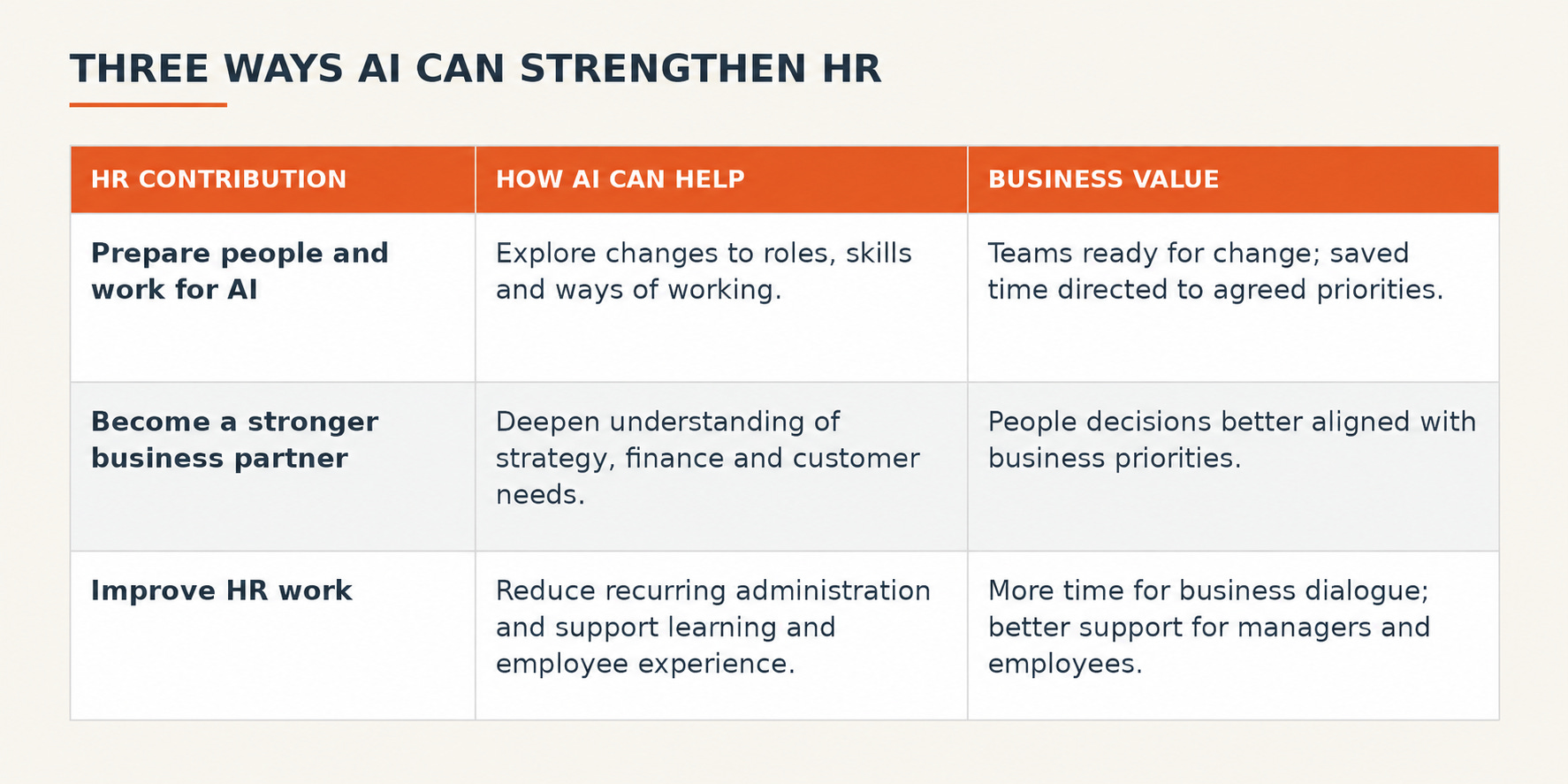
Creating People Advantage 2026, a study by Boston Consulting Group (BCG), one of the best-known consulting firms, and the World Federation of People Management Associations (WFPMA), finds that 65% of surveyed senior leaders see HR as a key business enabler. AI can help HR leaders strengthen this role in at least three areas: preparing the company for people and AI to work together, deepening their own business understanding, and improving HR’s work.
HR’s contribution to readiness for AI transformation
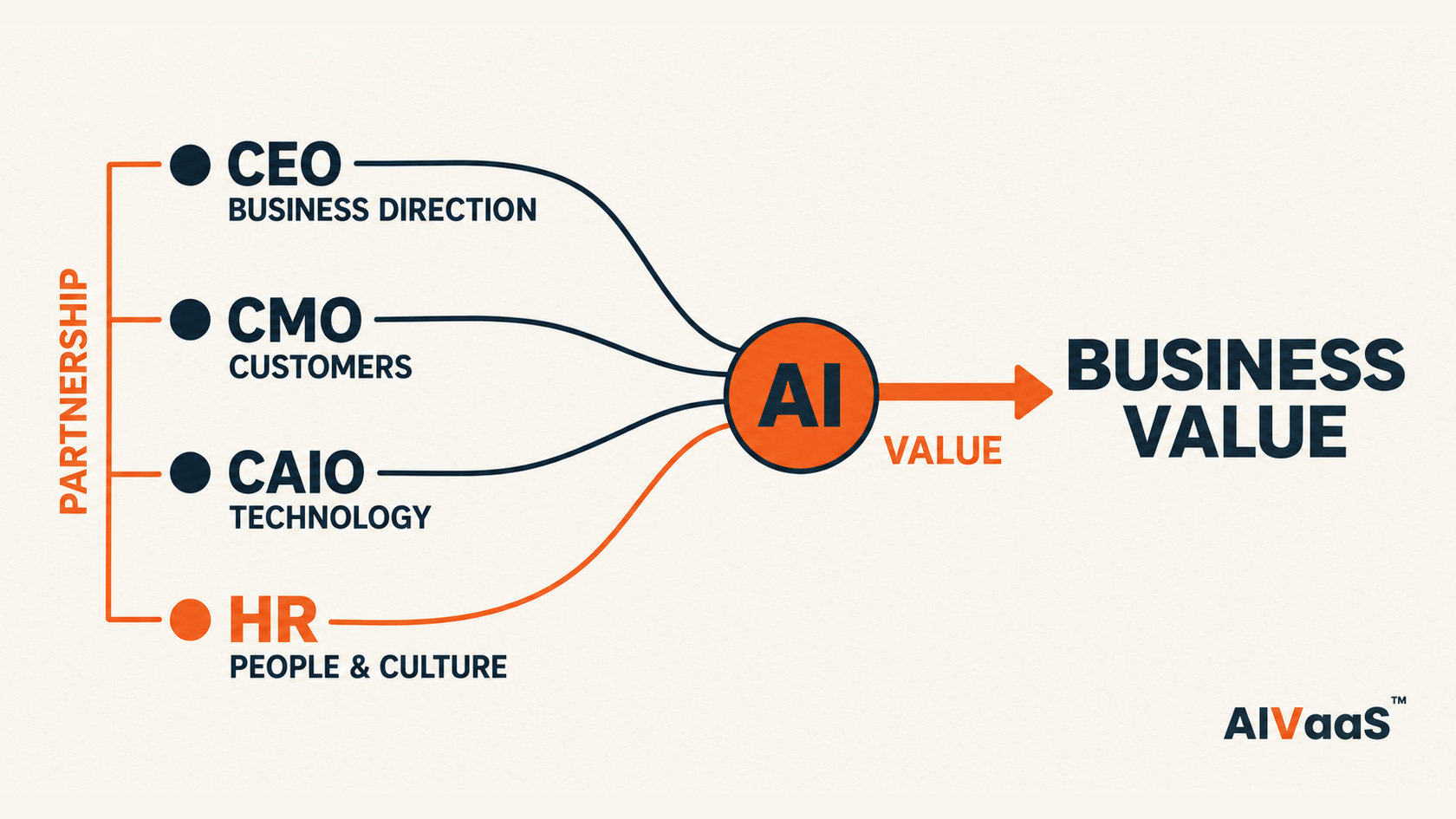
In an AI transformation, the CEO, CAIO (Chief AI Officer) and head of HR can form a leadership core that brings together business, technology and people perspectives. The CEO and leadership team set the strategic direction, business ambition, priorities and expected value. The CAIO connects AI capabilities and solutions with business goals. The head of HR works with business leaders to shape work, people development and culture, helping the organisation prepare for change.
The same study highlights skills development, technology adoption and new ways of working across the company as part of the transformation. This gives the CAIO a key partner in the head of HR. Together with other leaders, they examine how AI will change roles, responsibilities and collaboration, what skills people will need and how to prepare them for the transition. Before implementation, they can identify where unclear accountability, skills gaps or lack of trust could hold back the transformation.
Putting saved time to work
One of the first questions to address with the CEO is how to use the time employees save with AI. Leadership may choose to prioritize more complex customer needs, process improvements, learning for new roles or reducing excessive workloads. The choice depends on business needs and goals. HR can work with managers and employees to establish where time is actually being freed up, how fragmented it is, and what changes to work would make it usable. The agreed use of that time can then become part of tasks, expectations and development plans.
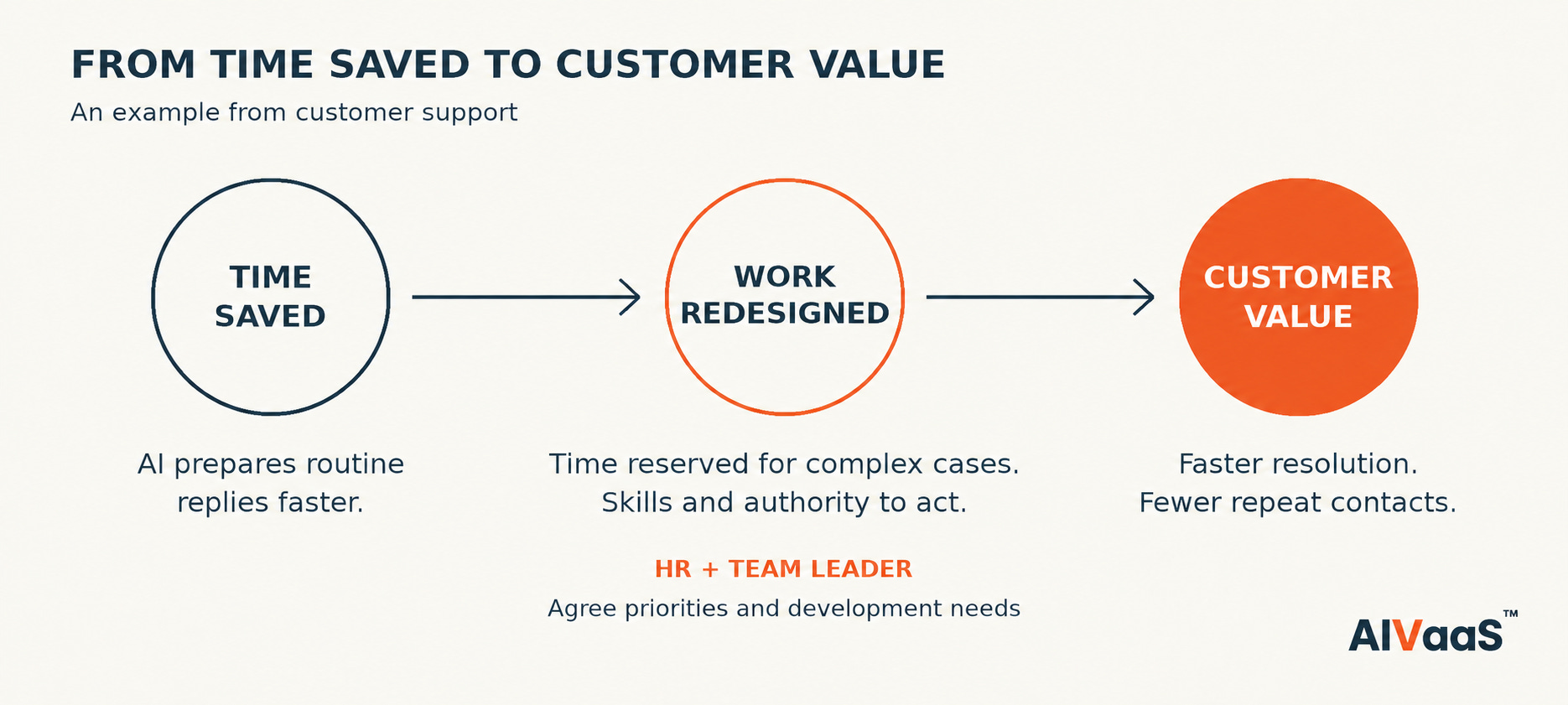
If AI helps a customer support team prepare routine replies faster, the company can devote some of the time saved to resolving more complex cases. The CAIO and their team integrate the AI solution into the process. HR and the customer support manager define the skills, development and changes in work allocation required. The team leader makes sure employees can use the time for that purpose. The business benefit may become visible when customers receive a suitable solution sooner and no longer need to return repeatedly with the same problem.
Developing human capabilities
Amid the enthusiasm for AI, the development of human capabilities can easily receive too little attention. Systems thinking, judgement, problem solving, empathy and collaboration become more valuable when working with AI. HR can give these capabilities greater emphasis in development programs for managers and employees. They help people identify the right problem, assess what an AI proposal could mean for other parts of the company, and understand what a colleague or customer needs in a given situation. People can then guide AI more effectively and complement its capabilities.
Managers also need support in leading teams as their work changes, setting expectations and assessing employee contributions. Employees need opportunities to understand the changes, develop the skills they need and help shape their own work. HR can help identify what motivates people through a change and what concerns them. Their readiness also depends on trust: whether they receive support while learning, can raise concerns and have their expertise taken seriously. These everyday practices also reshape the company’s culture.
HR can use AI to support this work too. Using descriptions of current roles and anticipated process changes, HR can compare ways of allocating work, identify questions for managers and draft development paths. Managers and employees then check whether the proposals fit the realities of their work.
A separate study by the Chartered Institute of Personnel and Development (CIPD), the UK professional body for HR and people development, surveyed more than 1,300 HR leaders and professionals. It found that skills in workforce planning, work design and engagement were already present, but confidence in applying them to AI transformation was lower. HR can therefore build its wider role on existing expertise, complemented by an understanding of AI. This requires a mandate from leadership and close collaboration with the CAIO and business leaders.
AI can help HR become a stronger business partner
Working with leadership brings HR into discussions beyond its specialist field. Why is a particular capability essential for growth? What drives the company’s profitability? How does poor collaboration between departments affect the customer? AI allows HR to deepen its business understanding systematically through questions it encounters in practice.
AI can act as a learning partner for core management knowledge. HR can use it to clarify the links between strategy, business models, processes and finance, compare approaches to leadership, or test its understanding against a practical example. Explanations can be adapted to the learner’s existing knowledge, with more time devoted to areas they use less often in their work.
This learning can also draw on the company’s own business data. AI can help HR understand where revenue comes from, which costs have the greatest effect on results and what capabilities a new offering will require. HR can then better assess how proposals for people development, work organisation or recruitment support business priorities.
The customer is an essential part of this understanding. With AI, HR can examine customer feedback and work with sales or support teams to explore why customers choose the company, where they face difficulties and what they need from employees. A development proposal can then be linked to a specific need, such as a team’s ability to help customers solve more demanding problems.
CIPD already includes business models, financial understanding, strategy and value creation for different stakeholders within the core business knowledge expected of HR professionals. HR can use AI to develop this knowledge. The benefit depends on checking its responses and applying what has been learned in real business discussions. Being able to explain the business reasoning behind a professional recommendation can help HR earn greater trust from leadership.
More efficient and effective HR work with AI
In the BCG and WFPMA study, 51% of surveyed senior leaders cited HR’s administrative workload as the main barrier to a greater strategic contribution. AI can save time in preparing materials, organizing information and answering recurring questions. HR can devote this time to conversations with managers, understanding business problems and improving support for employees. It makes sense to review the whole process and use AI to improve it.
Learning that improves work
When selecting training, HR can use AI to clarify development needs, find programs for its own team and other managers, and compare content, level and relevance to the business objective. For a manager who will lead a team working with AI agents, for example, knowledge of work design, accountability, business judgement and change leadership becomes particularly relevant. HR can use AI to prepare questions for the training provider and assess how well a program develops these skills.
Support can continue after the training. AI can help prepare exercises based on company situations, simulate a difficult conversation or explain material an employee has struggled with. HR can then adapt learning more closely to each person’s role and prior knowledge, and connect it with applying that knowledge at work. Before training begins, HR and the manager agree what the team wants to improve, such as becoming proficient in new work sooner or reducing errors. Afterwards, they review how employees are using what they have learned, what has improved and where further support is needed.
Employee experience and employee engagement
The same applies to improving employee experience (EX) and employee engagement. Suppose HR is preparing a project because employees have raised concerns about excessive workloads and unclear development opportunities. AI can help organize anonymized feedback from surveys and conversations, identify recurring themes and prepare questions for further exploration. This analysis may show that different groups of employees need different kinds of support.
HR can then use AI to draft a project plan, compare possible measures and design a way to track their impact. If expectations are unclear, HR can work with managers to revise agreements about the work. If the issue is development, it can prepare more suitable learning and career paths. AI helps process the material and compare options, while HR works with people to understand the reasons behind the problems and assess whether the proposed actions make sense. After implementation, AI can compare new feedback with the starting point and highlight persistent problems. HR can return to teams sooner and adjust a measure that has not produced the expected improvement. Responsible handling of data and employee trust are essential when using this feedback.
Employee experience and engagement are related but distinct. The former concerns how people experience the conditions and daily reality of work; the latter concerns their involvement and commitment. Gallup’s meta-analysis links higher engagement in business units with better results, including productivity, profitability and customer loyalty. This alone does not establish causation, nor does it establish the effect of AI on those results. It does give business relevance to the question of whether AI helps HR understand employees’ needs and work with managers to create the conditions for them to do their jobs well.
Some of this value also reaches customers. Employees with the right knowledge, support and authority are better placed to help a customer resolve a problem. HR’s contribution becomes visible in their work, even when the customer never has direct contact with the HR department.
To assess HR’s contribution, leadership can track how quickly employees become proficient in critical work, how successfully they move into new roles and whether managers make better decisions. In a redesigned customer support process, the company could track success in resolving complex cases and the need for repeat contact. HR and the business leader select measures that fit the specific need, agreeing in advance on the baseline and expected improvement. This makes it easier to show what people development and a different way of organizing work have contributed to the result.
The leadership team recognizes HR’s value
When the leadership team returns to the question of the next step, the head of HR can propose how HR can help the company prepare to put its business ambition for AI into practice, where to direct the time employees save, which leadership competencies to strengthen and which organisational capabilities to develop. With a better understanding of the business and personal experience of using AI, the head of HR can work alongside the CEO and CAIO as one of the key leaders of the AI transformation. Their contribution becomes visible in team readiness, the quality of decisions and the success of redesigned work.
The CEO can strengthen this role by involving HR in decisions about the transformation from the outset and providing access to business information, time for development and opportunities to collaborate with the CAIO and business functions. HR also needs training that connects an understanding of the business power of AI with its use in HR’s own work. To carry out the agreed changes, HR needs support with implementation and the opportunity to assess their impact with the leadership team.
The decision to give HR this opportunity is part of leadership’s responsibility for the transformation. If HR is to help the company create an environment for successful collaboration between people and AI, it needs such an environment itself. In that environment, HR can gain new knowledge, improve its services and make a significant contribution to the company’s success.