


If your organization is investing in AI and the value still feels just out of reach, you are not alone. The 2026 research wave makes the pattern undeniable, and what looks like a technology problem turns out to be something else entirely. What follows is the diagnosis from seventeen of the year's most cited AI and business reports, the three shifts that quietly changed the conversation since last year, and the methodology I built to address them - AIVaaS™, Turning AI into Value - now strongly reinforced by the research that arrived after it. The "V" in the name carries the publication's name as well: the AI Value Boardroom is where this conversation lives.
5 findings present in all 17 AI 2026 reports
Across seventeen major AI and business reports published in 2026, five findings appear consistently. The numbers vary. The samples differ. The questions are asked in different ways. Below I cite the most characteristic figure from each cluster, with the source that frames it most cleanly. The seventeen reports include studies from Deloitte, BCG, McKinsey, IBM, Microsoft, EY, KPMG, Capgemini, Accenture, Stanford HAI, Dataiku, and others. The point is not that all reports say the same thing in the same way. The point is that they converge on the same five gaps.
1. CEOs are now directly accountable for AI. Two out of three CEOs say they are their organization’s main AI decision-maker, twice the share reported a year ago (BCG AI Radar 2026). Three out of four organizations now have a Chief AI Officer, up from one in four (IBM 2026 CEO Study). AI has decisively left the IT and innovation departments. The consequence is structural: the executive who used to ask “what is our AI strategy” now has to answer it.
2. The gap between ambition and readiness is widening. Investments are rising. Self-assessed preparedness on infrastructure, on data, and on talent is falling (Deloitte State of AI in the Enterprise 2026). Ambition is accelerating faster than the foundations meant to support it. The result is not slow progress. It is fast progress on the wrong track.
3. Demonstrable value is missing. Around two in five technology leaders report low or no return on AI investments (Deloitte Global Tech Leadership Study 2026). CEOs themselves estimate that more than a third of their AI projects are more about optics than outcomes, what the field now openly calls “AI washing” (Dataiku Global AI Confessions 2026). The word matters. It suggests the problem is no longer denied. It is named.
4. Governance is in crisis. Only one in five organizations reports a mature governance model for AI agents (Deloitte 2026). More than half of department-level AI initiatives go live without formal oversight (EY 2026).
The question is no longer whether AI says the wrong thing. The question is whether AI does the wrong thing (McKinsey State of AI Trust 2026).
The shift from speech to action is a category change in what governance must now cover.
5. Agents are moving into production, but scaling is failing. Active agents have increased fifteenfold in a single year (Microsoft Work Trend Index 2026). Yet fewer than one in ten organizations has scaled them to deliver tangible business value (McKinsey 2026). The gap between deployment and value is not closing. It is widening, and the widening is the story.
What is new in 2026
Some of this is familiar. The ambition-readiness gap, ROI struggles, data quality issues were all in 2024 and 2025 reports. What stayed the same is that the problems remain. The numbers have barely moved.
What is new in 2026 is different in kind, not in degree.
CEOs stopped delegating. Last year only one in three CEOs described themselves as the main AI decision-maker. This year it is two in three. The decision to own AI personally, and to live with the consequences, has moved to the top of the organization. This change reaches every executive role: the CEO who owns the agenda, the CFO who funds it, the CAIO who executes it, the CHRO who prepares people for it, and the customer facing leaders who feel the consequence first.
Governance changed in kind, not in degree. Through 2025, governance discussions revolved around explainability and bias, around what AI says. In 2026, agentic AI shifts the question entirely. Governance must now address what AI does, autonomously, without continuous human intervention. Frameworks designed for the older question are no longer sufficient for the newer one.
Agents moved from experiment to production. A year ago the conversation was about whether to pilot AI assistants. Today the conversation is about scaling agents that handle multiple tools, data sources, and decisions continuously. The bottleneck is no longer technology. It is organizational readiness, and that bottleneck is now visible in every function, not only in IT.
2026 confirmed what I designed the year before
Three indicators capture the combined shift most concretely.
Most CEOs believe their workforce is prepared for AI, yet only a quarter of employees actually use AI regularly. In most organizations, AI still lives in a separate strategy document, adjacent to the business strategy rather than fused into it. Most technology leaders prioritize speed over verification, while half of departmental initiatives launch without formal approval.
Three numbers, three independent measurements, pointing to the same vacancy. Not technology. Not investment. Not even ambition. A comprehensive approach that systematically connects strategy, people, and technology as a single leadership responsibility.
This is precisely what I designed AIVaaS™ to address. The organizations I worked with through 2025 were already showing me the pattern that the 2026 research has now made visible across thousands of companies.
AIVaaS™ — AI Value as a Service. Turning AI into Value. The V in the middle stands for Value. Most frameworks treat value as an outcome to hope for. AIVaaS™ treats it as the starting point, and turns AI into it as the destination.
Three principles distinguish the method.
Value first, not adoption first. Adoption metrics describe activity, not outcome. Number of tools deployed, number of users trained, number of pilots launched. These tell you the organization is doing something. They do not tell you the organization is creating anything. AIVaaS™ measures realized business value across all stakeholders: customers, employees, partners, owners.
AI Strategy Fusion, not a separate AI strategy. The most common pattern in 2026 is the organization with an AI strategy document that lives separately from the business strategy, ignored by the business units it was meant to guide. AIVaaS™ rejects this construct from the start. AI is fused into the business strategy itself, where business leaders are owners from day one because the goals are theirs.
The reverse order: Business Strategy → AI Ambition → Organization → People → AI Tools & Solutions. AIVaaS™ proceeds in this order, deliberately. Business strategy first. AI ambition derived from it. Organization shaped to deliver the ambition. People prepared to operate within the shaped organization. AI tools and solutions deployed last.
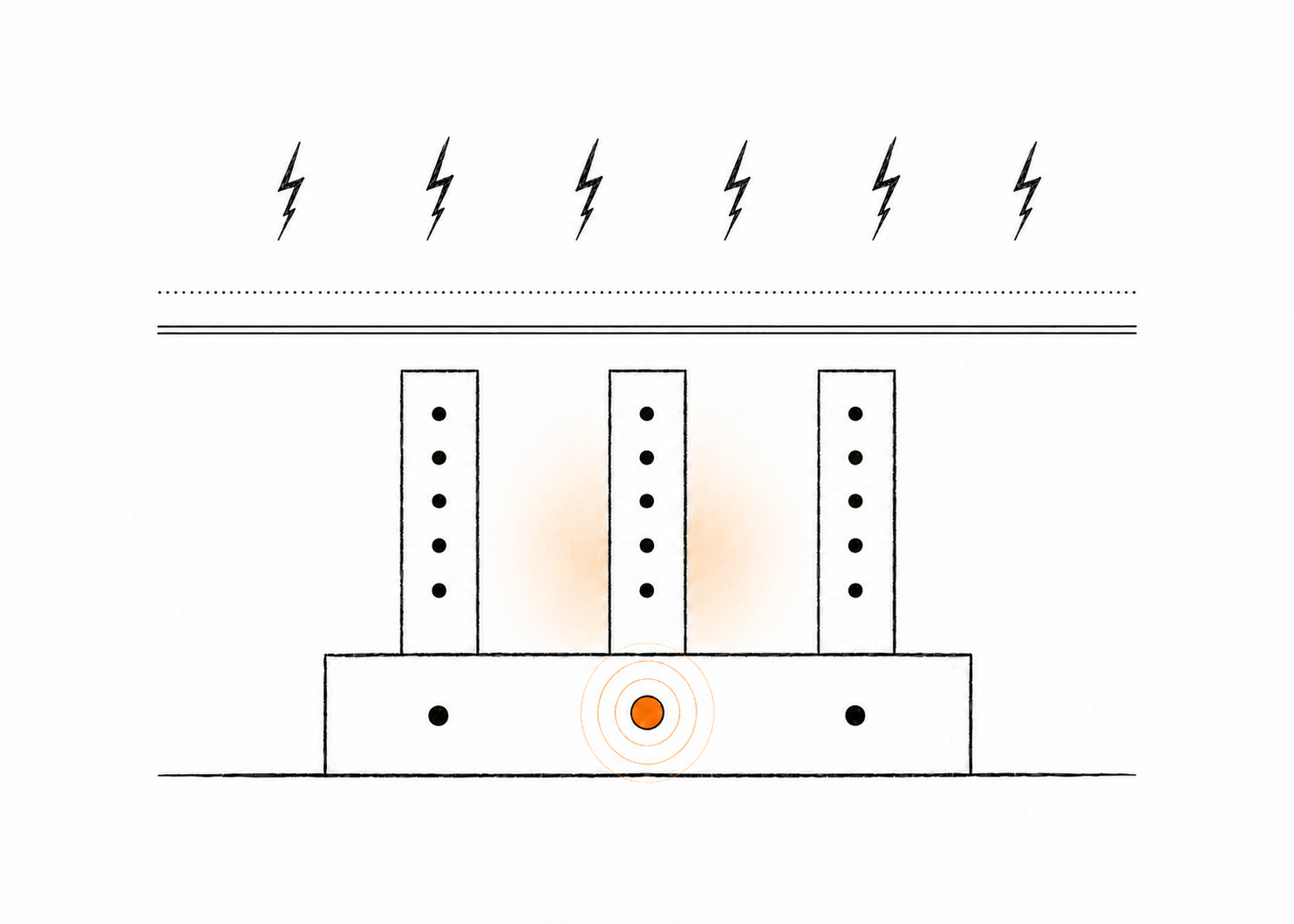
AIVaaS™ was conceived with multiple stakeholder groups in mind from the very beginning. It serves boards and leadership teams, managers across all functions, employees who live the transformation, and above all customers, whose experience is the ultimate test of whether anything was actually built. If you remember the orange dot from the earlier stories on this publication, this is where she returns. Not as a character. As a compass.
These three principles are operationalized by an architecture that the rest of this article develops in depth.
The Foundation
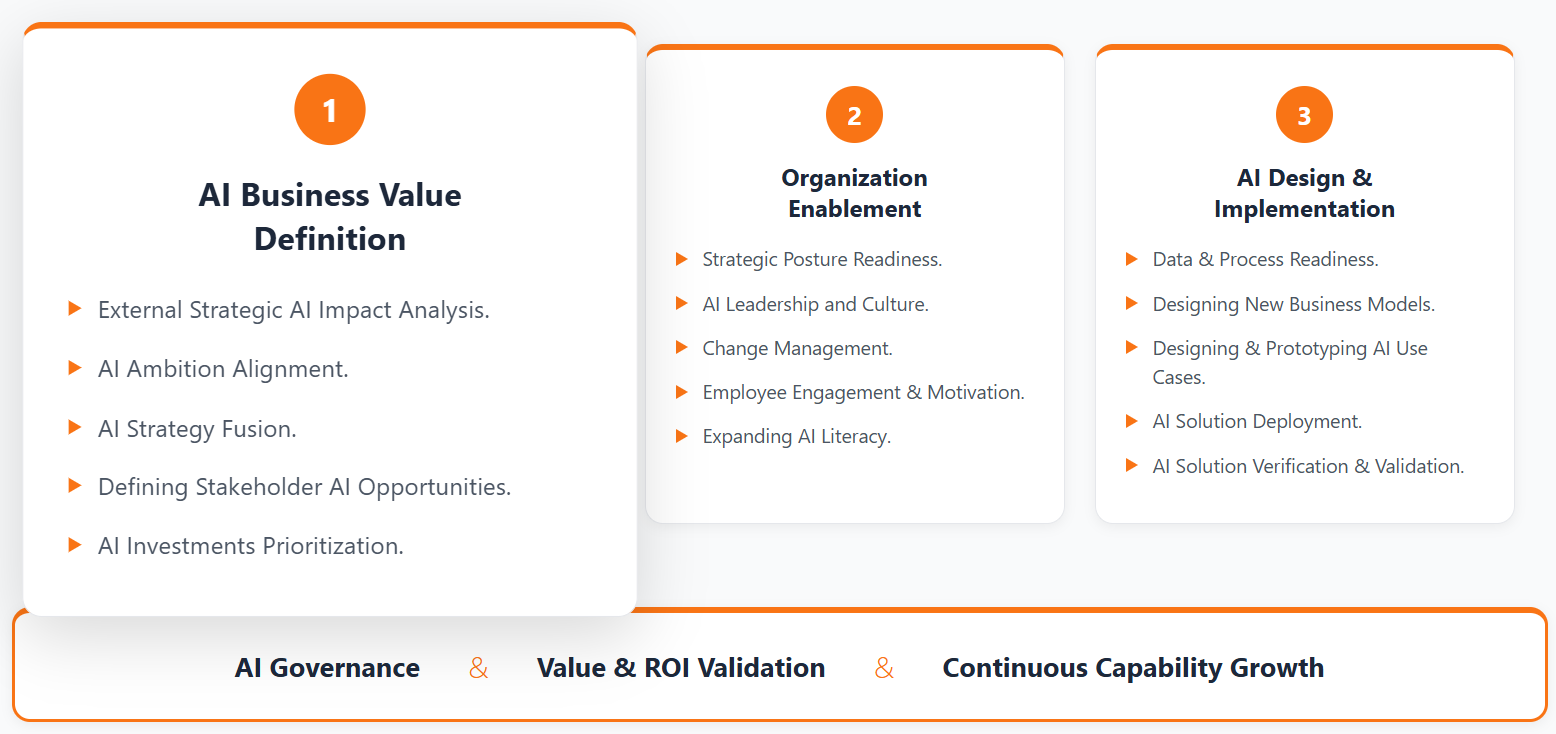
Underneath everything else in AIVaaS™ sits something I call the Foundation. It is composed of three cross-cutting functions that leadership carries throughout the entire AI transformation lifecycle, not before it, not after it, but through all of it. These are the functions that cannot be delegated to a CAIO, a transformation office, or a working group. They belong to leadership directly.
AI Governance is the rules of the game. Who decides on AI investments, how priorities are set, which ethical framework applies, how compliance with regulation is ensured. Governance is what gives every other AI activity in the organization a frame within which to operate. Without it, AI work happens in fragments and accumulates risk faster than value.
Value & ROI Validation is the principle leadership commits to before any execution begins: we will measure realized business value, not adoption. The goal of AI is not the number of tools deployed, nor the number of pilots run. The goal is measurable value for stakeholders. This function operates as a continuous check throughout transformation, not as a milestone at the end. Every AI investment, every prototype, every deployed solution is held to the same question: is this actually creating value, for whom, and how do we know.
Continuous Capability Growth stands on a simple premise. AI evolves faster than organizational competence can naturally keep up. Without a deliberate function that builds capability continuously, every AI advance leaves the organization further behind. AI transformation is not an event. It is an ongoing effort, and the organization that does not build the capability to absorb each new wave of AI will be unprepared for the next. This function is what keeps the organization moving forward at the pace AI itself is setting.
Three pillars
The three pillars carry AIVaaS™ from AI Strategy Fusion to AI Solution Deployment. Successful AI transformation requires a structured approach that addresses three critical dimensions in the right sequence.
Pillar 1: AI Business Value Definition translates external AI pressures into strategic AI opportunities. Its five elements:
External Strategic AI Impact Analysis — understanding the pressures of the digital and intelligent economy and recognizing the urgency to respond.
AI Ambition Alignment — leadership unification on a common AI transformation vision.
AI Strategy Fusion — AI is not a separate strategy, it is embedded into the business strategy itself.
Defining Stakeholder AI Opportunities — AI opportunities for customers, employees, owners, partners, and other stakeholders.
AI Investments Prioritization — turning selected opportunities into prioritized investments using shared criteria.
Pillar 2: Organization Enablement prepares the organization and its people for AI transformation. Its five elements:
Strategic Posture Readiness — can our strategic stance carry the chosen AI ambition.
AI Leadership and Culture — leadership thinks of AI as a transformational force, building a culture of trust and experimentation.
Change Management — communication strategy, new roles, leading through change.
Employee Engagement & Motivation — without people nothing moves; the AI ambition should be an opportunity, not a threat.
Expanding AI Literacy — from basic AI understanding to confident use and support.
Pillar 3: AI Design & Implementation designs, deploys, and technically validates AI solutions. Its five elements:
Data & Process Readiness — without organized data and processes AI does not work; traceability and structure.
Designing New Business Models — at higher ambition levels AI enables new ways of creating value.
Designing & Prototyping AI Use Cases — from opportunity and use case to a concrete testable prototype.
AI Solution Deployment — the transition from prototype through development into production with all system requirements.
AI Solution Verification & Validation — technical performance: does the solution work correctly, safely, and fairly, with the foundations for value generation in place.
Five elements in each pillar. Fifteen in total. Each one is its own field of practice. Each one will be developed in its own depth across the publication’s longer arc.
The Readiness Equation
The Foundation and the three pillars do their work continuously. What they produce, taken together, is a composite state of organizational readiness. AIVaaS™ expresses that composite as an equation:
Business AI-Ready = Business-Ready + Organization-Ready + AI-Ready + Implementation-Ready
The equation looks like arithmetic. It is not. It is a map of where readiness lives in an organization, broken into four areas, each with its own questions and its own ownership.
Business-Ready is about strategic clarity. Does the organization know why it is adopting AI? Is AI fused into the business strategy, or does it stand to the side as a separate “AI project”? Is leadership aligned on the ambition? Without Business-Ready, everything else is built on a goal that is either misaligned or invented.
Organization-Ready is about people and culture. Can the organization actually deliver the ambition it has chosen? Does leadership model AI as a transformational force, not just a tool for savings? Are employees enabled and motivated, or are they fearful? Are capabilities being built continuously? Without Organization-Ready, the technology has no one to use it well, and often no one to use it at all.
AI-Ready is about data, process, and capability foundations that make AI-enabled operating and business model changes possible. Are the data in a state that makes AI possible? Are processes understood well enough to be augmented? Without AI-Ready, the ambition has no execution surface.
Implementation-Ready is about delivery capability. Can the organization actually take an AI solution from idea, through prototype and technical validation, into production where value is created? Without Implementation-Ready, organizations live in permanent pilot mode.
The three pillars map onto these four areas. Pillar 1 builds Business-Ready. Pillar 2 builds Organization-Ready. Pillar 3 builds both AI-Ready and Implementation-Ready, because the same operational machinery that prepares data and processes also designs, deploys, and validates the solutions that prove value. The Foundation runs underneath all four, holding them together with governance, value validation, and capability growth.
AI transformation is a shared responsibility
Business AI-Ready emerges only when every readiness area has its keepers, and every keeper does the work.
Foundation — the CEO, board, and leadership team
Business-Ready — leadership with the heads of business functions
Organization-Ready — HR with managers and employees across the organization
AI-Ready — the CAIO with the heads of business functions
Implementation-Ready — the AI architect with PMO, project managers, business analysts, and implementation teams
What happens when one of the groups is missing:
Leadership without employees: the strategy stays on paper. Without the people who carry the change forward, the strategy does not become reality, and neither does the AI ambition behind it.
Employees without leadership: undirected effort. Individual successes that do not support a common direction. Pockets of progress that do not add up to transformation.
Technology without organization: disappointment. Tools that work in a narrow sense but never produce value for the stakeholders the organization actually serves.
Where this leaves us
The 2026 research shows where the gap is. Five findings, three shifts, one absence at the centre of all of them. The missing piece is not another AI tool, another pilot, or another strategy document. It is an operating methodology for turning AI ambition into measurable stakeholder value. AIVaaS™ is what I built to fill that absence.
This article is only the beginning. The methodology has layers that take longer to develop than a single piece can hold. Over the coming weeks, the publication will take each dimension in turn, in the depth it deserves, in the order that the work itself requires.
The orange dot stays at the centre. Not as a character. As the reason any of this matters. Because every Ana is scoring.