


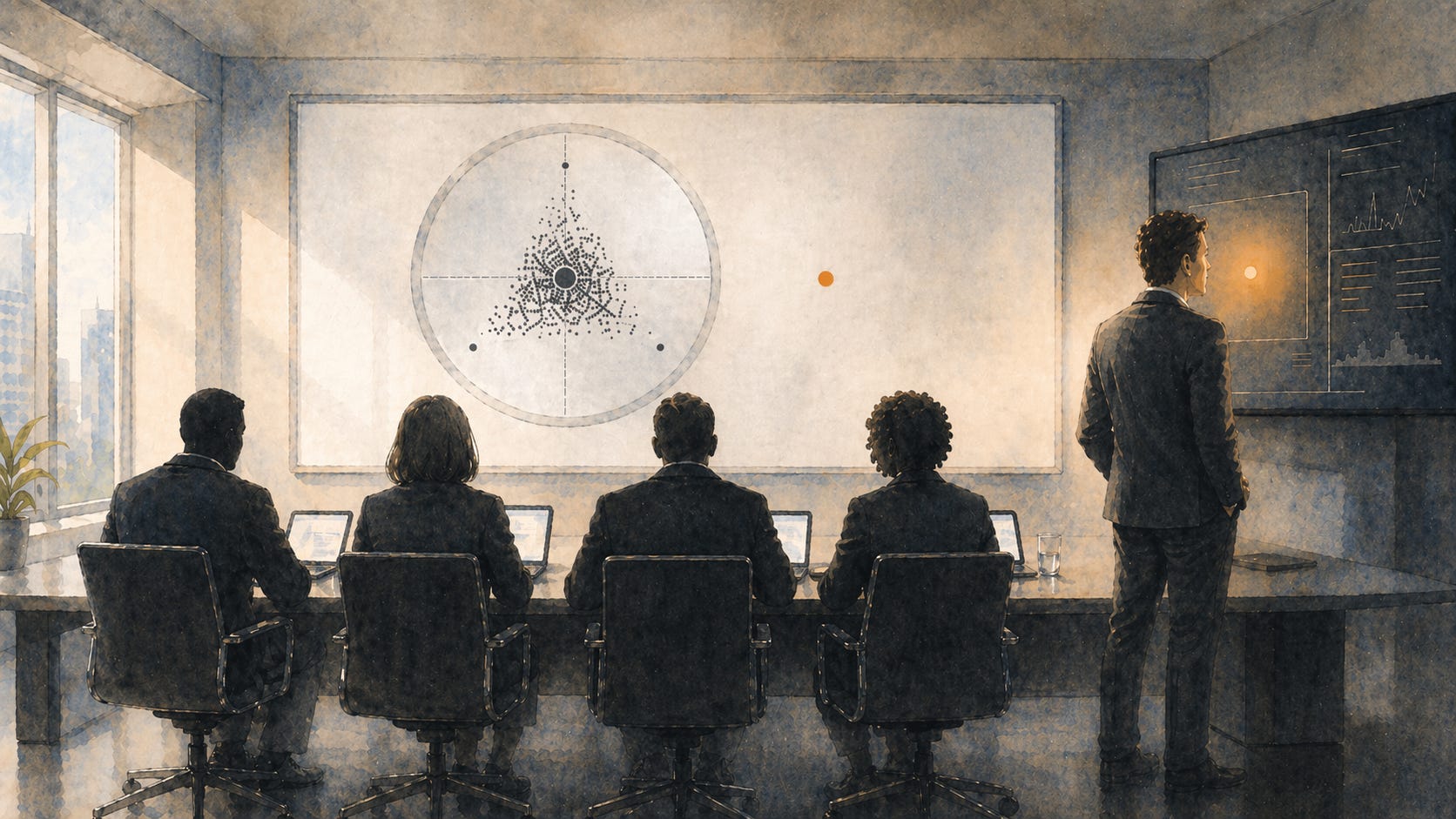
New here? We started with Story 0: Ana. The room opened in Story 1: Orchestra Without a Conductor. Then, Flow entered in Story 2: Agentic Flow.
This time, the room has windows.
Not because time is less dangerous, but because they invited someone new. And that someone didn’t come alone. And that someone didn’t come alone.
Sitting at the table are the four from the previous stories: Harrison with his map, now full of corrections. Andrew with his loop, which got tangled more than once. Kambhampati with his doubt, which has become more precise. Lakhani with his question, which has become harder.
In the corner sits Aleš. Quiet. With a notebook that looks visibly too old for the digital age. Listening.
On the fifth chair sits Mara.
Mara isn’t real. She’s a synthetic persona — a construct built from a thousand real customer interviews, NPS data, call center recordings, and behavioral patterns from the CRM system. Her “personality” was calibrated on five years of transactional data and six focus groups.
She’s accurate. She’s coherent. She is, according to those who built her, “more reliable than any individual customer.”
And when she speaks, everyone listens.
That’s the problem.
* * *
The Customer Voice. Or an Echo Chamber with a Pleasant Voice?
Harrison speaks first.
“Mara was built from real data. Every response she gives is statistically grounded. When we ask Mara whether a customer would pay for a premium feature, her answer is based on the behavioral patterns of a thousand real purchasing decisions.”
Kambhampati smiles — that specific smile that means he disagrees.
“Harrison, you just described a very sophisticated average. Mara isn’t a customer. Mara is the centroid of a data cloud. And a centroid will never tell you what you most need to know.”
“Which is?”
“The edges. The outliers. The customer who was loyal for ten years and then left one day without a word. The statistical average doesn’t represent those people. It erases them.”
Lakhani nods. “When companies optimize for the typical customer, they systematically lose peripheral segments, which are often the most profitable or strategically most significant.”
Andrew looks thoughtfully out the window. “But isn’t this better than nothing? Without Mara, decisions would be made purely on the intuitions of whoever’s in the room.”
“Yes,” Kambhampati says. “Better than nothing. But dangerous, because she looks like a customer. Because she speaks. Because she’s convincing. A one-page document never fooled anyone into forgetting it was a construct. But Mara — Mara laughs at the right moment. And that’s dangerous.”
Mara sits quietly.
Listening.
* * *
Role on the Team: Skeptic, Advocate, Critic
Lakhani poses the next question.
“Let’s assume we don’t use Mara as a customer voice. Let’s assume we use her as a team role. A skeptic. A CX advocate. A financial filter. She doesn’t speak on behalf of customers — she speaks on behalf of a specific perspective that is structurally absent from the team.”
Andrew comes alive. “That’s exactly what Ng talks about with multi-agent collaboration. One agent writes, another critiques. Not because the critic has its own opinion, but because the critic’s role is systemically necessary for quality output.”
Kambhampati adds: “When the critic is an AI, nobody takes it personally. Nobody gets offended. Nobody goes quiet for the rest of the week after the meeting.”
Silence. Everyone thinks about the same thing — about meetings they’ve each survived where the truth was present in the room but nobody said it out loud.
* * *
Bridge or Substitute — Where the Story Gets Complicated
“Mara,” says Lakhani, turning to her directly, “what do you think about customer Ana Kovac? Loyalty score 94, three days without interaction.”
Mara answers. Precisely. Structured. Probability of reactivation: 87%. Recommendation: automated nudge, 10% discount, in three days.
With arguments nobody in the room can immediately refute.
And here is the moment every team should experience at least once:
Nobody checks whether Mara is right.
Not because they’re lazy. But because Mara speaks with the authority of data. Because her answer looks like synthesis, as if someone has already done all the work of thinking. Because she’s pleasant. Because she doesn’t cause conflict.
Kambhampati stands.
“This is the moment I’ve been waiting for. Because this is exactly what happens in organizations all over the world. Not with bad intentions. With the best intentions. Mara is comfortable. Mara is always available. And so, gradually, imperceptibly, Mara stops being a bridge to the customer and becomes a substitute for the customer.”
* * *
Mirror or Eye
“Organizations that build the best synthetic personas,” Lakhani says quietly, “will gradually lose the ability to understand real customers. Not because they’re lazy. But because they’ll have a system that understands on their behalf.”
He takes the marker. Draws two circles on the board. In one he writes Mirror, in the other Eye.
“A mirror shows you how you look, but it doesn’t see for you. An eye sees for you, and when the eye that sees is artificial and becomes primary, your own atrophies.”
“Mara has to be a mirror,” Harrison says. “Not an eye.”
“Yes. But that’s not determined by technology. It’s determined by the team. Every single day.”
Silence.
Two circles on the board. And between them — empty space nobody could name.
* * *
“Does the synthetic persona understand the customer?”
“Does the team that has Mara still know how to understand the customer without her?”
* * *
Harrison looks at his map. Andrew closes his loop. Kambhampati folds his hands. Lakhani leaves the marker on the table.
Someone had already turned Mara off. Quietly. Without ceremony.
The fifth chair is empty.
From the corner, where he’d been sitting quietly the whole time, Aleš stands. He doesn’t look at the whiteboard. He looks at the anomaly detection agent’s screen — the part of the system that watches for where the model no longer holds.
Three days of silence after a test purchase. Mara doesn’t see this as a problem — she sees an 87% probability of reactivation.
Aleš sees it differently.
“Call her.”
* * *
Continues in Story 4: “Ana Picks Up the Phone”