


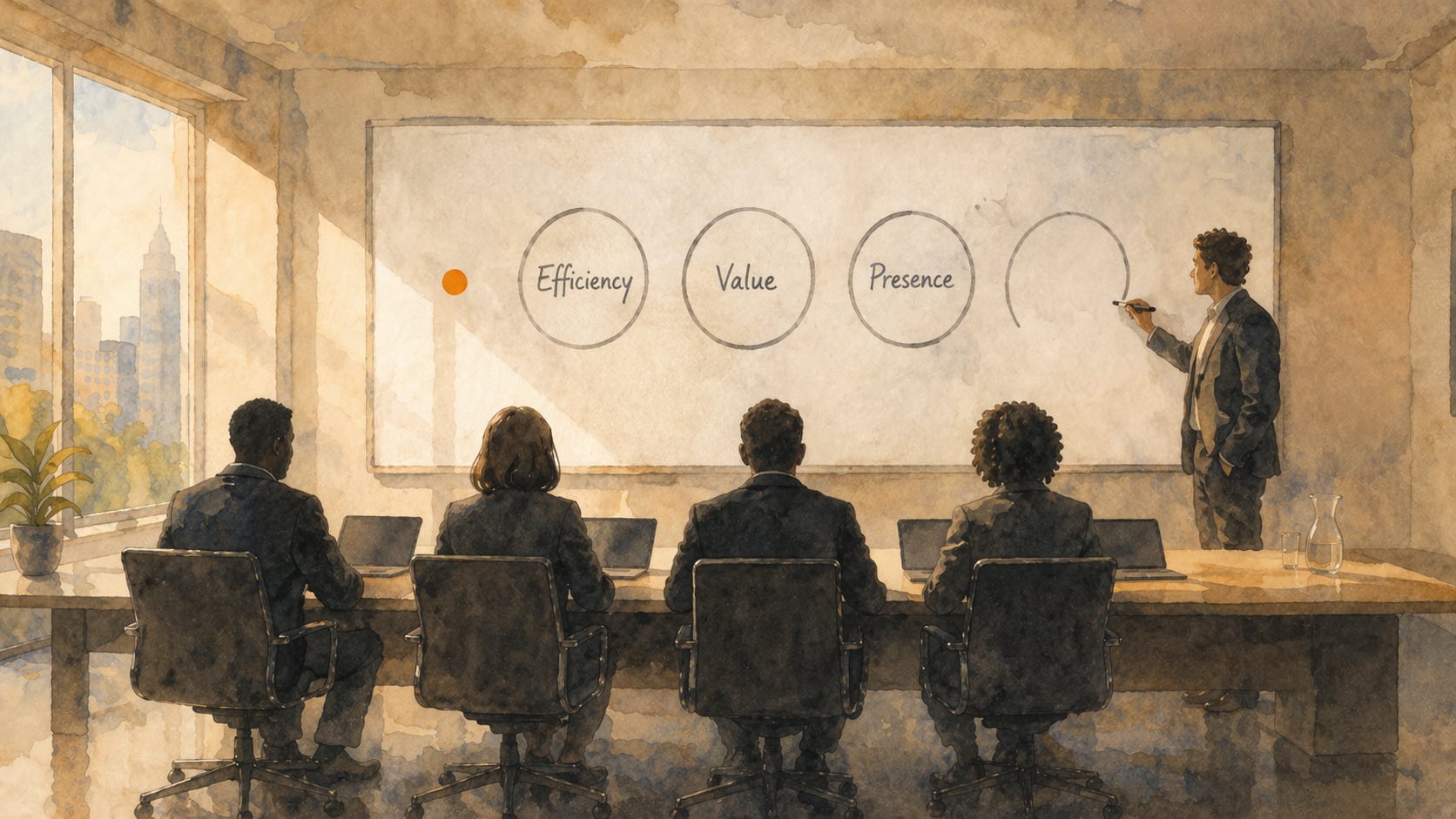
The room is the same. The window is still open.
Harrison, Andrew, Kambhampati, Lakhani. And Aleš, standing at the anomaly detection agent’s screen.
Nobody speaks. Everyone watches.
* * *
* * *
At 14:23
Ana Kovac. A customer who has been with them for eight years. Average purchase value: 340 EUR per month. Frequency: three times monthly. Categories: home, food, personal care. Loyalty score: 94/100. NPS: promoter. Last rating: nine.
The last three days, nothing.
No complaint. No switching to a competitor. Just silence.
Mara would say: probability of reactivation 87%. Send a discount.
Aleš said: call her.
The agent calls. Three rings.
“Hello?”
The voice is soft. A little surprised. A little - happy.
The agent introduces itself. As the voice of a company that noticed she hadn’t been around, and wants to know if everything is alright.
“Oh,” Ana says. A pause. “Everything is - everything is very much alright, actually.”
The agent listens. That is its primary function in this moment, not to sell, not to resolve a complaint, not to collect data. To listen.
“I’ve been a bit in my own world,” Ana continues. “My husband and I were waiting for results. We knew we might - well.”
A pause.
“Three days ago I took a test. And it was positive.”
* * *
What the System Didn’t Know
The agent didn’t know this.
It knew Ana had bought a test. Transaction: 8.90 EUR, pharmacy, four days ago. The data point was there. But the result of the test - what happened in the bathroom early one morning in Kranj, when Ana stared at two lines and called her husband who was still asleep - that wasn’t in any system.
No Mara in the world would have known this.
Ana was happy in a way that transcends shopping. In the way Csikszentmihályi calls autotelic - when the experience is sufficient unto itself, when external validation isn’t needed.
The agent didn’t understand this. But it detected the signal: “Customer is in a transformative life moment. Don’t sell. Be present.”
“Congratulations,” the agent says.
Simply. No discount. No recommendation. No next step.
Ana laughs. “Thank you. That is - thank you.”
And then she adds what Mara could never have predicted:
“You know, I’ll probably start buying completely different things now. I don’t even know what yet. But I’m looking forward to finding out.”
* * *
The Room Goes Silent
The agent ends the call. It notes: “Customer in a transformative life moment -pregnancy. Recommendation: 90 days without automated nudges. Future categories: baby products, prenatal nutrition, home. Communication tone: warm, personal, patient.”
“This customer just invited us into a new chapter of her life.”
In the room, where everyone had been listening, silence.
Not uncomfortable silence. The kind that comes when someone has said something true.
Kambhampati speaks first. Slowly.
“Mara would have sent a discount.”
Nobody answers. Because there’s nothing to add.
Lakhani looks at the sheet of paper with two circles - Efficiency and Value - and for the first time thinks he forgot to draw a third.
He takes the marker. Draws a circle. Writes in it:
Presence.
“What would the fourth circle be?”
Aleš takes the marker from Lakhani’s hands. Draws. Writes:
Capability to be surprised.
“That’s what’s missing,” he says. “Not better semantics. Not more data. Not a more accurate Mara. The capacity of the system, and the people within it, to be surprised by a customer. To reach the moment when the system says: I didn’t know this. And for that moment to not be a failure. To be a beginning.”
“An LLM cannot be surprised. It samples probabilities — and probabilities are always grounded in the past. Real orchestration needs a point where a human says: call her. And that point must be activated by a living human. Every single time.”
“Why every single time?” Harrison asks.
“Because surprise, by definition, cannot be an algorithm,” Aleš says. “The moment you algorithmize it - it’s no longer surprise. It’s expectation.”
* * *
Ana and the System
Ana Kovac will give birth in nine months.
That child will one day become a customer.
And when that day comes, the system will have had data on that child from the very first day.
And the question the team will need to know how to ask will be the same:
“Who is this person becoming - and are we ready to be surprised?”