


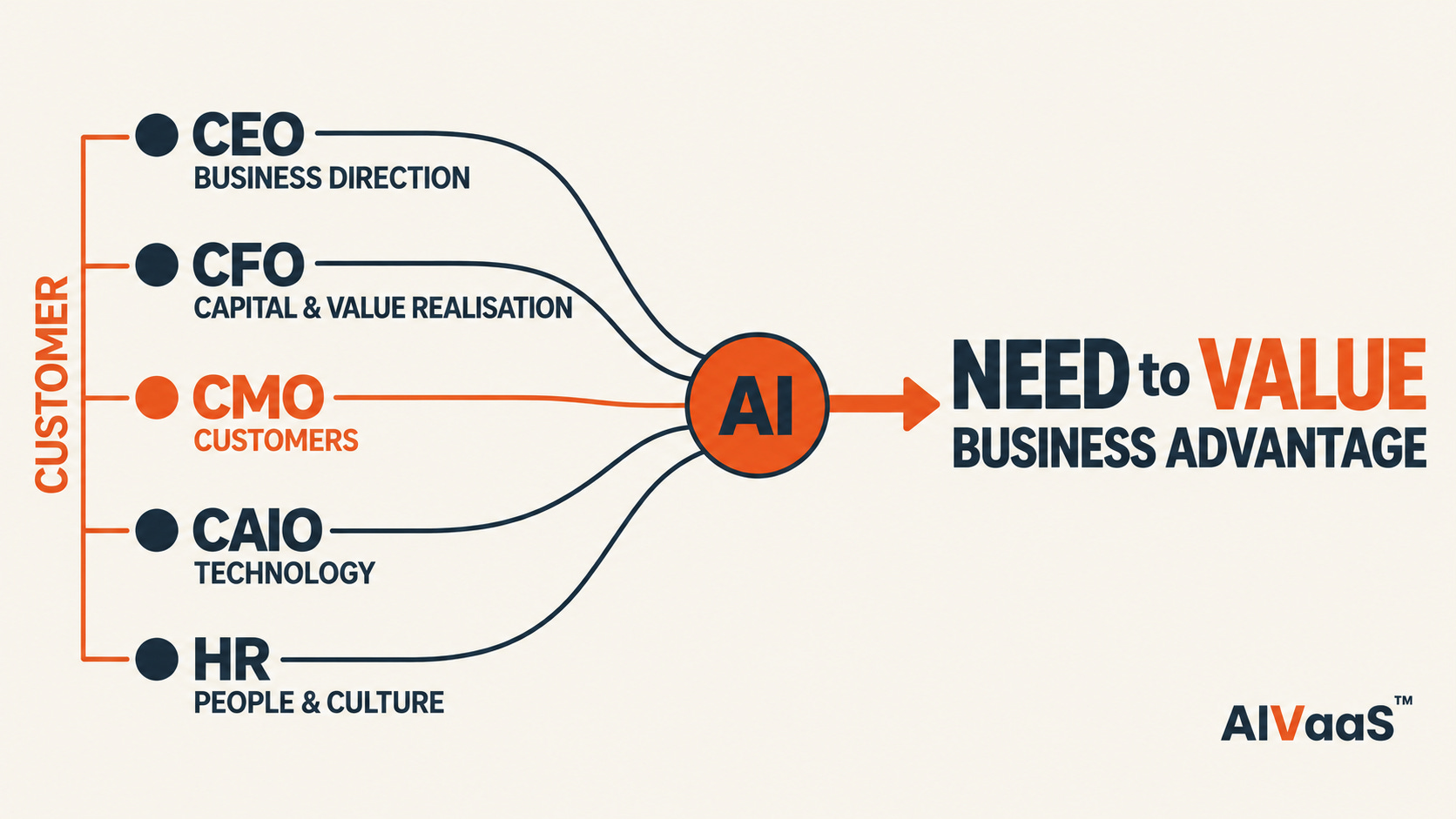
One of the CMO’s most important strategic contributions is helping the company decide which customer needs should shape its future. That judgement influences where the business competes, what it promises and which capabilities it develops.
AI makes this judgement more consequential. Customers may become better informed, do more for themselves or pursue a different result. At the same time, AI gives the chief marketing officer new capacity to explore those changes and consider responses that were previously difficult to assess or deliver.
AI increases the CMO’s business contribution when better understanding leads to better choices. Customers must receive a meaningful benefit, and the company needs a viable way to deliver it.
In AIVaaS™, value has an address: someone whose need is better met. The CMO helps leadership connect that benefit with the choices that shape the company’s future.
How customers are changing in the intelligent economy
Customers in the intelligent economy can define their needs and pursue results with greater independence. AI can support their judgement and actions, changing what individuals and business buying teams expect a provider to contribute.
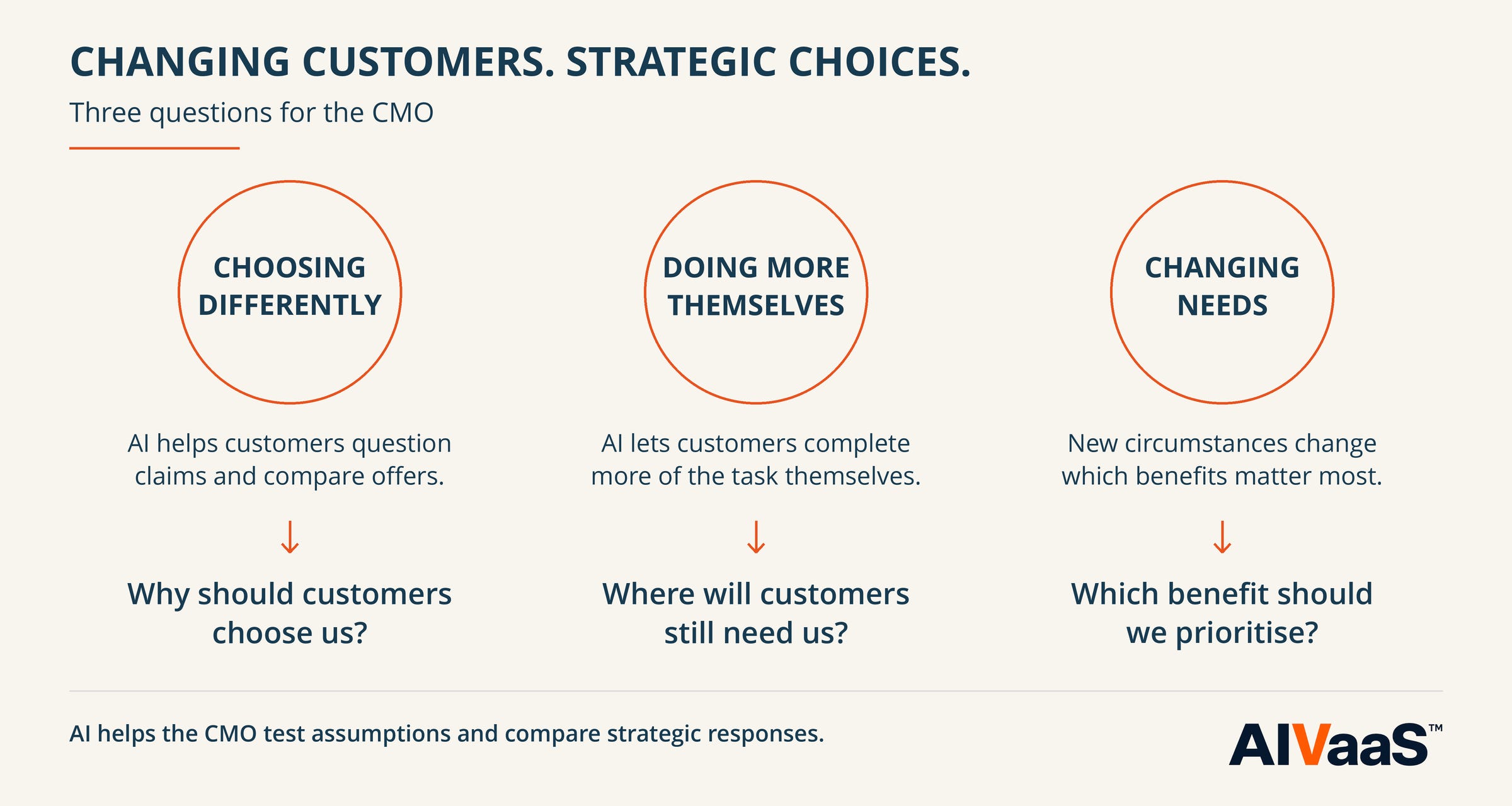
The same customer may need a different benefit as circumstances, priorities and capabilities change. A persona can guide the company, but the customer judges usefulness in a particular situation. AI can help articulate those requirements and compare offers against them, raising expectations of a relevant response.
More of that judgement can take shape before direct contact. Customers can use AI to question claims and compare possible outcomes. They may arrive with a clear view of what matters, or exclude a provider before the company knows it was considered.
The boundary between buying and doing is also moving. Customers can complete more of a task themselves or combine contributions from several providers. Their remaining need may concern expertise or coordination. As more becomes achievable, they may seek progress they previously considered out of reach.
Easier access to information does not necessarily make the decision easier. Customers may face conflicting recommendations and more claims to verify. Help with difficult trade-offs and making several contributions work together can become more valuable than another list of options.
Experience of rapid, adaptive assistance can also change how long customers consider it reasonable to wait for a result. The relevant interval runs from recognising a need to receiving the benefit. Customers may expect less coordination effort and continuity across providers, with support that adapts when their circumstances change.
Part of the relationship can also be delegated. A customer may ask AI to research and recommend, and may authorise an agent to take specific actions. The customer still sets the goals and boundaries; the provider must be understandable to both the person and the AI acting for them.
Greater assistance also makes control and trust more consequential. Customers need to know what has been delegated, how their information is used and who takes responsibility. Human reassurance and the ability to question or stop an action remain part of the value they seek.
These changes affect which benefit customers seek, what they can achieve themselves and how they judge a provider’s contribution. The CMO’s response begins with deciding which of those shifts require a different customer promise.
Reconsidering how the company earns relevance
AI is changing how customers judge an offer. They can question claims, explore alternatives and assess a proposition against their own circumstances through sources the company does not control. The CMO needs to understand which differences still influence their choice.
In BCG’s 2026 survey of 300 CMOs worldwide, 90% agreed that generative AI was already reshaping how consumers discover and evaluate brands. The strategic implication is that the distinction a company invests in may carry a different weight in the customer’s judgement.
AI can help the CMO examine whether the company’s positioning rests on a benefit customers consider important. Using customer research and evidence about competing offers, teams can compare the proposition across more circumstances and priorities. AI may surface weaknesses that a single persona or an averaged finding would conceal.
The CMO can then judge whether to strengthen the evidence behind a valuable difference, change the positioning or bring a weakness in the offer into the strategy discussion. Brand and product investment can focus on differences that give customers a sound reason to choose.
AI-generated perspectives remain hypotheses. They help focus investigation; research with actual customers must establish whether the proposed interpretation holds.
Choosing where the company will remain valuable
AI may also change what customers need a provider to do. If they can perform part of a task themselves or combine several services, the role of an established offer can change even while the underlying need remains.
The question now concerns what customers will still need the company to do. Which parts of their desired result remain difficult? Where could the company make a more valuable contribution?
AI can help the CMO compare how greater customer capability, new providers or different ways of meeting the same need could affect the current proposition. Working through the assumptions behind these scenarios gives leadership a stronger basis for deciding what to test before committing to future markets or partnerships.
The resulting choices may include a different service scope, new partnerships or a change in the customer groups the company prioritises. The relevant competition may extend beyond today’s product category.
For customers, the benefit would be support focused on what still prevents them from reaching their goal. For the CMO, the decision concerns the company’s future role in meeting
Making changing needs a strategic priority
A familiar customer segment can conceal a significant change in the benefit people need. Their role or broad objective may remain recognisable while circumstances alter what is urgent, difficult or worth paying attention to.
The CMO needs to judge which changes justify redirecting attention and resources. AI can compare evidence across customer contexts and challenge assumptions behind existing segments. A shared need may emerge across groups previously treated separately; customers in one segment may now require different propositions.
Following the customer’s value stream gives this work a clear purpose. The customer journey shows what someone does and experiences. The value stream follows how the benefit they need becomes possible and is realised. A smooth interaction or completed purchase does not establish that the customer has achieved the intended result.
If the constraint has shifted from obtaining an offering to using it successfully, the strategic response may involve extending the proposition to support that use. Making the existing interaction faster would leave the central need unresolved.
The CMO can use this judgement to direct attention and resources towards the benefit the customer now needs most.
Shaping a promise the business can fulfil
The customer promise connects these choices to the company’s strategy. It expresses which important benefit the business intends to deliver, for whom, and why it expects to be a credible and distinctive provider of that benefit.
The CMO can help turn a changing customer need into a promise that guides the business. This requires involvement before development and investment priorities are fixed. The promise has consequences for the offer, its economics and the capabilities needed to fulfil it.
AI can help the CMO compare alternative promises and examine their implications. With customer evidence and information about the business, teams can work through the expectations each promise creates, the assumptions it depends on and the changes delivery would require.
The CMO can use AI to explore whether reducing customers’ uncertainty, decision effort or the burden of coordinating providers could become a distinctive customer promise. Customer research must establish whether that benefit is important enough to shape the offer.
AI can also expand what is feasible to promise. Continuing guidance, adaptation to individual circumstances or coordination across services may become economical where they previously required too much individual effort. Understanding these possibilities lets the CMO contribute to the design of a more valuable offer.
A promise of continuing usefulness requires the service to adapt as customer circumstances change. AI may help recognise those changes and prepare suitable adjustments; commercial terms, service configurations and authority to act must also support delivery.
The CMO helps establish whether this continuing usefulness is important enough to customers to justify the commitment. Product and operations leaders assess delivery, the CFO examines the economics, and the chief AI officer (CAIO), or the leader responsible for AI, evaluates the technological possibilities. HR helps develop the people and ways of working required.
The CEO and leadership team retain overall direction, and delivery remains the responsibility of the relevant leaders.
Making trust part of the value proposition
Trust is part of what customers need from a relationship. AI introduces new ways to examine a promise and new decisions about how the company should behave on the customer’s behalf.
The customer must be able to trust the company. The customer’s agent must be able to verify it.
Where customers delegate comparison or action, clear conditions and credible evidence help their agents assess an offer against their requirements. For the CMO, this makes verifiability part of the design of a trustworthy proposition.
The strategic choice also concerns customer freedom. Personalisation may improve a decision, but it can narrow the options a customer sees. Automated assistance may remove effort while making it harder to understand or change what is happening.
AI can help the CMO and other leaders explore how different objectives and rules for assistance would affect customer decisions. Examining realistic situations can reveal a conflict between an immediate business target and the relationship the brand promises to build.
The CMO can use that understanding to help define the principles for AI in customer relationships. Operational choices about explanations, customer control and access to a person should follow those principles.
Customers gain value through greater confidence and the ability to act in their own interests. The company has a stronger basis for earning trust over time. The CMO’s contribution reaches into the decisions that determine whether the brand deserves that trust.
Turning customer understanding into a business response
As AI makes analysis more accessible, more companies can recognise similar opportunities. Advantage increasingly depends on their ability to choose a worthwhile response and organise its delivery.
The CMO contributes by defining which change in customer value deserves priority and helping other leaders understand its implications. The response may require a new offer, a different business model or the removal of an internal rule that prevents the promise from being fulfilled.
AI can help examine customer assumptions, response options and delivery dependencies together. When an assumption changes, the team can revisit the proposition and its value case. This makes customer priorities more concrete in investment and business design decisions.
The CMO and CFO need to work closely here. The CMO Survey’s March 2026 findings, based on 308 marketing leaders at US companies, found that fewer than half of companies reported marketing and finance working together on growth.
Their collaboration connects two distinct questions: does the customer receive the intended benefit, and can the company create and capture business value by delivering it? A valuable service can be uneconomic. An internal saving can leave the customer’s need unmet. Both sides require evidence.
Consider a hypothetical business travel provider whose customers increasingly plan routine trips with AI. The CMO could use AI to compare alternative promises to customers, such as keeping complex journeys on track when plans change, and explore their implications for the offer, required capabilities and economics. Research would test whether customers still need a provider to deliver this benefit. A trial would assess whether travellers spend less time rearranging travel and reach their destinations more reliably, alongside willingness to pay and delivery costs. This evidence would inform the CMO’s recommendation on the provider’s future role and investment priorities.
The time from recognising a material change in need to delivering a relevant benefit is also worth tracking. It can expose decisions or dependencies that delay the response. Evidence of customer outcomes should then guide what the company adapts, expands or stops.
Creating new ways for customers to progress
AI also allows the CMO to consider a more ambitious question: what could customers achieve with the company’s help that they cannot achieve today?
AI may make continuing expertise and adaptable support accessible to customers who could not previously obtain them. A company could help customers develop a capability, make a difficult transition or sustain an improvement after an initial service ends.
The CMO can use AI to explore alternative propositions around that progress and examine how they would change the company’s relationship with its customers. Research and practical trials must establish which forms of progress customers value and whether the company can help deliver them credibly.
Greater customer capability can itself change future demand. A customer who becomes more independent may need less help with the original task and become ready for a different one. More repeat purchases are therefore not always evidence of greater customer value. The CMO needs to anticipate that progression when shaping the offer and its revenue model, so the company can prosper as customers become more capable.
Developing the CMO’s business contribution
The connection between AI, customer value and the CMO’s contribution can be expressed through three strategic choices.
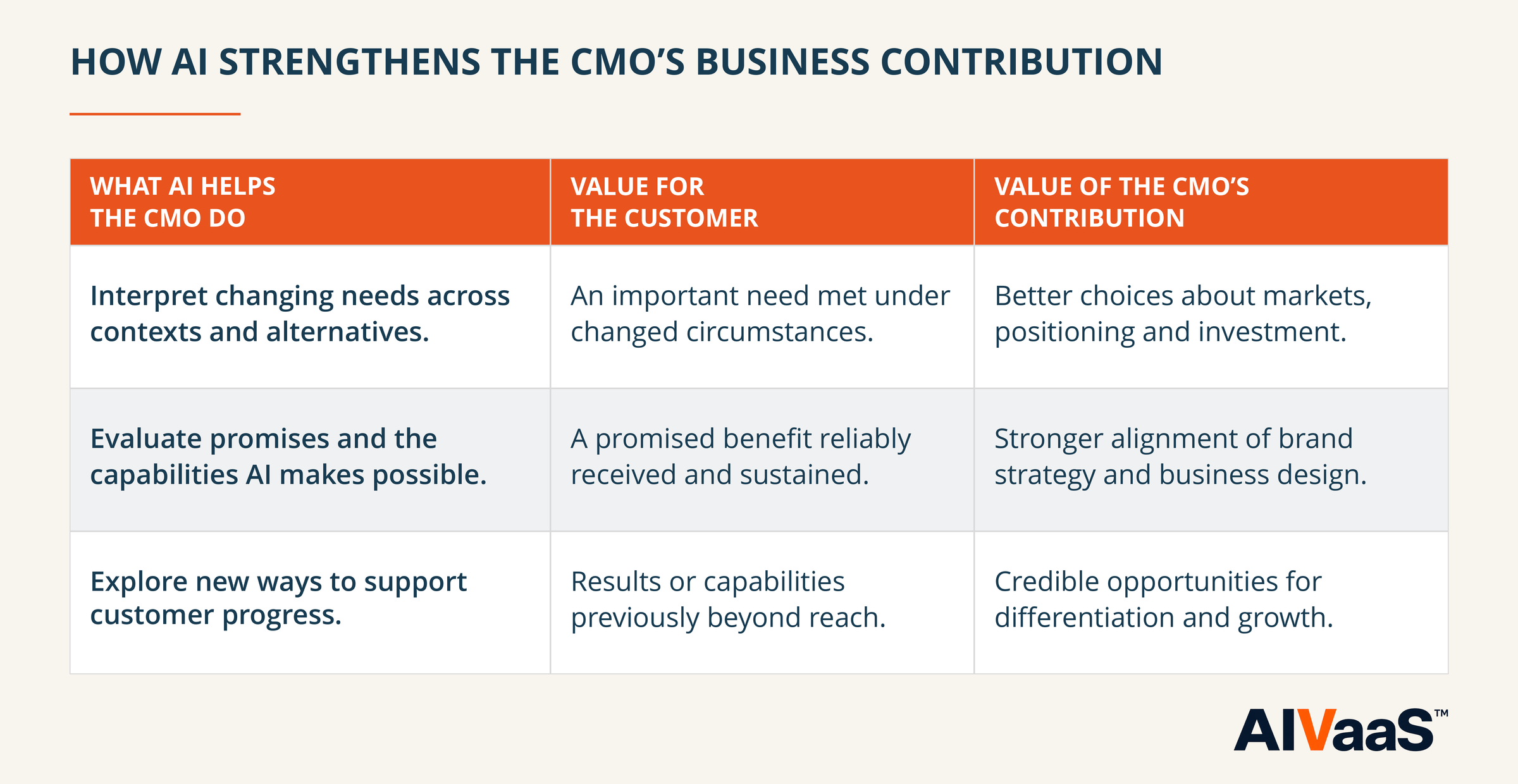
Day-to-day marketing work supports these choices. AI-assisted research synthesis or testing of a proposition matters when its findings improve a decision. The CMO needs to develop the team’s ability to make that connection and use the capacity AI creates for deeper customer and business understanding.
The CMO can also use AI as a learning partner to deepen their understanding of business models, finance and the capabilities needed to fulfil a customer promise. Working with validated business information, they can explore how a proposed commitment affects delivery costs and profitability, then test their reasoning with the CFO and operational leaders. This strengthens their ability to explain trade-offs and recommend a proposition that the business can deliver.
Gartner’s 2026 guidance for CMOs similarly emphasises strategic judgement, scenario planning and business acumen as foundations for greater influence across the enterprise.
Access to customer and operational evidence, together with support for the CMO’s business learning, strengthens that contribution.
From customer need to business advantage
Customers are changing in what they need, how they judge alternatives and what they can achieve for themselves. AI gives the CMO greater capacity to understand those changes and expands what the company can make possible. The strategic task is to judge which customer benefits should shape its future.
The customer promise gives those choices a common direction. Positioning, product development and investment must support a benefit the customer can actually receive. Evidence of that benefit, together with the economics of delivering it, should guide the company’s next decisions.
For the CEO, this is a reason to involve the CMO early in shaping strategy and investment priorities. The leadership team shares responsibility for turning the chosen promise into reliable delivery and a viable business.
The CMO’s value grows when AI helps turn a changing customer need into a benefit the company reliably delivers and a business advantage it can sustain.
Ales, the line that the customer must trust the company while the customer's agent must be able to verify it is the most practical one in the piece. I'd add the question of who answers for what the agent did on the customer's behalf. When an AI step goes wrong, customers forgive a mistake faster than an unclear owner. Settling that with the CFO and operations before the promise goes out is the same discipline you describe for the economics, applied to accountability.