


The series so far has moved in three steps. The opening diagnosis showed that most AI initiatives still fail to produce measurable value, and that the missing piece is a methodology for turning ambition into stakeholder value.
Outside-In AI Impact read the economy from the outside and derived the level of AI ambition the environment demands. AI Ambition Needs the Right Character tested whether the organisation’s strategic character can carry it.
An ambition that clears both readings is credible. It has survived the environment, and it has survived the mirror. Credible, however, is not the same as productive. A credible ambition still produces nothing by itself.
Where do concrete AI opportunities come from. Which ones deserve investment first. By what measure does the organisation know they were worth it. The last two elements of the first AIVaaS™ pillar answer the first two. One function from the Foundation underneath them answers the third.
The race moved to value
Across the major research houses, the 2026 reports converge on one message, stated in different words. The conversation is no longer about whether organisations use AI. It is about whether they can turn AI into value.
PwC finds that a fifth of companies generate nearly three quarters of all financial returns from AI. The race is not decided by who adopts. It is decided by who converts.
Capgemini describes ROI measures moving beyond savings, toward revenue growth, risk management, and customer experience. Efficiency itself is becoming a commodity. Organisations that stay with efficiency-only AI hit a ceiling, because the basic savings run out.
AIVaaS™ draws one structural conclusion. If value is the race, the measure of value cannot be an afterthought. It has to be committed before any execution begins.
That is why Value & ROI Validation sits in the Foundation of the methodology, beneath all three pillars. The commitment is made up front: realized business value will be measured, not adoption. Continuously, not as a milestone at the end.
With the measure committed, the two remaining elements of the first pillar can do their work.
Value has an address
Value is relational. Something has value for someone, in some context. Stated like that, it sounds obvious, and yet most AI opportunity lists violate it in the first column. They name a technology and a process, and leave the recipient implicit.
An AI opportunity that cannot name the stakeholder it creates value for is not a business opportunity yet. It is a business wish.
It also carries a practical penalty downstream: its KPI floats. Shorter handling time is value for a customer. Lower cost per transaction is value for an owner. Less repetitive work is value for an employee. A KPI without a recipient measures nothing in particular.
An opportunity without a firm KPI falls out of every serious prioritization, because nobody can say how much it brings, and to whom.
AIVaaS™ therefore reverses the usual order of the question. Not where could AI help, but for whom should value be created, and what kind. The search runs in two directions at once, and both are mandatory.
Outward, toward customers, partners and the market: faster and more personal experience, offers that were not possible before, new sales opportunities, better connected value chains. Value in this direction shows up as revenue growth and differentiation, the difference a market notices.
Inward, toward employees, leaders and owners: a better working experience, fewer repetitive tasks, faster and better supported decisions, healthier returns. Value in this direction shows up as productivity, lower cost, and better decision quality.
Organisations that search only inward end up with AI operations. Efficient, measurable, and quickly forgotten by the market. Organisations that search only outward meet resistance, because the people who must deliver the change see no value in it for themselves.
The portfolio that works covers both directions, by design.
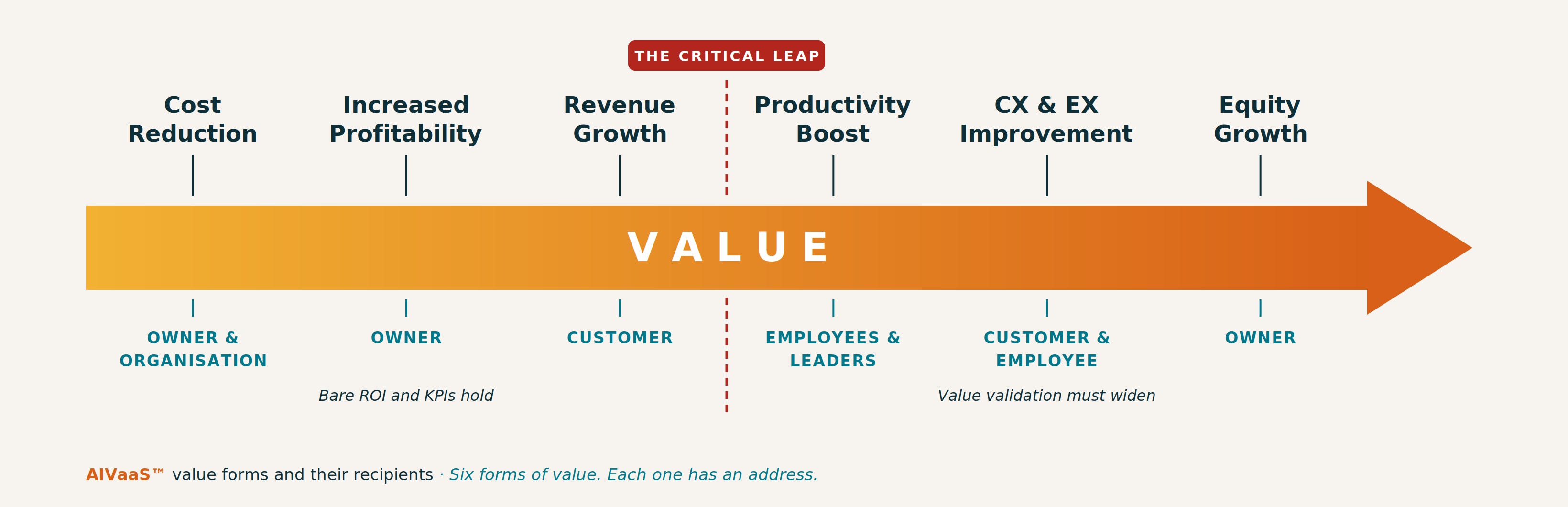
The series introduced four levels of AI ambition earlier, from L1, where AI supports people in their existing work, to L4, where AI is the core of the business model.
The red line on the arrow is the critical leap, the same boundary the series marked between L2 and L3. The forms to its left are within reach of L1 and L2, where AI improves existing work. Everything to its right opens only with an L3 or L4 ambition.
The stakeholder profile of the opportunities also performs a quiet diagnostic. It reveals the organisation’s actual ambition, regardless of the declared one.
Opportunities that address mostly internal stakeholders place the real ambition at L1 or L2, whatever the strategy slide says. Opportunities that reach external stakeholders in ways that were not possible before move the organisation toward L3 or L4.
A stakeholder-unbalanced portfolio is an early signal that declared ambition is higher than actual.
The stakeholder defines the value. The value defines the measure. The measure makes prioritization possible.
A portfolio, not a shopping list
Prioritization in AIVaaS™ is not the act of picking the most attractive individual ideas. It is a strategic decision about distribution, derived from the ambition the previous readings established.
The wrong question is which quadrant to invest in. The right question is what distribution across quadrants fits the organisation’s strategic position.
The quadrants come from the Value Creation Matrix. Its vertical axis measures the scope of change, from the operational model, how the organisation works, to the business model, what value it creates. Its horizontal axis measures value capture, from internal value to external value.
Four quadrants emerge. Q1, cost savings, the hygiene factor that funds the rest. Q2, revenue growth and enhanced customer value, the growth engine. Q3, the radical productivity leap, where breakthrough begins on the inside. Q4, new value forms, where differentiation and disruption live.
If the AI Ambition Matrix earlier in the series was the compass, this matrix is the X-ray. It reveals hidden value because it changes the unit of analysis.
A task focus produces Q1: automate what exists, optimise locally. A constraint focus opens Q3 and Q4: find where AI removes a critical business constraint, the one that kept a segment unserved or an economics unworkable. New value appears where the task list showed nothing.
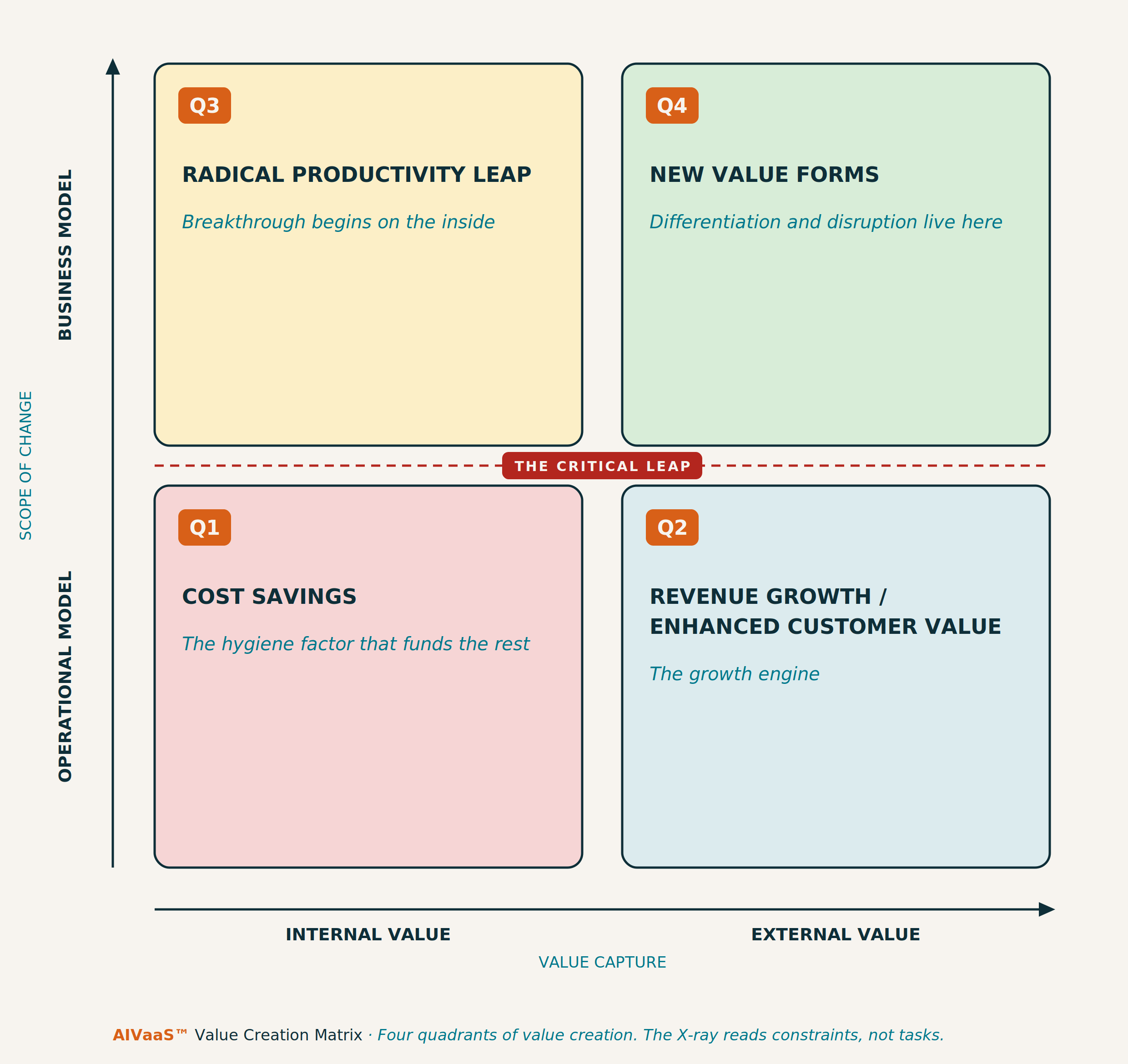
The balance across the four quadrants is an allocation decision. As a starting point inside the methodology, not a dogma: roughly 35 to 45 percent in Q1, funding the rest, 25 to 35 in Q2, 15 to 25 in Q3, and 10 to 20 in Q4, adjusted to the organisation’s position.
The warning signs matter more than the percentages. A portfolio that sits in Q1 alone does not survive long term, because everyone is harvesting the same savings. An empty Q4, where the environment demands transformation, leaves the door open to whoever fills it first.
The matrix is a tool inside a step where business direction is already clear. It distributes a committed ambition. It does not substitute for one.
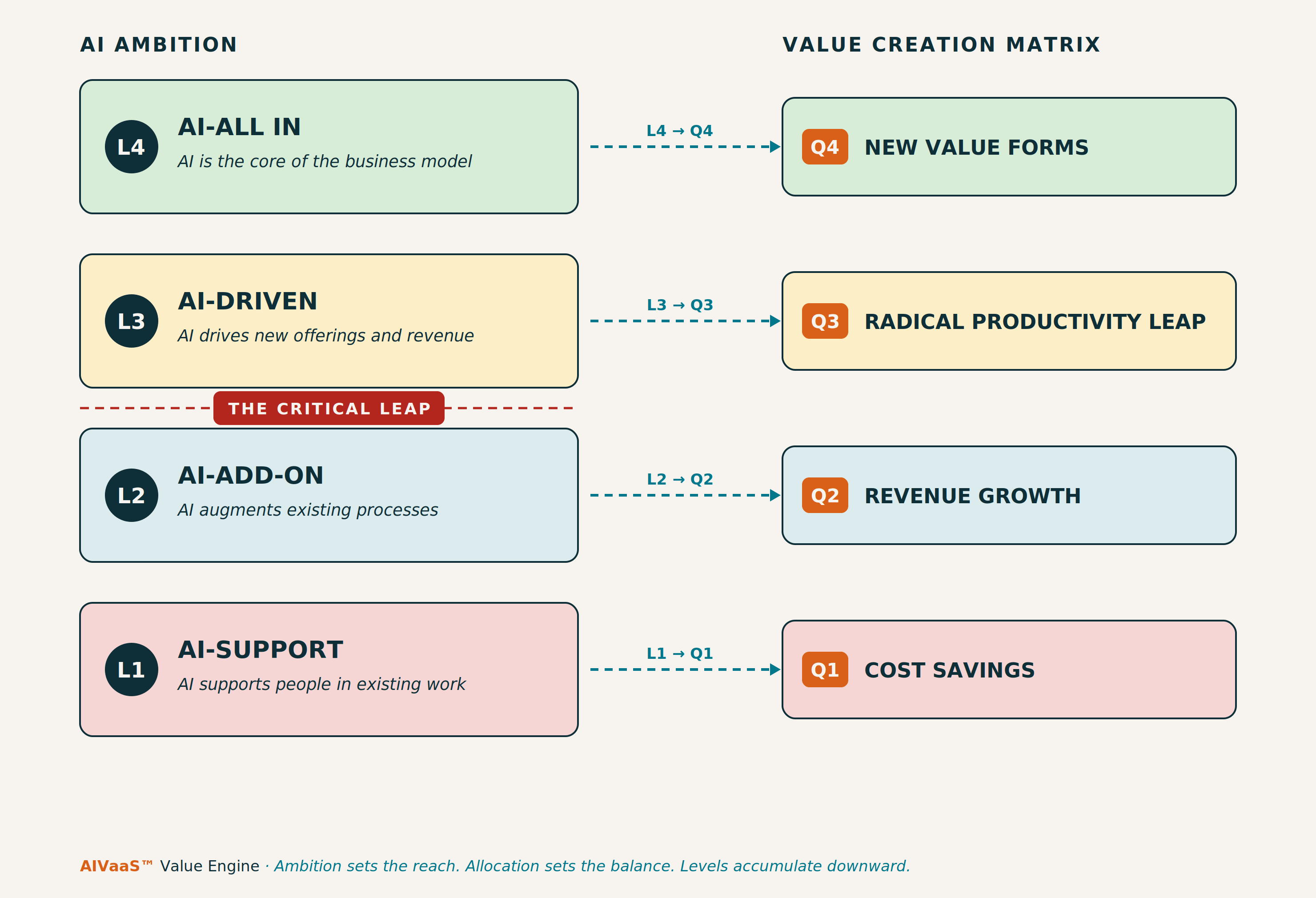
The two matrices stay distinct, and they connect. Ambition levels accumulate, because a higher level keeps doing everything the lower ones do. So ambition sets the reach of the portfolio: L1 reaches Q1, L2 adds Q2, L3 opens Q3, L4 opens Q4.
An organisation with a credible L3 ambition lives across Q1 to Q3.
Two prioritizations, one trap
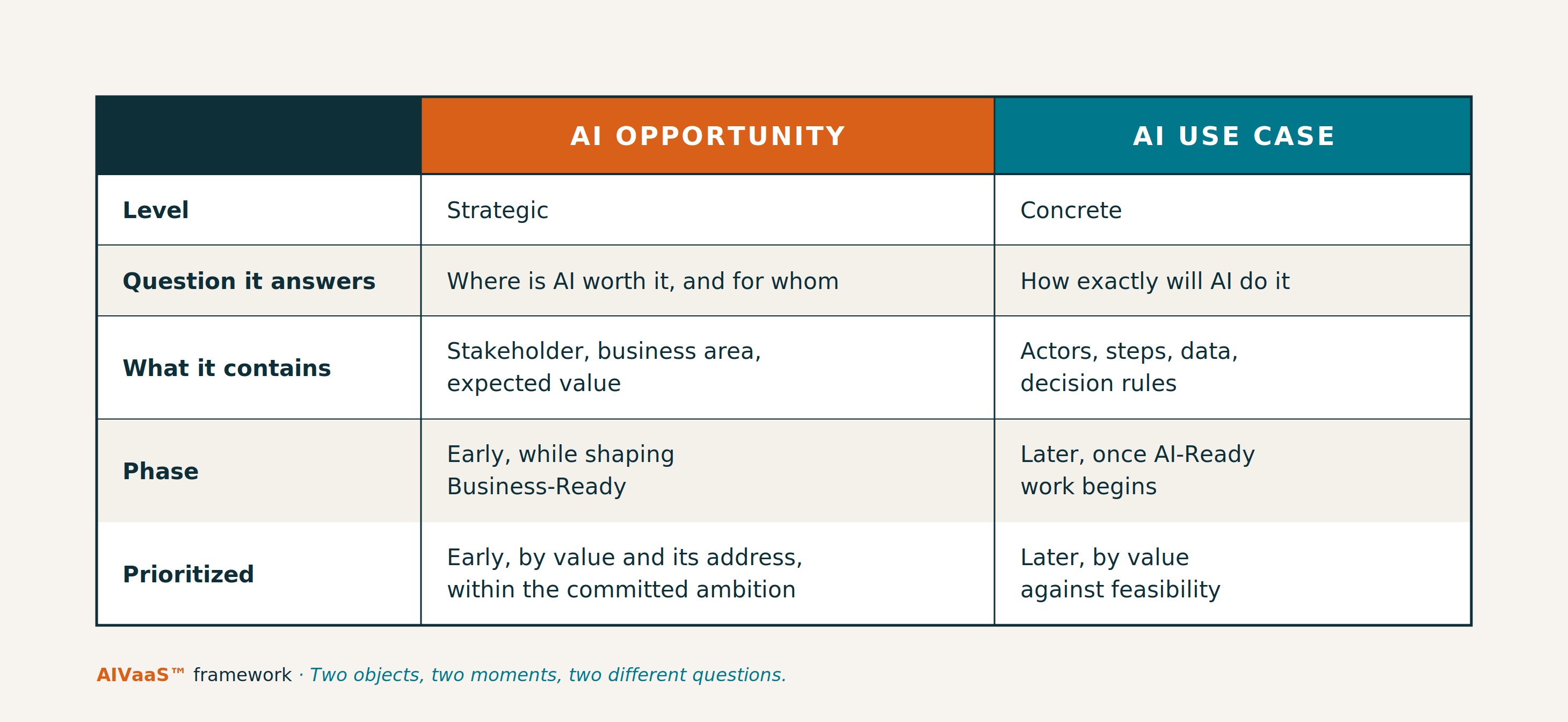
Prioritization happens twice in the methodology, not once, because early on feasibility is unknown. Process and data maturity, and the readiness of people, only become measurable later.
The early prioritization, the one described here, measures value alone. It produces a shortlist of opportunities worth deeper analysis.
The portfolio is also a strategic checkpoint, the last one where the selection can still be steered. Every opportunity that survives must belong to the business strategy, because AIVaaS™ knows no separate AI strategy to retreat to.
This is where the organisation verifies Ambition Fusion in practice: whether the AI ambition and the business ambition are still one and the same. A portfolio that drifts away from the strategy has already given the answer.
Value alone never meant size alone. Every opportunity on the shortlist carries two more readings: who receives the value, and whether it serves the ambition the organisation committed to.
The trap looks rational at every step. An organisation commits to L3, where AI drives new offerings. Then the portfolio fills with Q1 savings, because those score easiest, and each one is approved on its own merits.
A year later the portfolio says L1. Nobody voted against the ambition. The budget did, one approval at a time.
The drift has a second engine: power. The preference for measurable savings tends to sit with whoever approves the spending, and a tension that nobody governs is resolved by the strongest preference in the room.
That is why AIVaaS™ treats priority-setting as governance, not as a scoring exercise. The Foundation commits the rules for how priorities are set up front, next to the measure of value.
The final prioritization comes later, when opportunities convert into concrete AI use cases, with actors, steps, data and rules. There it weighs value against feasibility. Two different moments. Two different objects.
The measure that holds the portfolio
A portfolio is only as strong as the measure underneath it. Bare ROI, used as the sole criterion, has a systematic bias. It computes most easily where value is a direct saving on something that already exists.
An ROI ranking therefore always favours the left side of the matrix. Q4 measures the economics of something that does not exist yet. There is no baseline to compute against, so in a bare ROI table it loses every time. And it is where the most durable value lives.
The bias is not only ROI’s. Execution KPIs lean the same way, toward the left of the value arrow, because targets are easiest to define there and because most KPIs read in quarters, not years.
Customer-side value resists simple measures. NPS is one of the few that holds, and one instrument cannot carry half the arrow.
The boundary is the same critical leap the series crossed before. In ambition it separates L2 from L3. In value creation it separates the operational row from the business model row. In measurement it separates what bare ROI and standard KPIs can read from what they cannot.
The conclusion is not that ROI is wrong. It is the right instrument for the left quadrants, where value arrives as direct savings or direct revenue on the existing model.
Further right and further up, the measure has to widen: new capabilities, customer and employee experience, market position, the economics of a segment that could not be served before.
This is the work of Value & ROI Validation, the commitment from the opening, running through the transformation rather than waiting at the end of it. Every opportunity on the shortlist, and every investment that follows, is held to one continuous question.
Is this creating value, for whom, and how does the organisation know. The address is what makes the answer checkable.
Why this matters for Ana
In the stories that opened this series, Ana is the customer the organisation serves today, and the child she carries is the customer of the next, more intelligent economy.
Prioritizing by value is the act of choosing what to build for Ana first. Ana never sees the portfolio. She never sees the quadrants, the allocation, or the shortlist. She sees only what reaches her.
A portfolio that looks balanced on paper but leans toward internal savings produces nothing she will ever notice. The address on the value decides whether she ever receives it.
The series moves next to the people who have to deliver all of this, and to a question left open here: how each stakeholder perceives what is being planned for them. Engagement and motivation come ahead of everything else there.