


Most AI initiatives are designed from the inside out. The AI ambition that emerges reflects the organisation looking at itself.
The economy outside, where customers, competitors and value chains are being reshaped by AI, stays in the background. It should not.
Cost efficiency is a form of value, but competitors at the leading edge are already moving beyond it, building value on the outside while the inward-looking optimisers consolidate it on the inside. The gap is widening.
What many organisations did was optimise their existing operations and call it AI transformation. It was ordinary business optimisation with AI tools.
This is one of the quietest reasons AI investments produce so little measurable value. An ambition that started from internal optimisation never caught up with the value AI was already creating in the market.
The economies underneath have never moved this fast
The success of any business depends on the economy it operates in. Each economy rewards a different logic. Companies that won in the industrial economy did not automatically win in the digital one. The same is now true for the shift from digital to intelligent.
The pace is accelerating, and the time between economic shifts is shrinking. The transition from industrial to digital took two decades. The shift from digital to intelligent is happening in a fraction of that time, while the digital shift itself is still underway in many organisations.
Several economic transitions are now overlapping, each with its own pressure and its own pace.
This is not a story of catching up. It is the new condition of business. Companies that read the shifts well find advantage. Companies that read them late lose it.
External business environment is more than your customers
Customers are visible. They buy or they leave. They complain or they praise. Most organisations track them well.
The rest of the external environment is less visible. The economy that surrounds the customer, the competitors that reshape the offer next door, the value chains that reorganise without warning.
This is where AI is currently doing most of its work, and where organisations looking only at customers miss the most.
What follows is a working comparison of three economies. It surfaces where the pressure is now coming from, and serves as the terrain map for every decision that follows in this methodology.
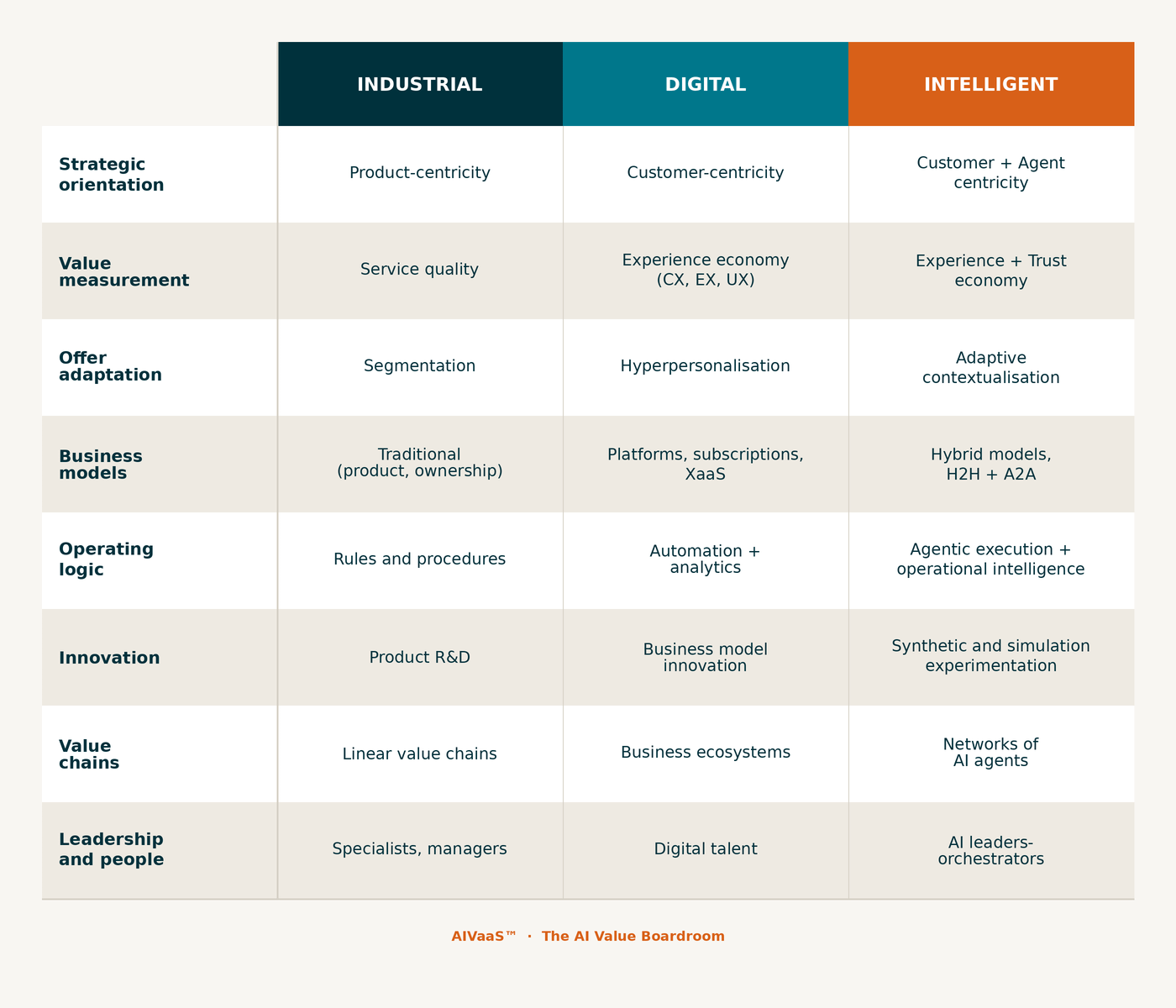
The table reads in two directions. Across each row, a single business dimension changes as the economy shifts. Down each column, the dimensions in one economy hold together as a coherent logic. The intelligent economy is not the digital one with AI added.
AI is not one row in the table. AI is the thread running through it: every shift toward the intelligent economy is enabled by the development of AI itself.
Eight dimensions appear in the table. Strategic orientation reframes who the organisation serves. Value measurement reshapes what counts as value. Offer adaptation changes how value is tailored. Business models change how value is captured.
Operating logic redefines how work gets done. Innovation redefines how the new gets created. Value chains restructure who connects with whom. Leadership and people reshape who leads and who works alongside AI.
These eight dimensions are the surface on which the four impact components below will work.
Universal shifts, specific impact
The dimensions in the table are universal. They describe the underlying logic of the economy, and that logic does not pick favourites among industries.
What is not universal is the impact.
The same shift in customer behaviour that erodes margins in retail may open new revenue streams in financial services. The same arrival of AI agents that disintermediates one industry consolidates another.
The same operating logic that delivers ten percent efficiency gains for a manufacturer rewrites the entire offering of a professional services firm.
Universal shifts. Specific consequences. Specific AI impact. This is the gap external analysis is built to close.
External Strategic AI Impact Analysis is not a one-time exercise that produces a report. It is an organisational capability. The economy keeps moving, and the reading has to move with it.
Reading the impact: four components
External Strategic AI Impact Analysis is the element of AIVaaS™ that turns the economic shifts into something an organisation can respond to. The four components below describe what the organisation actually reads.
Two components read pressures from outside. Two read how those outside pressures land on the inside, because what AI does to the economy does not stop at the company perimeter.
What the outside is doing
One: AI in customer behaviour and market expectations. This component reads how AI is changing the people the organisation serves. It draws on the customer dimensions of the economic shift: strategic orientation, value measurement, and offer adaptation.
Customer expectations move ahead of what the organisation can deliver, because customers compare every interaction with the AI-enabled benchmark they encounter elsewhere.
Channels of influence narrow, because AI agents now intermediate the customer journey. Trust criteria change, because customers begin asking different questions about AI in the loop.
The organisation reads how fast customer expectations are shifting, how present AI agents are in its sales and service journeys, and how much of its brand trust now rests on AI transparency.
Two: AI in competitive offerings and industry structure. This component reads how AI is reshaping how organisations create value in the industry and how the industry itself is structured. It draws on two dimensions: business models, and value chains in their external form.
Competitors redefine how they create value, because AI enables value propositions that were impossible before. New entrants arrive from adjacent industries, because AI capability moves more easily across industry boundaries than physical infrastructure ever did.
Industry economics shift, because outcome-based pricing and ecosystem dynamics change how value is captured.
The organisation reads which competitors have moved to AI-native business models, which adjacent industries are now positioned to enter, and how much of the value pool is migrating to ecosystem orchestrators.
What the outside demands of the inside
Three: AI in how value is created within the organisation. This component reads how external AI pressure is forcing the internal value-creation machinery to change. It draws on two dimensions: innovation, and the internal form of value streams.
Innovation cycles compress, because competitors learn faster through digital twins and simulation. Value streams designed for human handoffs lose efficiency, because hybrid flows with AI participation produce outcomes the human-only flow cannot match.
The boundary between innovation and operations blurs, because experimentation becomes continuous rather than periodic.
The organisation reads how fast its innovation cycle is relative to competitors, where in its value streams AI participation could change the outcome, and how much of what used to be R&D now happens inside operations.
Four: AI in operating logic and leadership. This component reads how external AI pressure is forcing the operating model and the leadership role to change. It draws on two dimensions: operating logic, and leadership and people.
The operating standard for the industry resets, because competitors that orchestrate people and AI agents produce speed and adaptability the people-only organisation cannot match.
The leadership skill profile changes, because managing hybrid teams requires capabilities that did not exist before. Talent flows shift, because professionals who learn to work with AI agents move toward organisations that build hybrid operating models.
The organisation reads which operating activities competitors have already moved to agentic execution, how many of its leaders are equipped to orchestrate hybrid teams, and how its talent pool is responding.
Reading discipline, not a report
The four components describe a reading discipline rather than a one-time exercise. Customers keep adopting AI. Competitors keep introducing AI-enabled models. New value patterns keep emerging.
An organisation that builds External Strategic AI Impact Analysis as a capability, not as a document, carries its ambition through changing conditions without rewriting it every quarter.
From reading to ambition
External Strategic AI Impact Analysis tells the organisation what AI is doing to its business environment. It does not yet tell the organisation what to do about it. The bridge from reading to response is AI ambition.
In AIVaaS™, AI ambition is the organisation’s clear and realistic vision of what it wants to achieve with AI within its business strategy, and what it is willing to invest in time, money and change to get there.
It is not a measure of how complex or advanced the AI solutions will be. It is a business decision about why the organisation is taking on AI in the first place, given its position with customers and competitors.
Ambition also depends on the forms of value the organisation expects to create. Different ambitions produce different value patterns, and the choice of ambition shapes what kind of business outcomes become possible.
The AI Ambition Matrix structures this choice along two dimensions. The horizontal axis runs from operational excellence, where AI optimises how the organisation operates today, to strategic transformation, where AI redefines what the organisation does tomorrow.
The vertical axis runs from defending the current market position to differentiating through competitive advantage to disrupting the market itself. Where an organisation lands defines its level of AI ambition, and the value pattern it can expect to create.
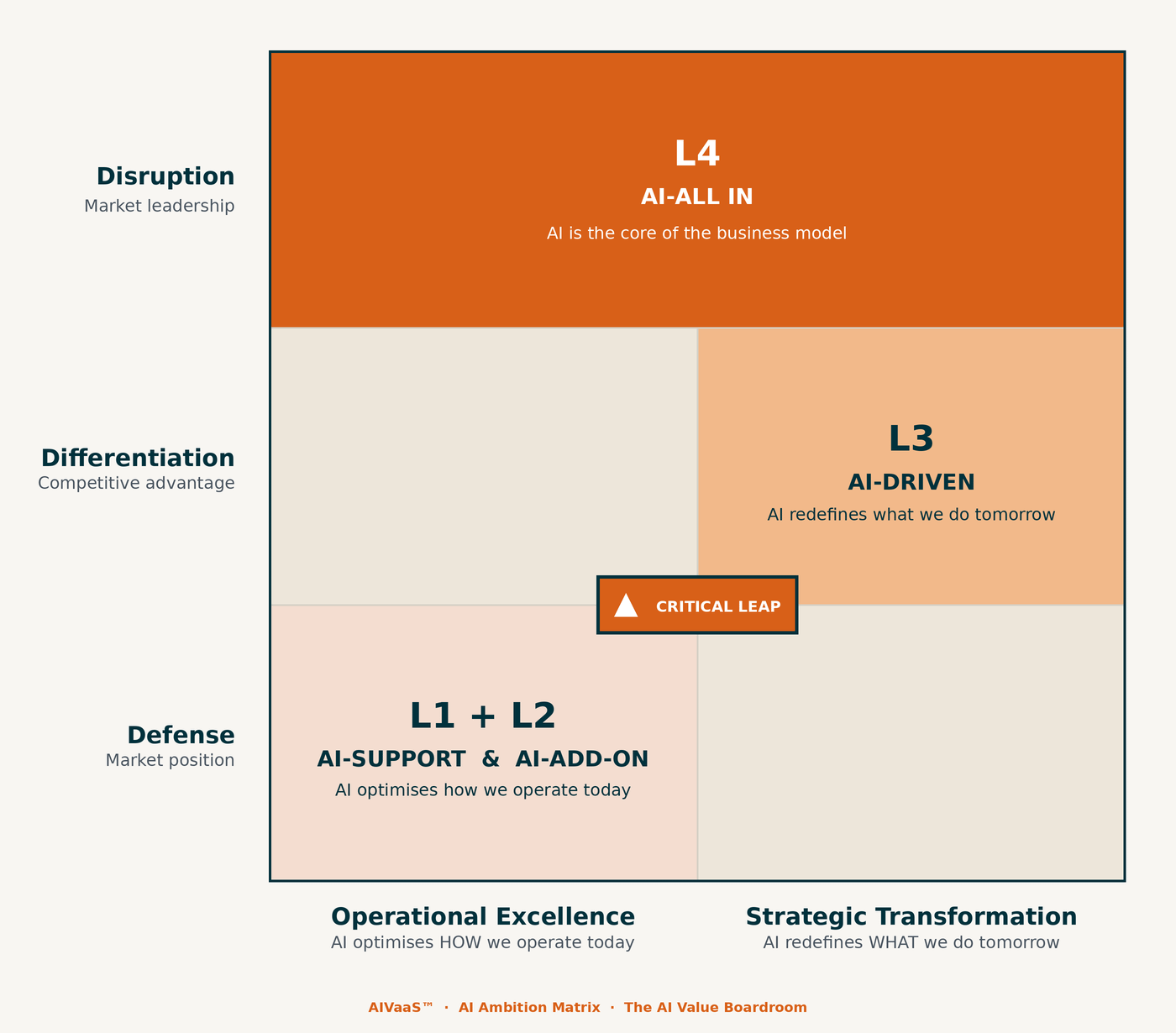
The four levels of AI ambition that emerge from the matrix have different demands, different timelines, different investment profiles, and different forms of value they create.
Each level is a coherent business choice. The right level is the one the organisation’s external reading and its internal capability can both support.
The four levels of AI ambition
Each level is a different vision of what the organisation wants to achieve with AI, and a different answer to the AI pressures the external reading has surfaced. A level defines both a strategic position in the market, from defence to disruption, and a depth of change inside the organisation.
These are not classical AI maturity levels. They do not measure how advanced the AI deployment is or how mature the AI technology stack has become. They measure the business ambition behind the AI commitment.
One principle holds across all levels. A higher level includes the lower ones. An organisation at L4 does not stop doing what it would do at L1. It does that and more. The levels accumulate, they do not replace.
An organisation can also reach a higher level in part of its business without first running the lower ones across the rest. A new AI-based business model launched in parallel may operate at L4 from day one, alongside the parts of the organisation still at L1 or L2.
L1 — AI-SUPPORT
At L1, AI supports people at their existing work, inside individual tasks and work streams. It accelerates tasks, surfaces information, drafts content, summarises documents. The work itself does not change. The people doing it gain a faster, more capable assistant.
The operational model improves. The business models and the competitive position do not. Strategically, this is a defensive position focused on operational excellence in how the organisation operates today.
Whatever advantage L1 creates tends to be temporary. AI at this level is being adopted across every industry, and what feels like a productivity gain today becomes the new operational baseline tomorrow.
L2 — AI-ADD-ON
At L2, AI is added to end-to-end processes as a layer that improves them. Decisions become better informed, operations become more efficient, customer interactions become more responsive. The processes still belong to the people. AI is the augmentation.
The operational model improves more broadly than at L1. The business models and the competitive position still remain the same. Strategically, this is still a defensive position, with wider reach across the organisation.
The same temporality applies. L2 advantage erodes as competitors reach the same baseline. The further the organisation goes inside L2, the closer it gets to the critical leap that separates operational improvement from strategic transformation.
L3 — AI-DRIVEN
At L3, AI starts driving outcomes the organisation could not produce before. New offerings emerge, new revenue streams open, new ways of serving customers become possible because AI is doing the driving, not assisting.
This is where the operating model and the business models begin to change together. Strategically, this is a differentiation position. The organisation competes on capabilities its competitors cannot easily match, because those capabilities depend on AI as a core mechanism, not as a tool.
L3 is the first level above the critical leap. Below the leap, AI optimises how the organisation operates today. Above it, AI redefines what the organisation does tomorrow. The leap is not technological. It is a leap in business ambition.
L4 — AI-ALL IN
At L4, AI is in the heart of every strategic and operational part of the organisation. Not in one corner, not as a layer over existing work, not as a driver of selected outcomes.
AI becomes the substance that runs through strategic direction, operating model, value proposition, and the business models the organisation runs in parallel in the intelligent economy.
The competitive position is no longer defined by the existing industry. Strategically, this is a disruption position. The organisation does not compete inside the existing rules. It redefines what the industry is.
L4 is also where the AIVaaS™ principle of accumulation becomes most visible. An L4 organisation continues to run L1, L2 and L3 inside its operations. The difference is that the whole rests on a strategy and a portfolio of business models that would not exist without AI.
Reading the levels in two directions
The four levels gain their full meaning in the shift from the digital economy to the intelligent one. The comparison of the three economies shows where that shift moves the business dimensions. The four impact components show how the shift lands on the organisation.
The critical leap between L2 and L3 takes on its full meaning here. L1 and L2 are internal responses to external pressure. L3 is the first level at which the organisation looks outward and repositions itself in the market. The leap is from absorbing the outside to facing it.
This is why organisations must form their AI ambition through an Outside-In perspective. Ambition is not picked from the inside and then validated outwards. It is read from the outside and committed to inwards.
Levels and the eight dimensions
L1 mainly activates the Operating logic dimension, at the level of individual tasks and work streams. AI accelerates the work.
The strategic orientation, the value measurement, the offer, the business models, the value chains, and the leadership configuration of the organisation all stay in place.
L2 extends the Operating logic dimension to end-to-end processes, and starts engaging Leadership and people as hybrid teams of people and AI agents begin to form inside operations.
Strategic orientation, value measurement, offers, business models, and value chains still hold the digital-economy shape.
L3 moves the activation upward. Business models shift toward hybrid forms, Innovation moves into business model and AI-enabled value creation, and Value chains start operating as ecosystems and emerging networks of AI agents.
The organisation begins to look like an intelligent-economy player on the dimensions that define how it produces value.
L4 touches all eight dimensions. Strategic orientation extends to customer-plus-agent, Value measurement adds the trust layer, Offer adaptation moves to adaptive contextualisation.
Business models become the form through which value propositions are realised in the intelligent economy. Operating logic runs on agentic execution, Innovation turns into synthetic experimentation.
Value chains extend business ecosystems into networks of AI agents that operate alongside human-led ecosystems.
Leadership and people become AI leaders-orchestrators. L4 is the level where the organisation is no longer partly in the intelligent economy. It is fully there.
Levels as Outside-In responses
L1 and L2 answer mainly the inside components of the impact analysis: how operating logic and how leadership are being reshaped by external AI pressure. They are responses to the demand the outside is placing on the inside, without yet changing how the organisation faces the outside.
L3 begins answering the outside components: how AI is reshaping competitive offerings and industry structure, and how AI is opening new forms of value in the economy. The organisation does not only adapt internally. It starts repositioning in the market.
L4 answers all four components together. Customer behaviour, competitive offerings, new value forms, operating logic and leadership are all being reshaped by external AI, and L4 is the ambition that responds across the full surface.
This is where ambition stops being an internal choice. It becomes the integration that turns external reading into a committed strategic move.
Choosing the level
Competitors that read the economy build new revenue streams, new offerings, new ways of serving customers. Organisations that read it without committing to a level matched to it produce neither.
The wrong level is the one chosen without the reading.
An organisation that picks L4 because it sounds bold, without understanding why the intelligent economy demands that level for its specific position, is choosing a wish, and pouring investment into it.
An organisation that picks L1 because it feels safe, without understanding that its competitors are already at L3, is choosing a slow decline.
The right level rarely announces itself. It emerges from the discipline of reading the outside, knowing the inside, and committing to the response that matches both.
The organisation’s chosen level and the external pressure it faces are not always aligned. When they are misaligned, the gap becomes the central strategic problem. The next article in the series addresses that gap directly.
AI Ambition Assessment
Maps your own view of where your organisation’s AI ambition currently sits on the matrix. A starting point for asking whether that ambition matches the external pressures you have just been reading.
Open the assessment → https://aivaas.biz/substack/ai-ambition
Ambition Fusion
This is where AI ambition meets business strategy ambition. Dr. Marc Sniukas defines strategy as a set of integrated choices that resolve the challenges and open the opportunities on the way to the organisation’s ambition.
Sniukas’s definition holds in any economy. Every economy has challenges to resolve and opportunities to open.
What changes in the intelligent economy is the volume and the weight. There are more challenges, more opportunities, and they shape the strategic landscape more decisively than in any economy before.
The reason behind this shift is the pace of AI development itself. AI keeps producing new challenges the organisation must address, and new opportunities the organisation can capture, faster than any previous technological wave.
The strategic choices that resolve those challenges and open those opportunities therefore include the AI choices, not as an attachment, but as a constitutive part.
This is why AI ambition cannot live in a separate document. When organisations write an “AI strategy” alongside the business strategy, they are at the same time usually treating AI ambition as a separate set of AI technological initiatives. The two failures reinforce each other.
AIVaaS™ answers both with fusion. AI ambition is integrated into business strategy ambition through Ambition Fusion. AI strategy is integrated into business strategy through AI Strategy Fusion.
Together, the two fusions produce business fusion, the state in which AI and business are no longer separate subjects of strategic thinking.
Ambition Fusion is where it begins. Two ambitions become one. The organisation does not pursue a business ambition and an AI ambition in parallel. It pursues a single ambition shaped by both.
Why all this matters for Ana
In the stories that opened this series, we met Ana. She is a customer, not a persona, but a real customer. And she is more than just a customer.
Ana is two customers in one. She is the customer the organisation serves today. The child she is carrying is the customer of the next economy, one more intelligent still than today’s.
Serving today’s Ana well takes attention to customer experience. Serving tomorrow’s Ana well takes much more. The child will expect agentic interactions, hybrid teams of people and AI, new forms of trust, new value chains. The full picture of the eight dimensions.
Organisations that want to serve Ana, and her child, cannot stop at customer experience. The shift that surrounds them runs through all eight dimensions of the economy.
If you have not met Ana yet — she is the central figure in the stories that opened this series. Story 0 introduces her, along with Harrison and the room where it all begins.
I think about AI in 3 dimensions when it comes to strategy:
1. How can AI enable/support your strategy?
2. What's the impact of AI on your strategy?
3. How to use AI to support strategizing?