


In the previous article, Outside-In AI Impact, AI ambition was read from the outside. The economy moves, customers and competitors are reshaped by AI, and the organisation derives the level of ambition that this outside pressure demands. That reading produced the AI Ambition Matrix, a level of ambition committed to inwardly. If the framework is new, the link is here, because this article picks up exactly where it left off.
But that reading left a question open. The level an organisation chooses and the pressure it actually faces are not always aligned. When they are not, the gap becomes the central strategic problem. It was named there. It was not yet closed.
This article closes it. And the closing happens inward, because the gap has two layers, and both of them live inside the organisation rather than out in the market.
The first layer is whether the organisation aimed high enough for the environment it is actually in. The second is whether it is, by character, capable of reaching the level it aimed for. Most organisations measure neither. They measure ambition, write it down, and move to execution. The ambition stays on paper because nobody asked the two questions that decide whether it can leave the page.
The economy is not a fixed picture
Where the reading began, the nature of the economy was the subject: industrial, digital, intelligent, each rewarding a different logic. That description was a snapshot. What it did not capture is motion. How fast the ground is moving under the organisation, and how predictably.
This is where Igor Ansoff still matters, decades after he wrote. Ansoff, often called the father of strategic management, spent twenty-five years studying why firms succeed or fail in turbulent environments. He placed environments on a scale of turbulence, from stable and repetitive at one end to surprising and discontinuous at the other.
Turbulence is not a mood word for difficult times. It is a measurable thing, built from a few concrete questions. How fast are customer needs changing, and how predictably. How often do new competitors arrive, and how often from outside the industry entirely. How quickly do products and business models age. How much of the future can be read from the past. A stable environment answers all of these with slow, predictable, rarely, rarely, most of it. A turbulent one answers with fast, discontinuously, constantly, often from nowhere, and almost none of it. The point is not the exact level. The point is that an organisation built for one set of answers cannot survive a different set.
From this, Ansoff produced a single rule that survived empirical testing across more than a thousand firms.
For optimum profitability, the levels of both the strategic aggressiveness and the general management responsiveness of the firm must be aligned with the environmental turbulence level. Aggressiveness is how boldly the organisation behaves. Responsiveness is whether its capabilities can keep up. Both must match the turbulence outside.
This is not a soft rule. Ansoff observed that as the gap between the organisation and its environment widens, performance falls faster in intensely competitive markets than in calmer ones. And it does not stop at decline. The organisation that stays matched to an environment that has moved on does not simply earn less. It loses the right to compete at all. Match the turbulence and the organisation lives. Fall behind it and the organisation is removed, not by a single dramatic failure, but by a market that has quietly stopped needing what it was built to do. This is the rule underneath everything that follows.
Ansoff built this into three propositions. Strategic aggressiveness must match environmental turbulence. Internal capabilities must match strategic aggressiveness. And the organisation’s subsystems must operate in harmony with each other. That third proposition is worth holding on to. It returns at the end of this article, and it is the part almost everyone forgets.
AI is raising the turbulence
Here is what changes the picture now. AI is not only a technology operating inside the economy. AI is raising the turbulence of the economy itself, and it does so along the very dimensions the opening of this article used to define turbulence.
Customer needs change faster, because customers recalibrate their expectations against every AI-enabled experience they meet elsewhere. Competitors arrive more often and from further away, because AI capability crosses industry boundaries more easily than any physical advantage ever did. Products and business models age more quickly, because an AI-native offering can make an established one feel dated within a single cycle. And the future becomes harder to read from the past, because the patterns that planning relied on are exactly what AI is rewriting. Each of these was already a source of turbulence. AI pushes every one of them upward at the same time. Agentic systems continuously redefine how enterprises operate while forcing them to rethink how they create value, and the pace of that change keeps rising rather than settling.
Put Ansoff and this condition together and the consequence is sharp. AI lifts the effective turbulence of the environment upward, and it does so continuously, not once. An organisation that was well matched to its environment a year ago can find itself behind without having changed anything at all. It did not get worse. The ground moved. The previous alignment quietly became the new misalignment.
This is the first layer of the gap, and it is the quietest, because nothing inside the organisation signals it. No project failed. No number dropped on the day it mattered. The organisation kept doing what used to fit, while the environment it was fitting to dissolved underneath it. An ambition set for last year’s turbulence is already too low for this year’s, and there is no internal alarm for that.
Who the organisation is, not what it aims to be
Turbulence tells the organisation how high it needs to aim. It does not tell it whether it can reach. For that, ambition is the wrong instrument entirely, because ambition describes where the organisation aims to be. The thing that decides whether it gets there is something slower and harder to change: who the organisation is.
Ansoff had a name for this. He called it the organisation’s strategic posture: its fundamental relationship to uncertainty, competition and growth, the underlying stance that shapes every strategic choice downstream, from where it invests to how it competes to what it measures. Posture is not one decision among many. It is the logic that sits above all the decisions. And it is a whole-pattern thing, the organisation’s relationship both to the environment outside and to itself inside, which is why it is so easy to leave undefined and so dangerous to leave that way.
Because here is what happens when posture stays implicit. Leadership declares an ambitious vision, the fused ambition of the previous article, an innovator’s posture on paper, while the systems underneath it, the KPIs, the capital allocation, the structure, the way managers are rewarded, all quietly reward defensive behaviour. The organisation says one thing and is built to do another. This is structural hypocrisy, and it is the real reason so many strategies never survive execution. The strategy is not wrong. The posture was never made explicit and built into the machine that has to carry it.
Most organisations, in other words, do not have a strategy problem. They have a posture they never named. The discipline is simple to state and hard to do: before defining where the organisation is going, establish who it is, and if there is a gap between the two, that gap is the first strategic priority, ahead of everything else.
To make posture concrete, it helps to give it types. Miles and Snow, building on the same Ansoffian foundation, named three viable forms of strategic orientation. This is the working language for the rest of the article: posture is the concept, orientation is its visible character, and there are three of them that hold together.
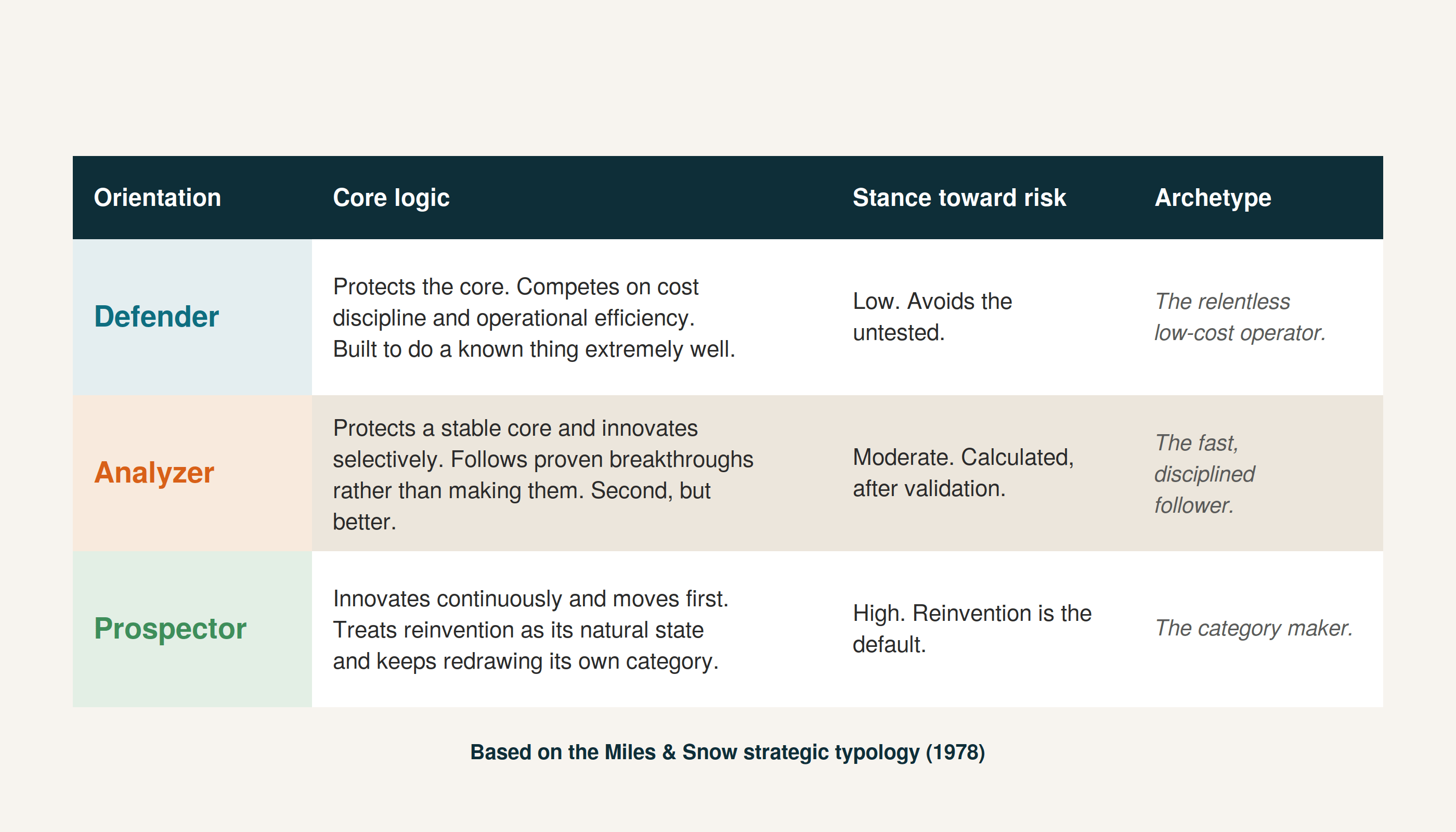
There is a fourth pattern, but it is not a strategy. The Reactor is what appears when an organisation solves its problems inconsistently, declaring one thing and rewarding another. The Reactor is not a fourth way to compete. It is a warning light. It is structural hypocrisy showing up as a type: the organisation’s subsystems out of harmony with each other, which is exactly the third Ansoff proposition failing in plain sight.
None of these orientations is better than the others. A Defender in a stable market is perfectly placed, and a Prospector there is burning money. The character is only right or wrong relative to the ambition it has to carry and the turbulence it has to survive.
The posture gap
Now both instruments are on the table. Ambition says where the organisation wants to go. Orientation says who it is today. Lay one across the other and the second layer of the gap appears.
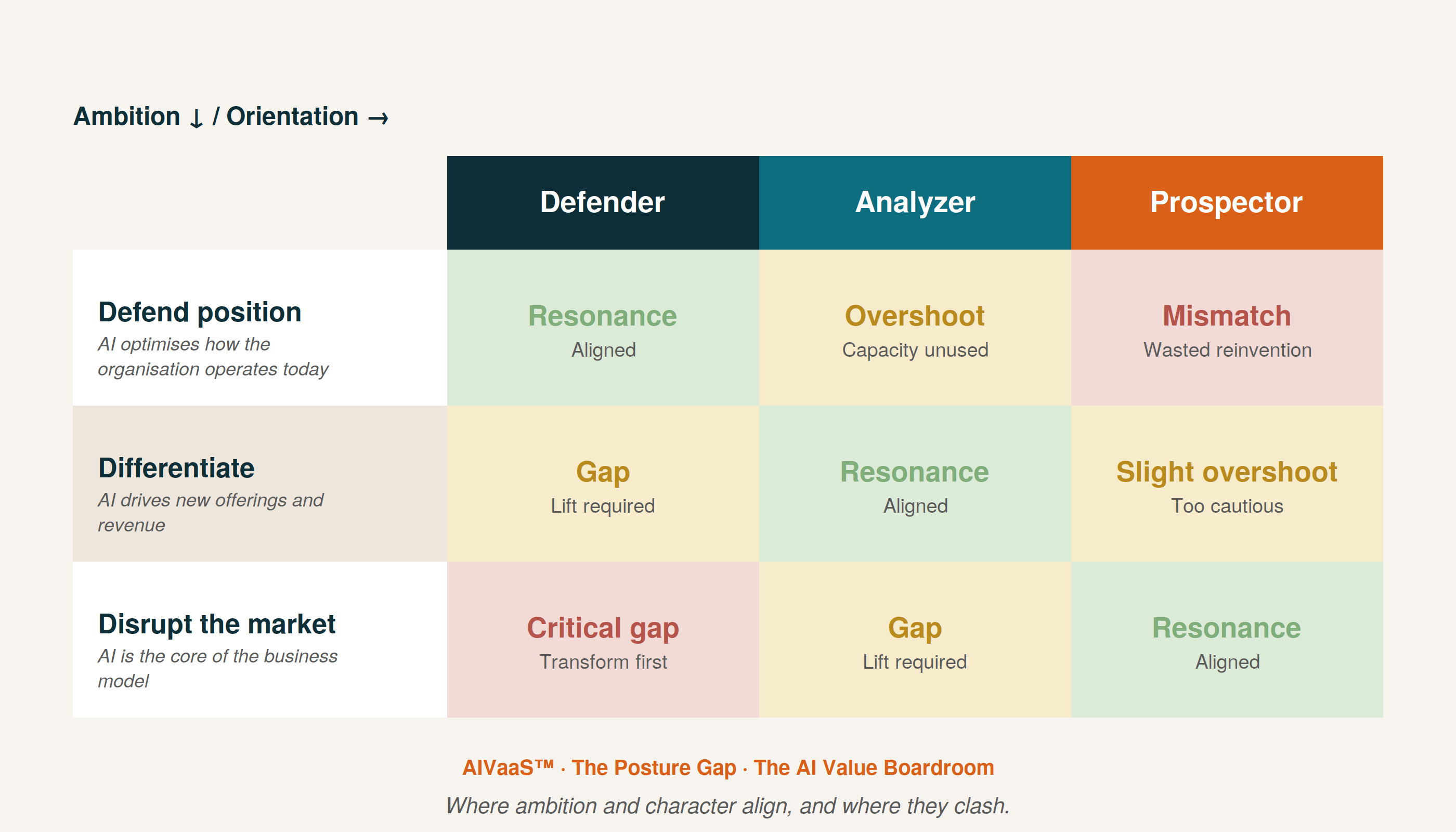
On the diagonal, the cells resonate. A Defender pursuing a defensive ambition, where AI optimises how the organisation already operates, is aligned. A Prospector pursuing market disruption is aligned. Off the diagonal, the gap opens. A Defender reaching for disruption is the most dangerous cell on the grid. The ambition demands continuous reinvention, high risk tolerance, decentralised decision-making. The character supplies cost discipline, low risk, central control. The organisation is not lazy and not wrong about where the market is going. It is structurally unable to get there with the character it currently has. The ambition is real on paper and impossible in the building.
This is where the AI ambition levels meet a hard threshold. L1 and L2 keep AI inside existing work. AI supports people, or it augments existing processes, but the operating model and the business model stay as they are. A Defender or an Analyzer can carry that. The critical leap is between L2 and L3. At L3 and above, AI begins to drive outcomes the organisation could not produce before: new offerings, new business models, a repositioning in the market rather than an optimisation inside it. That leap is not technological. It is a leap in character. The table below maps each level to the orientation it requires.
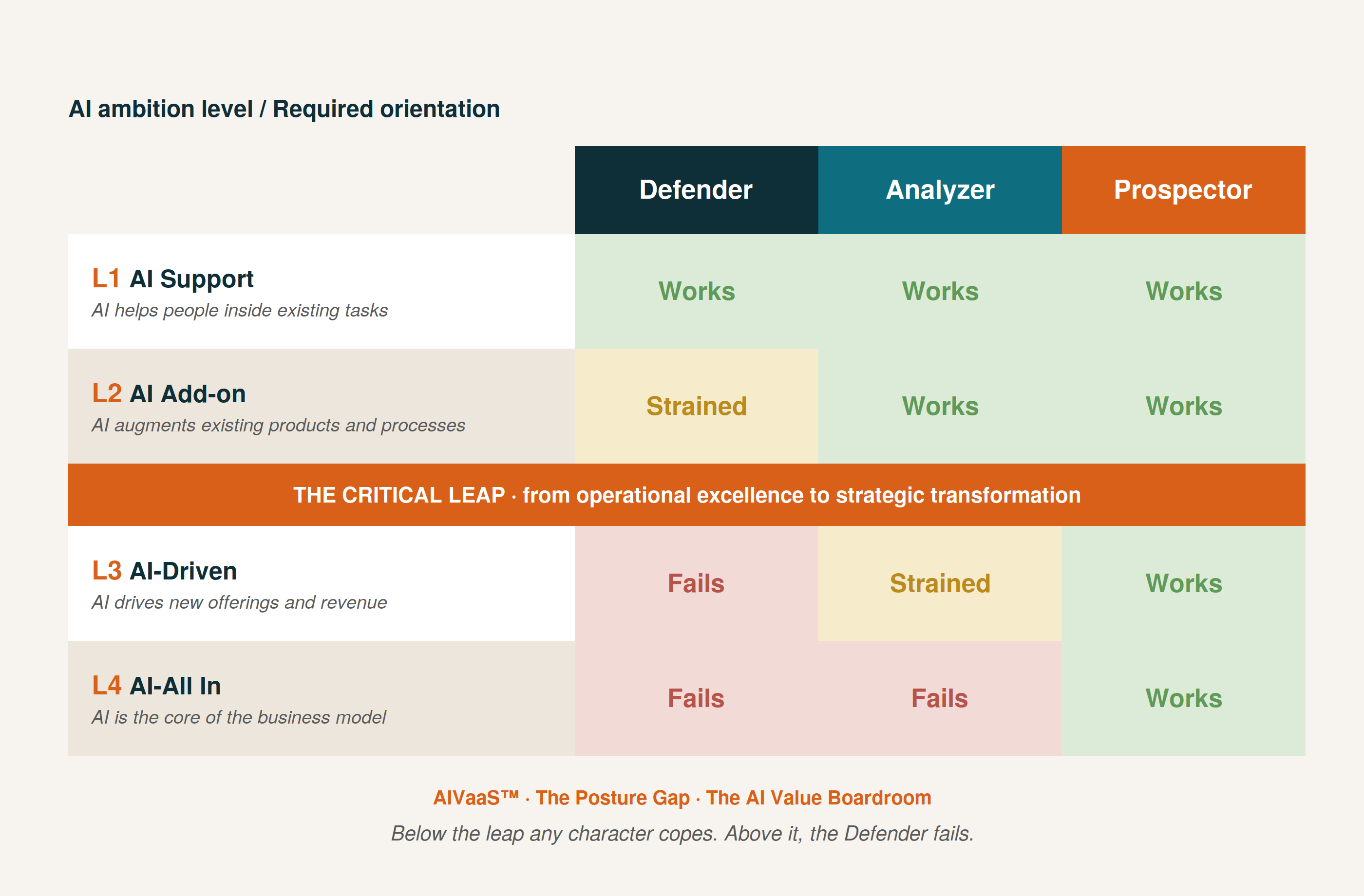
Below the leap, almost any orientation can cope, because AI is only making the existing organisation faster. Above it, the Defender orientation runs out of room. An organisation reaching for L3 or L4 with a Defender character is attempting the most common and most expensive failure in AI transformation: trying to jump from operational excellence to strategic transformation without the disposition that strategic transformation requires.
The gap between where the organisation wants to go and who it is today is its strategic posture gap. Its value is not that it judges. Its value is that it shows what has to change first, before any AI project is worth starting. Close the posture gap and the ambition becomes credible. Leave it open and every initiative downstream inherits the misalignment.
Two layers, one reading
So the gap that the previous article left open is not one gap. It is two, stacked. The first layer asks whether the organisation aimed high enough for the environment it is actually in, the environment whose turbulence AI keeps raising. Aim at L2 in an environment that now demands L3, and the misalignment is there before character is even considered.
The second layer asks whether the organisation’s character can carry the level it aimed for. Reach for L4 as a Defender, and the ambition cannot survive contact with the organisation that has to deliver it.
A credible ambition has to clear both. High enough for the turbulence. Matched to the character that has to execute it. An ambition that clears only the first is a wish exposed to the market. An ambition that clears only the second is comfortable and slowly fatal. Only when both layers close does ambition stop being paper and become something the organisation can actually do.
Closing the gap is not the same as lowering the ambition to fit the character. That is the wrong move, because the turbulence does not lower with it. The gap can also close from the other side: by reshaping the character to carry the ambition the environment demands. Character feels permanent, but it is not. It is built into systems, incentives and leadership behaviour, and what is built can be rebuilt.
Why this matters for Ana
In the stories that opened this series, Ana is the customer the organisation serves today, and the child she carries is the customer of the next economy, more intelligent still.
Reading Ana from the outside was the whole point before, because the shift around her runs through every dimension of the economy. This article adds the harder half. Reading Ana is not enough. An organisation can see exactly what she will need, and exactly what her child will need, and still fail to deliver any of it, because the organisation that has to build it is the wrong character for the ambition that serving her requires.
Ana never sees the ambition the organisation chose for itself. She sees only the organisation that actually serves her. The level on the page is invisible to her. The experience is not. Serving tomorrow’s Ana is not a question of ambition. It is a question of whether the gap between the ambition and the organisation was closed in time.
There is a free way to begin. The Strategic Posture Assessment reads an organisation's character against the AI ambition it has set, so the gap between the two becomes visible before any project starts.