


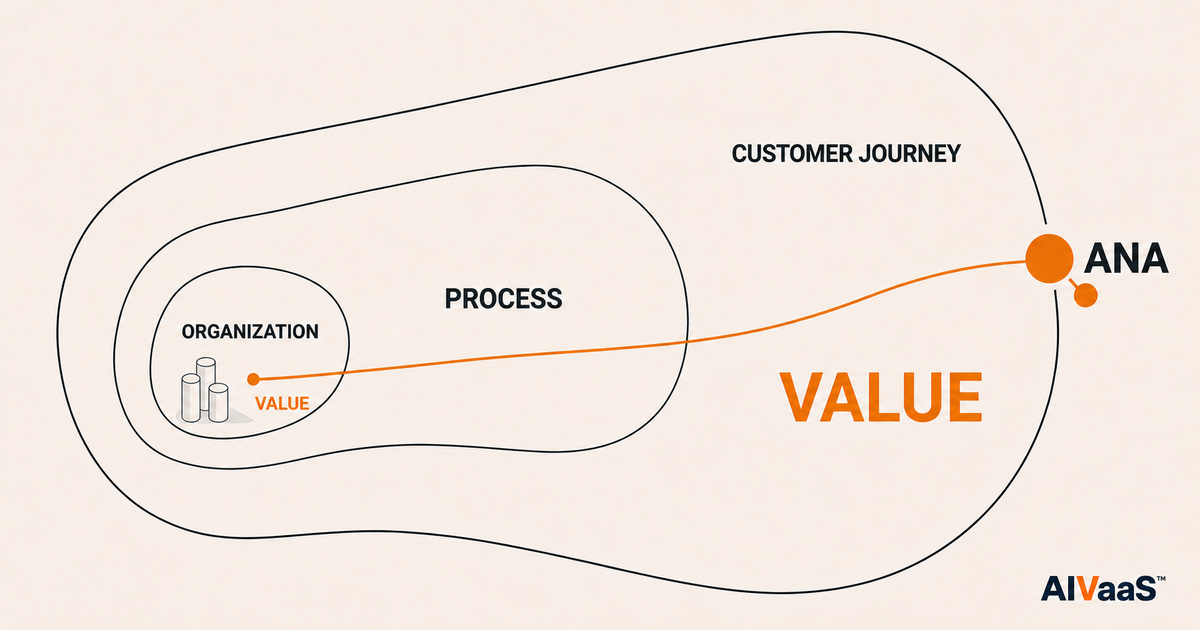
In AIVaaS™, orchestration is not the coordination of agents inside the organisation. It is the synchronisation of the organisation’s flow of value with the customer’s own. That is where the depth of co-creation is decided, and where the value that returns to the business is decided with it.
Most organisations running agents today can answer one question about them without hesitation. What does the system do? Fewer can answer the second one. What does it do for the customer, and where in their life does it land?
Both questions are fair. Only the second produces value anyone outside the company can feel.
The distance between them is not a gap in technology. It is a gap between two flows. A business runs a flow of value from a signal to a delivered result. The customer runs a flow of their own, from a need to the result they were actually after. Theirs is longer than ours, it started before our first contact, and most of it is invisible from the inside.
How deeply AI co-creates value with a customer is settled by how much of that flow the orchestration was designed to see. What a business orchestrates is its own side and the connection between the two.
The previous article closed by naming this as the next question.
The customer is running a flow of their own
Start with what the customer is actually doing, because consumption is not an event. It is a process. They recognise a need, search, compare, choose, acquire, use, maintain, and eventually replace. Every one of those steps costs them time and effort.
Give the two sides equal standing and the picture changes. One flow contains everything the customer has to do. The other contains everything the provider does. Walk theirs backwards from the customer, walk ours forwards from the business, and study where the two meet and where they miss. What the combined view exposes is the time the customer loses inside a process that was designed only from the inside.
Two flows meet at every customer, and only one of them belongs to the business.
A journey map is a different artefact. It shows how the customer lives that flow, the moments, the friction, the feeling. The flow of value asks a colder question. What must the customer actually do to reach their own result, and what does each step cost them?
Both are needed. Only the second one prices that effort, which is the part a business is most tempted to overlook, because customer effort never shows up in its accounts.
The level you design from decides how far out you can see
An earlier AIVaaS™ article set out the five process levels an organisation runs on, from the landscape of its main processes down to the tasks a system executes. Those levels describe our side of the encounter, and they settle something about the other side that is easy to miss.
A system designed from the level of tasks can see tasks. The customer’s path is not in its frame, so no quantity of data will place the customer there. A system designed from the level where value is understood carries the customer’s flow in its frame from the start.
The level is therefore not a question of granularity. It is the reach of the design, and the reach is measured in how much of the customer’s path the system can see at all.
Orchestration that runs inside the organisation’s own flow automates. It executes faster, routes better, fails less. All of that is real, and the customer notices almost none of it.
Orchestration designed from the customer’s flow co-creates. It knows which step of that path each internal activity exists to serve, and what has to happen on our side for the customer to take the next one.
Depth, then, is the distance the design travels in the customer’s direction.
Business architecture has a plain test for it, and it requires no new method. Lay the customer’s flow against ours and connect them stage by stage. A touchpoint unsupported by an organisational response is a probable gap. An internal activity with no traceable contribution to customer value, business value, a required obligation or an enabling capability is a candidate for waste.
The test exposes two different failures, and the second is the more serious. In the first, both flows are present and out of step. In the second, we are simply absent from a stretch of that path, and absence leaves no trace in our systems to investigate. Research combining journey analysis with process mining found a case of exactly this kind, where two of the customer’s touchpoints were run by a partner and the main provider did not know they existed.
A value flow does not simply replace itself. It branches
Look at this through Ana, who stands in this publication for a customer in a specific situation.
Ana has bought from the same company for eight years. Steady, loyal, well understood, well served. Then something in her life reorganises itself and the shape of her path changes. She named it herself, more precisely than any framework would: she will probably start buying completely different things now, and she does not yet know which.
The tempting reading is that she has become a different customer. She has not.
Her old needs are still there. A new branch has been added beside them, and the order of priority between them has been rearranged. The company that has served her for eight years is serving the same person. What it has lost is the shape of her path.
Ana remains one customer, and her change matters before it becomes anything larger. At first it is a signal, not yet a pattern.
Where that signal can be seen at all is decided by the level. At the level of tasks and workflows Ana is a record: a purchase, a gap, a silence. At the level where value is understood, the same event carries a shape, a sequence and a consequence.
When the same branch begins to appear across many customers, it becomes a business opportunity, without turning any one of them into an average. And it becomes visible only from the level where somebody is reading her flow rather than ours.
A new branch also rarely stays with one supplier, because the needs that open on it are covered by several organisations at once. Value on such a branch is assembled across an ecosystem rather than delivered by a single provider, which is a subject of its own.
What the data has to notice
Both flows used to be drawn by hand, once, by walking and watching. For a long time there was no other option.
There is one now. Parts of her path leave traces a business can legitimately see, and our processes leave event logs, which means the two can be compared continuously instead of in a workshop every few years.
Process mining calls this the difference between the model as designed and the model as it actually runs. Turned outward, the same comparison shows the difference between the journey we assumed and the journey she is walking. When the two drift apart, something in her flow has changed, and the drift is measurable before anyone has interpreted it. A drift is a signal, not yet a confirmed need.
This is the work of the process analyst, and it is not the work the title usually suggests. Not someone documenting tasks at the bottom of the hierarchy. Someone who sets the process architecture, who reads the customer’s flow from the outside in, and who in the AI era does it through data rather than through interviews alone.
That person builds two things. An alignment between the internal flow and the external one. And a running loop that notices when the external one has changed, locates where new value now appears on the new branch, and drives our own processes and decisions to meet it.
Three things change once this runs on data rather than on recollection. Scale, because thousands of individual flows can be read at once instead of one segment average. Speed, because a branch becomes visible while it is forming rather than at the next annual review. Precision, because the system can locate where on her path the new value appears, and not merely report that something has moved.
For Ana that adds up to something modest and specific. Fewer steps of her own, and less of her time spent explaining a new situation to an organisation that should have noticed it.
What the loop must not do is decide on her behalf. A detected branch is a hypothesis about a person, not a conclusion about her, and the right response is to make contact and find out, rather than to fire an offer at an inference. AIVaaS™ already places a human at the decision points where the unexpected arrives, and this is one of them. Ana was understood because someone picked up the phone, not because a model produced a recommendation.
There is a second reason to keep the loop open at that point. If the value on the new branch is genuinely new, the catalogue does not contain it yet. Detection then feeds design rather than sales, which is where new offers and new business models begin.
One further thing changes as AI takes a larger part in this. A service blueprint remains a model of the service. An adaptive AI-enabled service can change its path while it operates. Alignment therefore cannot live only in a diagram. It has to become a capability the organisation continuously operates.
Value returns when hers completes
There is a reason this matters beyond the customer.
Her result is not automatically our result. Value becomes business value only when her completed flow returns as revenue, retention, lower cost, or a position a competitor cannot easily take. That return has one precondition, and it is not negotiable. Her flow has to turn. From a need, through her own steps, to the value she was after.
Everything the organisation orchestrates internally exists to make that turn happen sooner, with less of her time and less of her effort.
One boundary belongs here as well. Her flow is hers. A business can understand it, support it and adapt its own response to it. It cannot orchestrate it. What it orchestrates is its own flow, and the connection between the two.
The ecosystem value flow, where several organisations serve the same customer flow at once and none of them holds the whole picture, has an article of its own ahead of it.
The question in front of most organisations is smaller and closer. Ana is walking a path she has not walked before, and she does not yet know what she needs.
The depth of your AI answers one thing only. How much of that path you are on.