


In AIVaaS™, Process & Data Readiness is not the technical audit most writing describes. It is the business logic of processes and data that determines whether AI improves isolated workflows or transforms how the business understands customers, makes decisions, creates value and operates end to end.
Boards no longer ask whether prepared processes and data matter for AI. The conversation has moved on: what is missing, and when will we be ready?
The answers arrive in a technical register: data quality scores, integration roadmaps, process documentation, a programme plan with milestones and a budget line.
Then one voice asks: AI-ready for what?
The question returns to the board. Readiness only has meaning against the level of AI ambition the business has chosen and the strategic directions it has committed to. Without the why, the what, the how and the when have nothing to lean on.
Naming the why is leadership work, the same accountability the previous article placed with leadership for how far AI may go .
The why is one half of what must come before the execution layer. The other half is the connection between processes and data, which most readiness models read separately.
Processes show where value should flow, where decisions belong and where customers are met. Data shows whether value is actually created, which decisions are made or missed, and where customer needs surface, including the ones nobody has voiced yet.
Processes and data give value to each other. Read together as business logic, they make the why testable: the value the business has committed to has to show up in real processes and real data before anything turns into use cases, prototypes and build decisions.
Readiness has a reference point
Readiness is a state of preparation, and preparation is always for something. In AIVaaS™ that something has two names: the level of AI ambition, set through Ambition Fusion, and the strategic directions committed in the AI-Infused Business Strategy.
The reference point reaches wider than AI. A new business model, a new market, a sustainability commitment, an acquisition to integrate: every strategic direction eventually lands on the same two carriers, the processes the business runs and the data it holds.
At pilot scale the missing why stays hidden. The first two levels of AI ambition improve work that already exists: AI supports people at tasks or augments running processes. The present operation serves as the reference point, and technical readiness can carry the effort.
From the third level on, AI drives outcomes the business has never produced before. Their reference point does not exist in the present; leadership has to name it before the work of readiness begins. The wider the change AI brings, the earlier the naming has to happen.
When the why stays unnamed, the loss is quiet: months, budget and the goodwill of capable teams, spent on precision without direction. Operational teams feel it first. They carry the task of readiness, and the starting point they need sits with the board.
The 2026 evidence points one way. PwC’s AI Business Predictions put technology at roughly one fifth of an AI initiative’s value; the rest is created in redesigned work. Deloitte and BCG find the same pattern among the leaders: redesigned roles, decision rights and end-to-end processes.
Readiness in AIVaaS™ is more than this article’s element. The whole preparation is one formula: Business AI-Ready = Business-Ready + Organization-Ready + AI-Ready + Implementation-Ready.
The formula exists to protect the why. Each term checks readiness against the same reference point, so the ambition named at the start is still the ambition being built at the end. Process & Data Readiness opens its AI-Ready term.
An organisation has more process levels than it thinks
Ask for the process map and most organisations bring workflows: task sequences in an IT system, an approval chain, a wizard guiding a user through steps. Useful, real, and the smallest part of the picture.
Processes run on five levels. At the top sit the main business processes: the end-to-end value streams of the business (from order to cash, from idea to product). Below them, the value-adding phases where customer value takes shape, and under those, the individual processes a manager can own.
The fourth level, subprocesses, breaks a process into measurable steps, with rules, metrics and decision points. Only the fifth level, the tasks, holds the work people and systems execute in sequence. That is where workflows live.
A workflow executes, and every task in it has a performer responsible for it. What it lacks is management. Its goals, its rules and the monitoring that notices a wrong outcome and corrects course all live on the levels above.
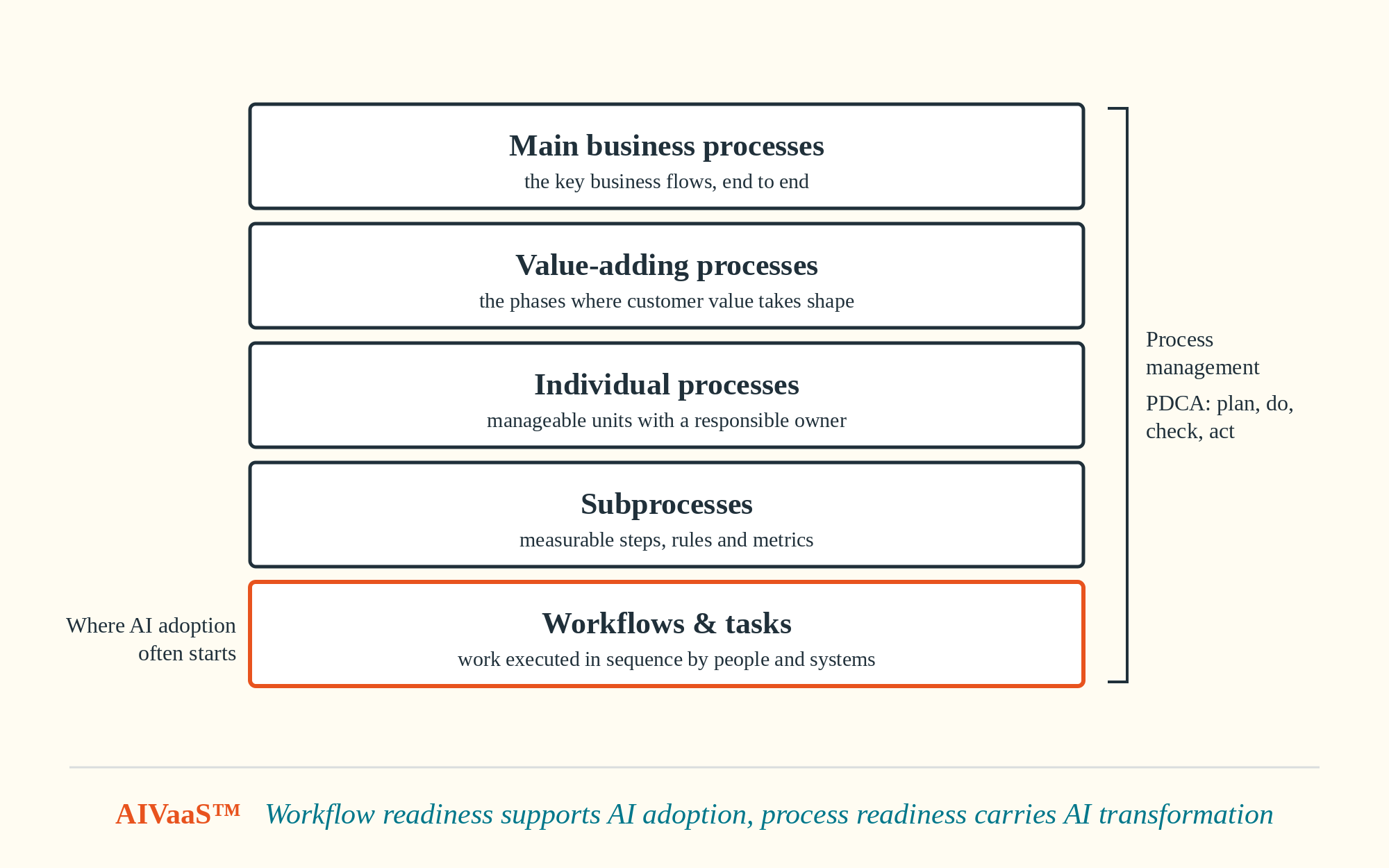
Most AI adoption enters here, into tasks and workflows, and inherits their limits. It executes faster, drafts faster, routes faster, while the decisions above stay untouched. In ambition terms, that is L1, AI-Support. Workflow entry is enough for it.
L2, AI-Add-On, already asks for more. AI layered over an end-to-end process improves only what the business sees whole: the value stream, with every phase and handoff inside it.
Above the workflows sits the business logic of processes, and it faces two directions. Inward: ownership, business rules, decision points, and the management loop of plan, monitor, correct.
Outward it faces the customer journeys the processes exist to serve. A journey reads as a process too: stages and touchpoints, each backed by an end-to-end flow, each a moment of truth where value is won or lost.
Decision points deserve special attention. They sit before and after workflows, deciding what enters them and what their output triggers. A workflow executes a decision made elsewhere. Where that decision happens, and on what basis, is process knowledge AI will need.
One management axiom seals the point. W. Edwards Deming taught it; Russell Ackoff formulated it most sharply: parts made to perform as well as possible, each on its own, do not produce a whole performing as well as possible.
Workflows optimised one by one do not add up to an optimised value stream. And the value stream reaches beyond the organisation: the whole a customer experiences is the junction of the customer’s processes with ours. Readiness that stops at the company boundary prepares half of the whole.
Data that does not know what it means
Where the customer’s processes meet ours, data faces its real test: the same accurate records can carry two opposite decisions about one customer.
Ana, the customer this series has followed from its opening stories , is about to be on the receiving end of one of them.
Ana has been a customer for eight years. Then, for three days, silence. The organisation holds every transaction she has ever made with it, and one of the latest is a pharmacy purchase: a test.
An agent reads the silence as a reactivation case: high probability of return, queue a discount. Every value in its records is accurate. The meaning that runs across them, a life about to change, is not a field in any table.
The usual response is technical: better quality, cleaner pipelines, a unified platform. All of it matters, and later articles will give the technical side its space. None of it changes what the records mean.
In AIVaaS™, the business logic of data comes first, and it stands on three members: the decisions the data must serve, the customers it must reveal, and the semantics that makes both possible.
The first member connects straight back to the process map. The decision points identified there define which data matters, at what moment, in whose hands. In the scene above, the decision was whether to send the discount or to pick up the phone.
The decision member carries two blind spots, both business rather than technical. The first is what the business does not know: signals never collected, signals held and never read. No system knew what the test had shown. That knowledge arrives only when the business is present to receive it.
The second is sharper: the decisions that should have been made and were not. Systems record executed transactions. The call never placed, the option weighed and dropped, leaves no trace. Gartner’s 2026 work on decision traces and context is an early attempt to capture this.
The second member is the customer. Steve Jobs liked to say that people often do not know what they want until someone shows them. Data with meaning is how a business shows them: read against the journey, it surfaces needs forming before the customer voices them. Ana’s records held one.
The third member, semantics, makes the first two possible. It is the shared business meaning of what the data describes: what a customer is, what an order is, what a silence is, and how they connect across systems.
Gartner now ranks the semantic layer as critical infrastructure for AI. The reason fits one sentence: systems act on the meaning they are given, and where none exists, they act on probabilities. A discount for a life moment is what that looks like.
The question for the data organisation grows. Clean and complete stay necessary; the bar above them is meaning: which decisions the data serves, which customer needs it reveals, which value it makes possible. That is data readiness read from the why.
The layer in between
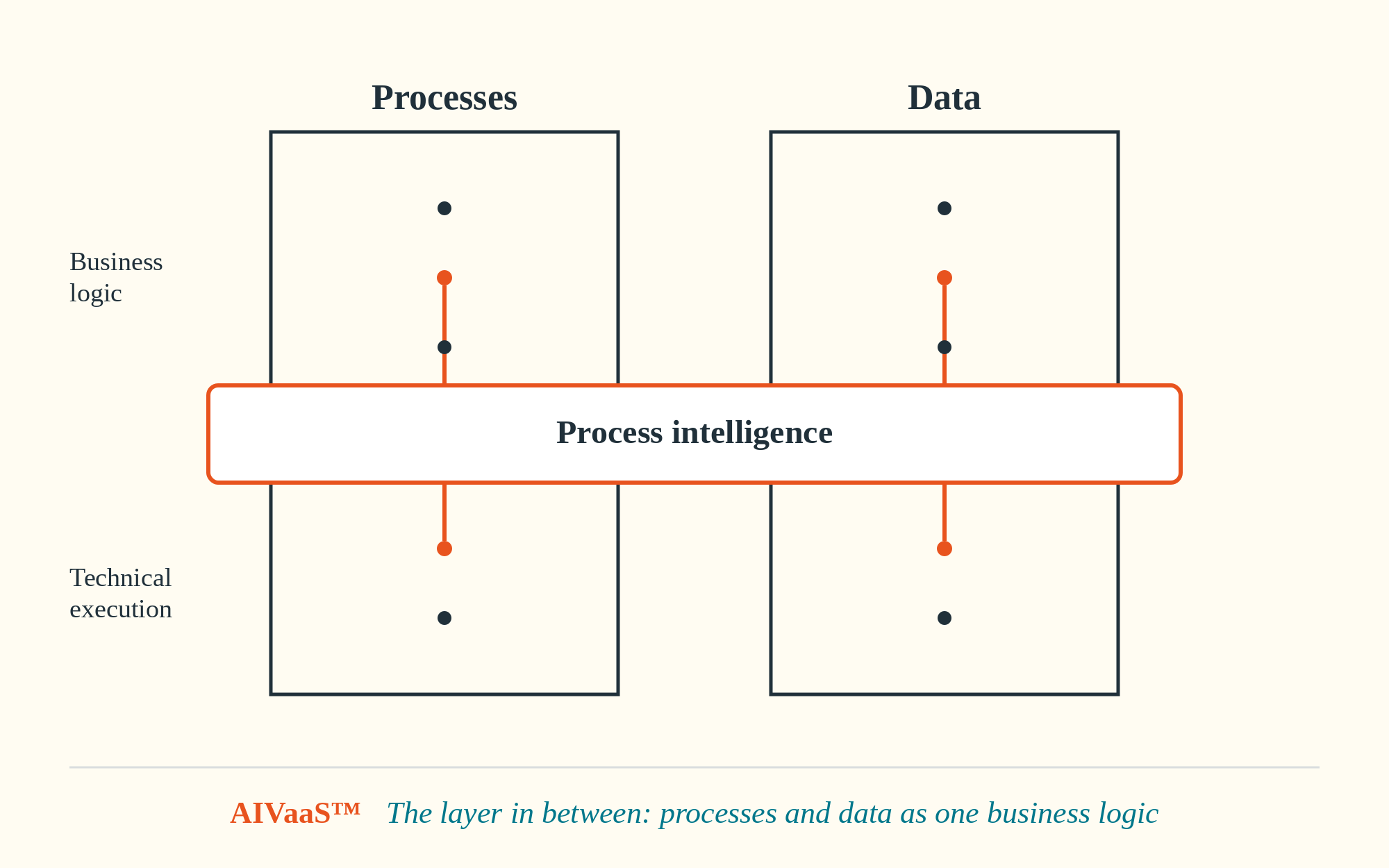
Business logic above, technical execution below. The two layers of preparation meet in the middle, and that middle is where organisations see their processes and data as one for the first time.
Process mining reads the digital traces work leaves in IT systems: timestamps, approvals, handoffs, exceptions. From those data points it reconstructs the process as it actually runs, in all its variants and workarounds.
The mirror is rarely flattering. Organisations discover their one designed process living dozens of parallel lives. What leadership believes about the operation meets what the event data shows, and the gap between the two is measured, in delays, rework and cost.
The market has moved with the need: Gartner now frames the field as process intelligence, platforms that combine mining, analytics, modelling and monitoring into one management layer over end-to-end flows.
Business intelligence answers what happened: which numbers moved, which targets slipped. Process intelligence answers how and why, because it keeps the sequence: which step produced the delay, which decision routed the case wrong, which handoff lost the customer.
The same traces read further. Object-centric mining follows the order, the delivery, the invoice and the complaint as they interweave, and journey-to-process analytics joins the customer’s experience data with the operational data behind each touchpoint.
That last connection makes the junction of the customer’s processes and ours visible: the moment of truth a customer feels, linked to the exact flow and step that produced it. Friction stops being an opinion and becomes an address in the process.
One layer, then, proves the article’s claim in practice. The process lives in the data, and the data gains meaning in the process. Davenport and Redman reach the same conclusion in Harvard Business Review: process management and AI reinforce each other, each making the other more valuable.
For the why, this layer is the proving ground. AI opportunities infused into strategic directions meet here the processes they must change and the data they must run on, while they are still opportunities, before they become AI use cases, prototypes and builds.
This is what stands between the why and the execution layer. Above it, ambition, strategic directions, processes and decisions. Below it, workflows, datasets and AI solutions. In between, the place where both sides meet.
One final test: the decision
Among everything the process levels map, one thing matters most here: they show where the business decides. The data members show what it decides with. A decision needs both at once. Preparing them in two separate audits prepares two halves of the same capability.
Most writing about decisions and AI starts at the operational level: which offer to show, which case to escalate, which route to take. Real, useful, and downstream.
The first decisions sit higher. What the business wants from AI, at which level of ambition, with what transformative intent: set where ambition fuses with strategy. Every operational decision inherits its direction from there.
The decision inventory looks in three directions. The decisions made today. The decisions the business does not know it should be making, invisible until someone maps where deciding belongs. And the decisions ahead, created by the ambition, each arriving with changes to prepare for.
So the test of readiness reads from the top down. Which decisions, today’s and the coming ones, will carry this ambition. Where in the processes do they live, or will they live. Does the data give them the meaning to act on. The decisions define which data is needed, never the reverse.
Value creation is the starting point. Processes and data are the connected lenses through which the business makes value creation understandable for AI.
The leap beneath the leap
AI ambition in AIVaaS™ draws one critical leap, between L2 and L3: below it, AI improves how the business operates today; above it, at L3 and L4, AI drives outcomes the business could not produce before. The leap is decided at the top. And a decision at the top does not land by itself.
This strategic leap has leaps beneath it, and this article has been preparing one of them: the leap of processes and data. Without it, the ambition above has nowhere to land.
Below this leap, AI improves isolated workflows. The gains are real: faster execution, fewer errors, lower cost. They are also temporary, and open to every competitor buying the same tools. Improvements like these settle into the new baseline of the industry.
Above it, everything assembled so far becomes one ground: processes known down to their decision points, and no longer only the internal ones. The outcomes above the leap, new offers, new ways of serving, live in the customer’s processes.
Data that carries meaning, one layer joining both worlds. On that ground AI begins to change how the business understands customers, makes decisions, creates value and operates end to end.
Orchestration is the nearest test. AI agents already work across processes, handing work to each other, deciding in sequence. They can cooperate only inside a shared frame, a constitution or a harness: the rules of the business, the boundaries of autonomy, the meaning of everything they read.
Here semantics stops being one member among three and becomes the precondition. One discount for a life moment is a single mistake. The same misreading, executed by a network of agents across every process, becomes the operating model.
Field evidence from 2026 agrees. BCG places the value of agentic AI in processes redesigned end to end, and names the technology and data foundation as the common blocker at scale. Deloitte counts roughly one organisation in five with a mature governance model for autonomous agents.
Above the leap something else opens as well. Customer needs read from data, including needs no customer has voiced yet, are where new offers and new business models begin. That is the next element of the third pillar, with its own article ahead.
The leap above is decided in ambition. The leap beneath decides whether it lands.
The ultimate why: Ana
The discount was never sent.
The agent had followed the workflow: silence, reactivation case, discount. The human at the decision point above followed the customer: eight years of loyalty and three days of silence deserved a voice. Call her.
The agent did not sell. It listened. And Ana told it what no system could have known: three days earlier, a test had shown two lines.
Congratulations, said the agent. No discount, no recommendation. It noted a life moment, paused the automated nudges, set its tone to warm and patient. Presence, executed by a machine, decided by the business.
Then Ana said the sentence every executive waits for: she will probably start buying completely different things now, she does not yet know which.
A need no customer has voiced, forming in real time. The new offers above the leap, and the value they carry, begin exactly here, in a customer’s process the business was present for.
Readiness made the difference, end to end. The why, set in ambition, gave the direction. The process knew where the decision lived. The data caught the signal. The layer in between connected them. And the agent acted on the meaning it was given.
One link in that chain stays human. The stories behind this series call it the capacity to be surprised: a surprise turned into an algorithm becomes an expectation. Readiness for it means keeping people at the decision points where the unexpected arrives.
One day her child will be a customer, with data in the systems from the very first day. Serving that customer will raise the question this article started with, at full weight: ready for what?
Ana answers it better than any framework. Ready for the customer: for her processes, her moments, her needs before she can name them. Everything else is the execution layer.
The AI Value Boardroom builds the AIVaaS™ methodology article by article. The next element opens where this one closed: customer needs, read from data, becoming new offers and new business models. Subscribe free to follow the arc from ambition to the ground it lands on.