



In AIVaaS™, AI is approached as a business transformation and not as a technology deployment. The goal is an AI-Infused Business in which AI becomes part of how the organisation creates, delivers and captures value.
This publication has run two series. The first was five stories about a room where people argue about AI, and about Ana, a customer the systems knew only through data. The second was nine weeks of articles building AIVaaS™ element by element, the approach for turning AI ambition into value.
Before the second series began, the promise was that nine weekly articles would stand for nine months. Ana has reached the end of them.
This article connects the two series and tests whether the connection holds. The stories were written first, and they left questions on the whiteboard without answering any of them. The methodology answers them, one element at a time, and almost every question the room asked turns out to have an element with its name on it.
The room has a whiteboard covered in arrows. Someone says it looks like the London Underground. Harrison Chase agrees, and adds that the map does not determine the destination. It only makes sure you do not miss your stop. [LINK Story 1]
AIVaaS™ is a map of that second kind: three pillars, fifteen elements, a foundation beneath them, and one formula that connects it all. The nine articles walked the map element by element. This article walks it from the ground up, and stops six times.
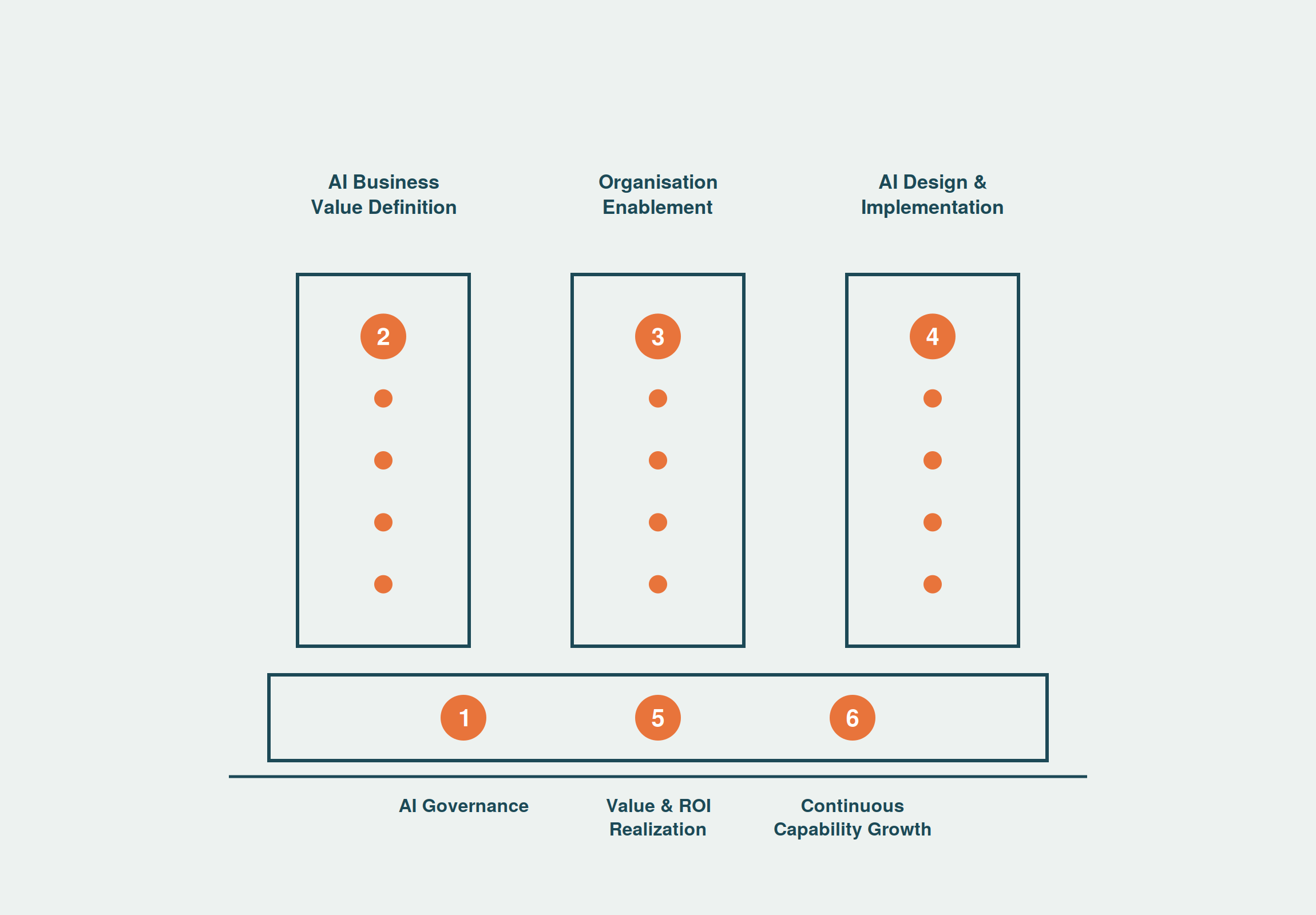
Each stop opens with what the method says and who is accountable for it, then returns to the room where the same question was already on the board. Ana closes each one. Organisations invest in AI, and Ana keeps score.
New here? Ana and the room are introduced in Story 0. She is the reason the methodology exists, and the methodology itself opens here.
1. Governance begins by authorising ambition
In AIVaaS™, AI governance decides how far AI may go in creating value. Its first act is the authorisation of ambition. Ambition comes in four levels. At L1, AI supports people inside their existing tasks. At L2, it augments end to end processes. At L3, it drives outcomes the business could not produce before. At L4, it runs through the whole business strategy.
The critical leap sits between L2 and L3, because below it AI improves what the organisation already does, and above it AI changes what the organisation can offer, how value is created, and what competitors have to answer. That leap cannot be handed to a technology function. It changes the organisation’s understanding of value, risk, investment and future advantage, which makes it a leadership decision before it is a technical one.
Accountability for it belongs to the CEO, the board and the leadership team, and accountability of this kind is not delegable. The highest governance body is the board itself, extended with the roles that make transformation real: the Chief Transformation Officer, the Head of the Strategic Project Office, the Head of Enterprise Architecture, the Lead Business Analyst.
Governance holds all four terms of the readiness formula together, because transformation fails when the parts move at different speeds. One of those roles carries a map of its own. The Business Architect holds the design of the whole organisation and joins the business view to the AI technology view. They stand between the CEO on one side and the CAIO and HR on the other, because all three views have to end up in one picture.
The room asked this first. Story 1 opens with Harrison’s whiteboard and names its own limit: an architecture of movement, with no architecture of purpose behind it. The room had a map of how the agents move, and none of what they move through.
The same story ends with an empty chair, and gives the reason plainly. There is no business architect in the room, and nobody invited one. The story describes them as the person who knows why the company exists, and whether the orchestration supports that why or quietly erodes it. That is a description of the work governance cannot do without, written before any of the methodology was published.
Story 3 adds the other half. Mara, a synthetic persona built from a thousand customer interviews, answers precisely, with arguments nobody can immediately refute, and nobody checks whether she is right. She speaks with the authority of data.
AIVaaS™ answers with three tests of a reviewer. One who does not understand the output cannot produce judgement. One without authority cannot enforce it. A review step that records approvals and never disagreement produces neither.
So the reader has two things to check. Who knows the design of the organisation as a whole, and whether that design connects business requirements with AI technology well enough for a use case to stand on it. And whether the people signing off AI solutions can weigh the value they are signing for.
Ana appears in that article as the final test. Governance that produces a safer organisation the customer cannot feel has done only part of the job.
2. Value has an address
Value is relational. Something is valuable to someone, in some context, and an AI opportunity that cannot name the stakeholder it serves has no measurable KPI to stand on. Shorter handling time is value for a customer. Lower cost per transaction is value for an owner. Less repetitive work is value for an employee.
Prioritisation then becomes a decision about distribution rather than a ranking of attractive ideas. The Value Creation Matrix sets out four quadrants: Q1 cost savings, the hygiene factor that funds the rest, Q2 revenue growth and enhanced customer value, Q3 the radical productivity leap on the inside, and Q4 new forms of value, where differentiation and disruption live. Ambition sets the reach of the portfolio, because higher levels keep doing everything the lower ones do.
The portfolio is also the last checkpoint where the selection can still be steered, and it is where Ambition Fusion is verified in practice. Every opportunity that survives has to belong to the business strategy, because AIVaaS™ knows no separate AI strategy to retreat to. A portfolio drifting away from the strategy has already given its answer.
This is the work of the first pillar, AI Business Value Definition. Accountability sits with leadership together with the heads of business functions, and it produces the Business-Ready term of the formula.
The room reached the same point from two directions. Kambhampati looks at Mara and calls her the centroid of a data cloud, then names what a centroid can never show: the edges, the outliers, the customer who stayed loyal for ten years and left one day without a word.
Averaging a thousand customers produces a recipient who lives nowhere, and every KPI derived from that recipient measures nothing in particular. Mara was accurate throughout. She had no address.
Lakhani takes the marker in the same room and writes two words, Exploitation and Exploration, and says most organisations want the second and pay for the first.
AIVaaS™ supplies the mechanism. An organisation commits to L3, the portfolio fills with Q1 savings because those calculate most easily, and each one is approved on its own merits. A year later the portfolio says L1. Nobody voted against the ambition. The budget did, one approval at a time. And the observation gains an address of its own: an empty Q4 in an environment that demands transformation means no new business models are in design.
The reader can run this on a single artefact. Look at the stakeholder profile of the opportunity list. It reveals the actual ambition, whatever the strategy slide says.
Ana never sees the portfolio, the quadrants or the shortlist. She sees what reaches her.
3. The person who has to work differently on Monday
Value distributed on paper moves nothing by itself. AIVaaS™ reads every opportunity through the stakeholders it touches, one at a time, through four questions: what they gain, what they pay or risk in time, control or the job itself, how they see it, and whether their support is needed for the opportunity to work at all.
The third question carries the most weight and is skipped most often, because perception is what people act on. Underneath it sits trust, and trust is built from memory. Where earlier initiatives promised much and returned little to the people who delivered them, the next promise lands on that record.
The human veto is the quiet verdict that follows. The value of this AI belongs to the company, the saving belongs to the owner, the risk belongs to me. From where the employee stands, that verdict is rational, and it is exercised by withholding work rather than by objecting to it. Readiness at this stop is a state of willingness.
This is the work of the second pillar, Organisation Enablement. Accountability sits with HR together with managers and employees across the organisation, and it produces the Organization-Ready term.
And here the room says something about itself. Across four stories it held four external thinkers, a strategist in the corner, a synthetic persona, and the customer, first through a screen and then through a phone. It never once held the person whose work the orchestration changes.
The stories come close to naming it. Kambhampati, arguing for an AI critic on the team, says that when the critic is a machine nobody takes it personally, nobody is offended, and nobody goes quiet for the rest of the week after the meeting. Everyone in the room then thinks about the meetings they survived, where the truth was present and nobody said it out loud.
That silence and the withheld work are the same event at two sizes, and this is the lesson the stories were built to deliver. The veto is the decisive moment in AI transformation because it is exercised by the only person nobody asked.
A room can be full of people who understand how AI works and still be missing the one person who has to do the job differently on Monday morning. That room produces a plan that is correct on paper and thin in practice.
Lifting the veto runs on three moves held together: a vision leadership visibly owns, change management run through value rather than through steps, and an employee experience that raises engagement, because employees now see value that is theirs. AI literacy belongs here too, understood as judgement rather than tool training, since the human in the loop has to be able to think.
For the reader this is one action, taken earlier than feels comfortable. Before the next deployment is designed, find the person whose day it changes and ask how they see it. The answer changes the design, which is why it has to arrive while the design is still open.
Ana meets none of this. She meets a person, or a service a person built, and she feels whether someone cared. Employee experience and customer experience are two sides of one coin, and people who have quietly vetoed the change deliver her a thinner version of everything planned for her.
4. Readiness needs a why
Process & Data Readiness is business logic before it is a technical audit. Processes show where value should flow, where decisions belong and where customers are met. Data shows whether value was actually created and where needs surface, including the ones nobody has voiced.
Semantics gives the records their shared business meaning, and systems act on the meaning they are given. Where none exists, they act on probabilities.
The design of an AI use case then stands on two grounds. Its business ground is the Stakeholder AI Opportunity, which states what success means. Its architectural ground is the design of the organisation. Business Solution Design is the last point at which business intent can still govern the technical solution. [LINK A8]
This is the work of the third pillar, AI Design & Implementation, and accountability inside it divides in two. AI-Ready sits with the CAIO and the heads of business functions. Implementation-Ready sits with the AI architect together with the PMO, project managers, Business Analysts and implementation teams.
The Business Analyst carries the individual use case, from the need through the requirements into the design. The Business Architect carries the coherence check across the whole, which is the level the foundation works at.
The room supplied the evidence early. The first sentence of this publication describes a company that held all of Ana’s data and did not know her. Every record was accurate: eight years, loyalty score 94, a pharmacy transaction four days old, then three days of silence. The meaning running across those records was in no table.
Someone in the corner said two words. Call her. The agent listened, and Ana said the sentence that reorganised everything downstream: she will probably start buying completely different things now, and she does not know which yet.
Story 1 had already described the alternative. Andrew Ng is asked what happens if the instructions are wrong, and answers that the agent will then do the wrong thing exceptionally well.
A budget for data cleaning does not buy meaning. Map where the decisions live, and keep people at the ones where the unexpected arrives.
Ana does not experience an operating model. She experiences whether the business models made room for her new life.
5. The sum and the destination
Value matures through three states. It begins as potential value, the promise inside an opportunity. It becomes emerging value when design, prototypes and early use start producing evidence. It becomes realized value when a result arrives and lasts in daily business.
Each transition needs evidence, and evidence needs a baseline, criteria set in advance, and an honest view of how much of the result the AI solution may claim.
AI Solution Evaluation asks whether one solution delivers its expected contribution. Value & ROI Realization asks whether those contributions together move the AI ambition, and through it the business strategy.
The AIVaaS™ commitment is value for all stakeholders from the start, even when realization unfolds at different times. Where the commitment excludes some stakeholders from the start, the resistance returns later as the human veto.
A solution can reach every local goal and add almost nothing to the transformation. It can stay isolated, duplicate capabilities that exist elsewhere, or improve an activity while the operating model stands still. A sum of successful AI use cases is therefore not necessarily an AI transformation.
The portfolio has to be read as a whole, including enabling value: the reusable data, shared components and capabilities that later work will build on, which a narrow review would cut. Accountability sits with the CEO, the board and the leadership team.
Story 1 closed on this in one line, before any of the method was published. The risk is not that the orchestra plays wrong notes. It is that the orchestra plays the wrong piece. Every musician can be correct while the evening is lost.
In the article that covered this element, Ana was in month eight. The room prepared, the bag by the door, the route tested, everyone around her knowing who does what. She prepares because of the value that is coming, and every item on the list exists only because of it.
6. The one capability that must not become a routine
Readiness in AIVaaS™ is read at two scales, and the difference matters here. Business AI-Ready covers the organisation as a whole through the formula, with its four terms and their keepers. AI Solution Evaluation & Readiness covers one solution and the context it is deployed into. Capability sits below both, because it outlives every deployment.
Capability is the repeatable organisational ability to create and realise value across solutions, and most of it is business capability rather than technical. Continuous Capability Growth is the discipline that builds it, keeps it and extends it.
Reading the outside economy continuously, which the first article of the series already called an organisational capability and not a report. Fusing AI ambition into the business strategy and keeping the two aligned as both move. Finding the AI opportunities worth pursuing and choosing correctly among them. Designing new business models beside the running operation, which becomes a permanent capability rather than a one off exercise. Producing evidence that value arrived.
Trained people, a centre of excellence, purchased technology and a maturity score may support capability or describe it, and none of them proves it exists. It becomes real through routines, decision rights, institutional memory and the ability to transfer learning from one solution to the next. One question tests it. Would this capability survive if its main carrier left the organisation today?
It has to keep growing for two reasons. The forms and the scale of value the organisation pursues expand, and AI itself keeps moving. Accountability sits with leadership, with the Business Architect holding coherence across the whole.
And this is where the map runs out. In Story 4, after the call, Lakhani draws a circle and writes Presence inside it. Then the marker changes hands and a fourth circle appears: the capability to be surprised. The reason follows immediately. Surprise cannot be made into an algorithm, because the moment it is, it becomes expectation.
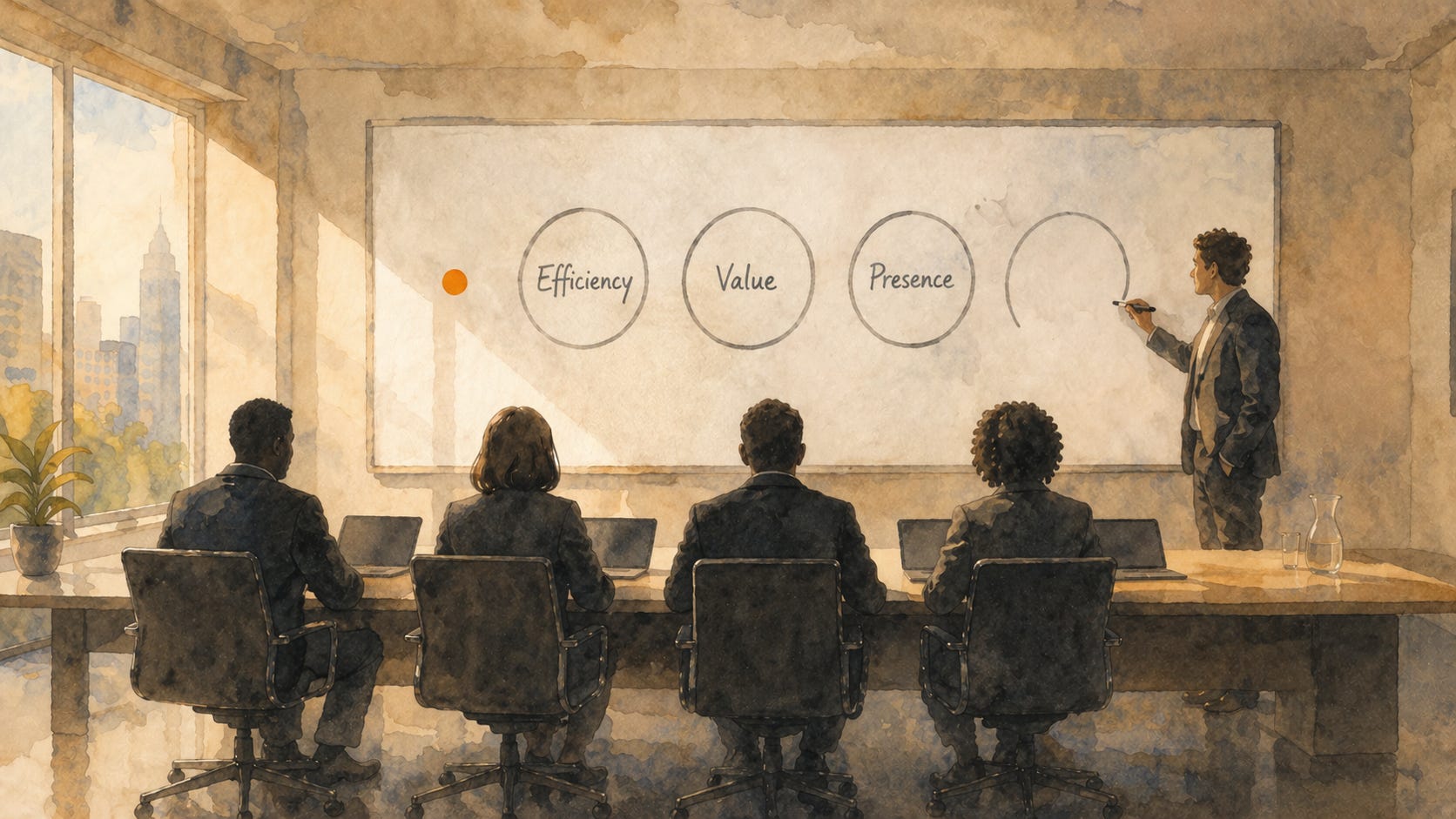
Every other discipline in AIVaaS™ exists to make good results repeatable, and to repeat them each time at a higher level. That rise is the fourth wall of this room, the spiral: the same questions returning from a higher level of understanding, with more to build on.
This one has to be protected from repetition. It is carried by a decision, taken by a living person, every single time, at the point where the system says that it did not know this and the organisation treats that as a beginning.
There is no element on the map that can take it over. That is the boundary the method draws around itself.
In the article that covered this element, Ana was days away. The value she had carried for nine months was about to get a face, and nine months of growing capabilities were only the beginning, because the child will keep asking for abilities she does not have yet. Organisations are no different.
Ana gave birth this week
Which is where her sentence on the phone comes due. A life reorganising itself into new needs, before any product has a name, and now the needs multiply and no single organisation covers them alone. The paediatrician holds one part of the picture, the pharmacy another, the nursery a third.
That is where this publication goes next. First to the process levels, and the question of how deep in the process hierarchy an agent system has to be designed before it understands what a customer treats as value. Then to the level above a single organisation, where value is created for the customer simultaneously by several actors, and to the canvas built for designing it.
Then back to AIVaaS™ itself, to the readiness formula, and to the roles this article has named without unpacking: the Business Architect, the Business Analyst, the Process Analyst.
Before that, a pause.
The child in this series is not mine. The methodology is. Nine weeks of articles were its nine months, and this week both arrived. I am taking a month of paternity leave.