


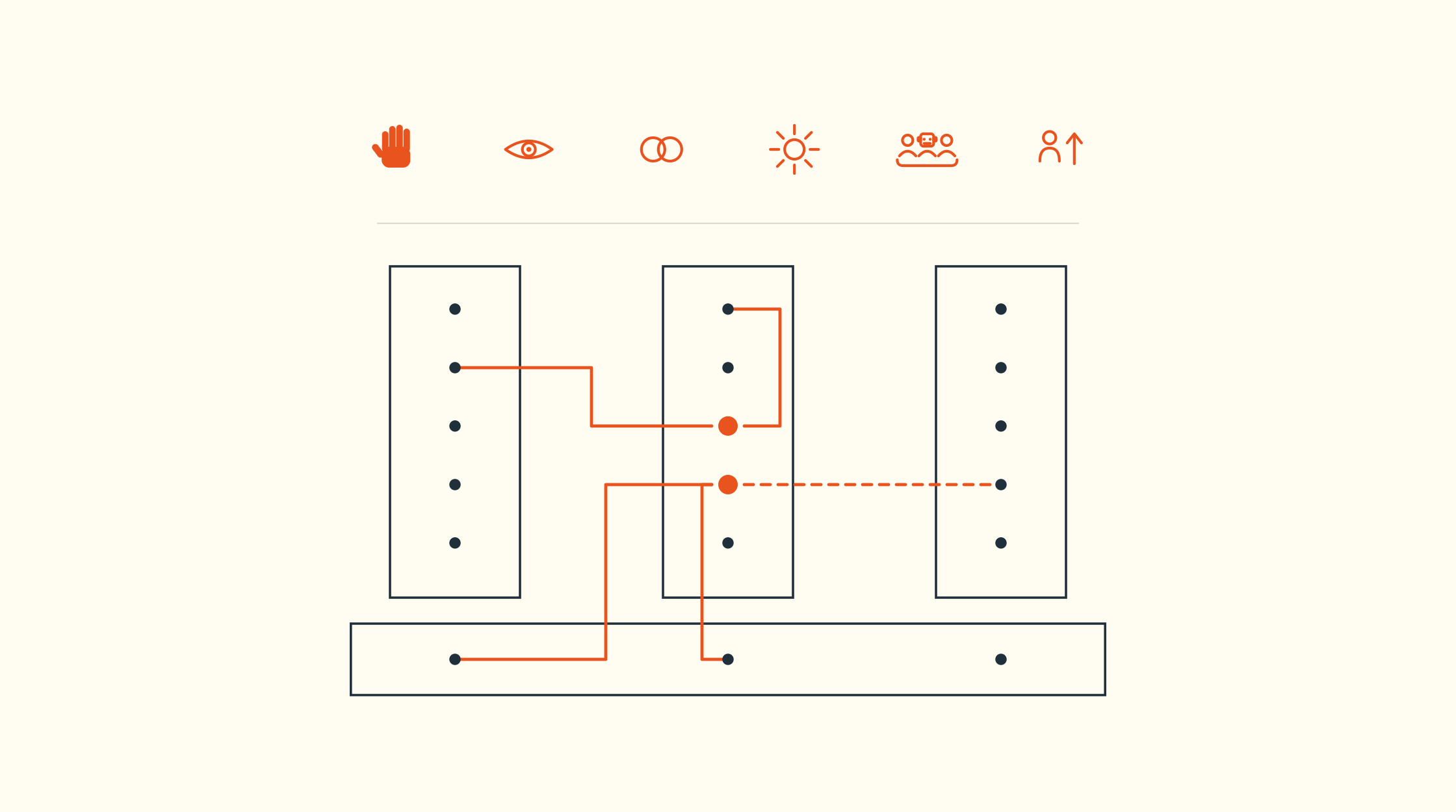
Four articles in, the series has turned AI pressure into value. The opening diagnosis named the failure. The next two read the economy from the outside and tested the organisation’s character, and AI Value Has an Address gave every opportunity a stakeholder it serves.
That portfolio completes the first AIVaaS™ pillar, AI business value definition. It is value on paper. Nothing on paper moves a customer, and nothing on paper survives contact with the employees who have to carry it.
So the methodology enters its second pillar, organisation enablement. The previous article left one question open: how each stakeholder perceives what is being planned for them. That question now decides everything.
And a person can decline. A portfolio that is net positive on paper still fails when one stakeholder reads it as a threat and quietly withholds the work.
Every AI opportunity the organisation priced carries a risk it did not price. The AI transformation has to be carried out and absorbed by employees, and any one of them can veto it.
The veto is a feature of ordinary organisations, where AI transformation arrives from above and employees are simply expected to accept it. In a young technology firm, however, employees adopt AI of their own accord, so the veto rarely arises. Most organisations, though, are not like this.
Where the veto begins
Distributing value across stakeholders was the last article’s work. It is necessary, and it is not enough. What decides whether the change is accepted is not the spread on paper, but whether each stakeholder sees the value as meant for them too, and believes it will really reach them.
So, every opportunity has to be read through the stakeholders it touches, one at a time, a person, a team, or a whole department.
Four questions decide how the value lands. What the stakeholder gains. What they pay or risk, in time, control, or the job itself. How they see it, not how the plan assumes they should. And whether their support is needed for the opportunity to work at all.
One of the four carries the most weight, and it is the one most often skipped: how they see it. Perception is not what the value is. It is what they believe it is, and belief is what they act on.
The same opportunity often reads two ways at once. For example, shorter handling time is a gift to the customer and a warning to the employee who runs the process, because the time saved is the work removed. One opportunity, two perceptions, and the veto sits with the second.
This is why the stakeholder work is more than analysis. To name who an opportunity serves, and to ask how they see it, is the first act of involving them in the change. Value defined with people, rather than for them, is far harder to veto.
Underneath perception sits something slower to build: trust. How far do employees believe leadership, and the way it says the value will be shared. A plan can be sound and still be disbelieved.
Trust is built from memory. Past experience shapes it, and so does any disappointment already lived through. When earlier initiatives promised much and returned little to the employees who delivered them, the next promise lands on that record. Each unkept one makes the veto more likely.
And where employees see the value flowing mainly to the organisation, its leaders, and its owners, the veto is already forming. Not because the value is false, but because it is not theirs.
How the veto looks in practice
The veto rarely shows itself at the start. Employees often welcome AI when it first appears, because the early version lifts a tedious task off the desk. The relief is real. It is also small, and it does not last.
The fear arrives later, when employees see the rest of what the tool can do. Not the one task it took off the desk, but how much of their work it can carry, in a fraction of the time and often at higher quality.
That is the turning point. The same capability that saved an hour could, scaled across the role, reshape it or remove it. Maslow’s hierarchy is blunt about this: while survival is in question, the higher rewards wait.
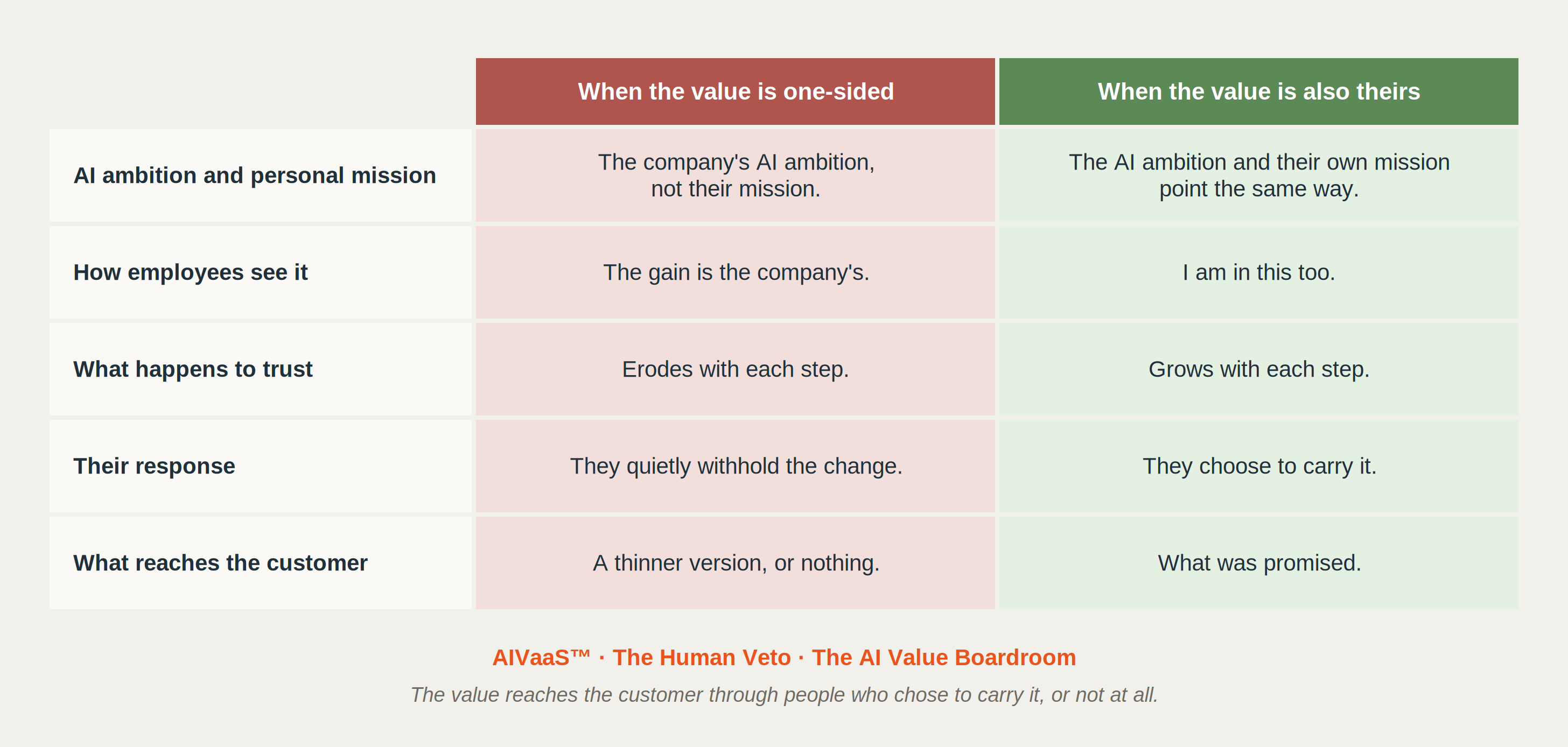
What employees settle into is a quiet verdict. The value of this AI is the company’s, the saving belongs to the owner, the risk belongs to me. That verdict is the veto, and from where they stand it is rational.
The ground was thin before AI arrived. Gallup’s State of the Global Workplace 2026 puts engagement near one in five worldwide, and finds most who use AI report a productivity gain while almost one in five expect their role cut within five years.
The last number is that fear in the data. The employees who gain most from the tool are the same ones who expect it to take their role, and the fear of being replaced outweighs the gain.
A narrow value is not only a failure of communication. It is a tell about the AI Ambition behind the plan. An organisation that points AI at cost and efficiency alone, at L1 and L2, has nothing larger to offer, because it set out to save, not to build.
Behind that ambition is the organisation’s strategic posture, its character: how it reads the world outside and inside, and where it therefore chooses to create value.
A Defender posture turns inward by instinct. It protects what exists, and rarely reaches for the AI opportunities that open new value for customers or break new ground in the market. Those are the very ones that give employees a reason to move.
The posture gap becomes a motivation gap. The trap is conditional, and the condition is the opening. The arc from welcome to veto runs only where AI is introduced without a story, as a saving with no shared future attached.
Making the value theirs
Lifting the veto is not a campaign to convince employees that a one-sided deal is fair. It is the work of making the value theirs, and it runs on three moves held together: a vision from leadership, change managed through value, and the employee experience and engagement that follow.
The first move is leadership, and it leads for a reason. Employees read a change by who stands behind it, and one the leadership does not visibly own is one they can quietly refuse.
Leadership here is a vision before it is a plan. People accept the change when the organisation’s bright future is visibly their bright future too, and not a future where the gains are the company’s and the costs are theirs.
That vision carries a commitment employees can hold the organisation to. The promise is a balanced fusion of employees and AI agents, built in their favour, not against them.
The agents take over the routine that drains the day, and the employees are freed for the creative, higher work the machines cannot do. The judgement stays with the employee, and there is more of this better work ahead, not less.
What this asks of leaders is the subject of the next article. Here it is enough that the promise is credible, because a vision employees do not believe is one more reason to veto.
The second move is change management, run through value instead of through steps. The familiar models move employees along a sequence. AIVaaS™ begins from another question: what each employee stands to gain, and whether the plan lets them share in it.
The promise of a share in the value is matched by a real shift in the daily experience of work. Not lighter tasks. That is the small relief that already failed to convince. Something higher than that.
More success at the work that matters, as employees reach the goals and the mission they are there for, achieving more of it rather than doing less. And greater personalisation, as AI shapes the tools and the workplace around how each employee works best.
More confidence in the right decisions, with AI as support rather than threat. And better wellbeing, as the routine that consumed the most time falls away.
And some of the reward comes from outside the company. When the value reaches customers, their thanks and their praise return to the employees who built it, and recognition of that kind moves motivation more than any internal measure.
These are not perks. They are the conditions under which trust recovers, the veto lifts, and engagement and motivation rise, because employees now see value that is theirs.
And only then can the organisation reach the more far-reaching forms of AI. The orchestration of agents, where they take over more and more of the employees’ own work, asks for even more trust than the first steps did.
They accept it only when they already hold the end vision, have had their fear answered, and find direct and indirect value in it for themselves. Where that holds, the veto is behind them. Readiness is not a technical state, it is a willing one.
Why this matters for Ana
In the stories that open The AI Value Boardroom, Ana is the customer the organisation serves today, and the child she carries is the customer of the next, more intelligent economy.
Ana never meets the portfolio, the planning, or the veto. She meets a person, or a service a person built, and she feels whether someone cared. With a birth approaching, she reads that care more closely than before.
Care for each customer comes from the experience and the engagement of the employee behind it. This is why the employee experience (EX) and the customer experience (CX) are two sides of one coin.
People who have quietly vetoed the change deliver Ana a thinner version of everything planned for her. People who believe in it deliver what was promised. The value reaches her through people who chose to carry it, or it does not reach her at all.