


In AIVaaS™, AI is approached as a business transformation, not as a technology deployment only. The goal is an AI-Infused Business in which AI as technology becomes part of how the organization creates, delivers and captures value.
Every AI initiative lives in two worlds. The business world speaks in stakeholder needs, decisions and value. The technical world speaks in models, data, proofs of concept and traces. Between them lies a distance, and most of the value that AI promises is lost somewhere along it.
The two worlds often share the same words: validated, evaluated, ready, accepted. Each word carries a different meaning on each side, and behind each meaning stands different evidence, a different decision and a different accountability.
Behind the words sits a clean division of accountability. The business side answers for value created for the customer, the core of every business model. The technical side answers for an AI solution that works.
Between the first accountability and the second stretches a long distance, and it is a competitive one. The company that crosses it faster holds a shorter distance to the customer than a competitor fighting for the same one.
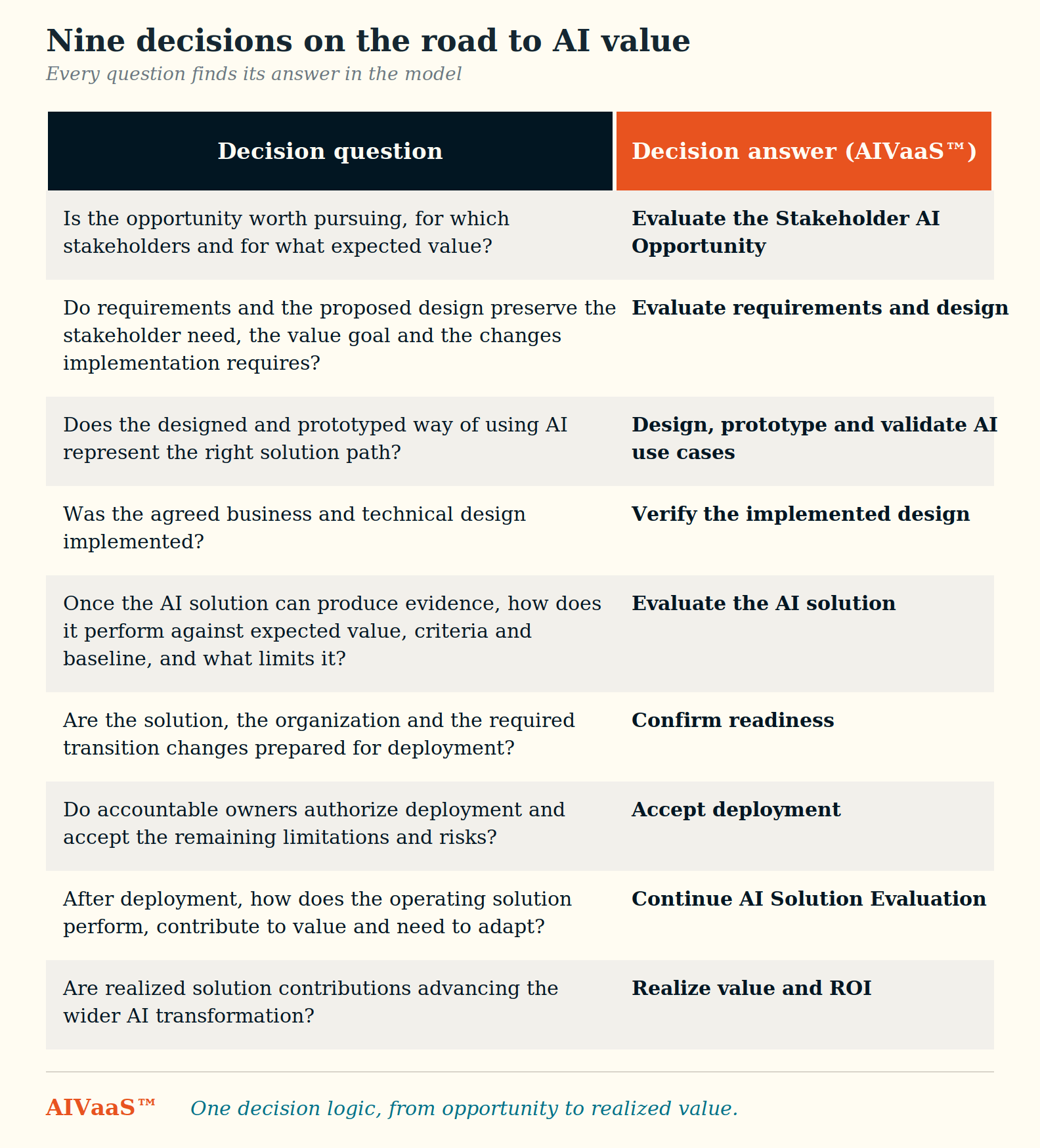
From intention to realized value, a chain of questions waits along the road. Each question has a business face and a technical face, and each becomes dangerous when only one side answers it. Answered together, the two faces form one decision logic, and that is what shortens the distance.
Start right, or the distance grows
The road to value begins at a Stakeholder AI Opportunity: a business object and a value goal, a partial manifestation of the AI ambition, with its own place among the types of value the organization pursues (its position in the Value Creation Matrix).
An opportunity answers one question: where, for whom and through which business change could AI create meaningful value? It arrives with owners, stakeholders and an expected value attached, long before anyone mentions technology.
This is where evaluation begins. The first object under judgement is the opportunity itself: how important it is, which stakeholders it serves, what value it should create, how well it fits the strategy, and whether it deserves further investment at all.
An AI use case is a designed path toward the opportunity: a concrete combination of people, processes, decisions, data, tools and AI. It is born in design, and this order matters. The opportunity states what success means; the use case shows one way of reaching it.
One opportunity may need several use cases before its value is within reach, and no single use case defines the whole opportunity. Losing sight of this relationship is how value quietly narrows: the use case gets delivered, the opportunity stays unrealized.
Most business conversations about AI start with a list of use cases to identify and prioritize. Read closely, most entries on those lists are opportunities in AIVaaS™ terms: places where AI might create value, named before any path exists. One word carries both objects, and the goal disappears inside the path.
The business model behind the opportunity has already promised value: created for the customer, delivered through the offer, captured in the results. The use case takes that promise to the test. And when the transformation is later measured, the question will return to the beginning: was the opportunity realized?
Where the two worlds must meet
Design is where the two worlds first sit at the same table, because the object of design belongs to both. What travels toward deployment is a business solution: people, processes, decisions, data, tools and AI working as one system, with the model inside it.
The business half of design has one central duty: to keep the expected value of the opportunity alive inside the solution. Every trade-off made at this table is measured against that value, or it starts working against it.
Business analysis builds the bridge and keeps the journey fast and on course: every detour off the road makes the distance longer. It clarifies the need, then defines the business, stakeholder, solution and transition requirements that carry stakeholder needs and expected value into design.
Design answers with a possible shape, and the shape reveals new requirements, so the loop runs until both worlds recognize the solution. The table fills with trade-offs along the way: value against cost, usability against feasibility, AI autonomy against human control, provider standardization against the actual business process.
The name itself can mislead. Solution Design sounds like a technical discipline, which is why AIVaaS™ insists on Business Solution Design: a solution here always contains two poles, the business system and its technical implementation.
The word business in that name works on two levels. The constitutional level is inherited from the foundation: how far AI may go, what it must mean, what the transformation owes its stakeholders. The solution level is written here: the value hypothesis, criteria, decisions and business logic of this one opportunity.
Business strategy is the constitution of a company. An AI Solution Constitution, an AIVaaS™ term, plays the same role for a single AI solution: non-negotiable purpose, principles, priorities, business rules, decision boundaries, autonomy limits and escalation paths, written down before any technology enforces them.
The constitution governs. The agent harness makes it executable in daily operation. And the evaluation harness, the machinery that runs repeatable tests and records how the solution behaves, will later produce the evidence.
The last line of defence
Business Solution Design is the last point at which business intent can still govern the technical solution. After it, implementation begins, and every trade-off becomes more expensive to reverse. What the line defends is the value the opportunity promised.
The pressure at this line is real. Providers naturally lean toward their own solution patterns, clients want progress, and attention slides toward the solution itself. The stakeholder need gets overlooked one small decision at a time, while everyone in the room believes they are still serving it.
A design built from one side carries a double price: higher cost and lower realized value. The road then gets walked more than once, redesign after redesign, or it reaches its end without the main thing: satisfied customers willing to take over the result. Those customers can be external, internal, or both at once.
The numbers behind this are brutal. IDC found that 88 percent of AI proof-of-concepts never reach production, and MIT research put the share of AI pilots failing to deliver expected returns at 95 percent. Behind many of those failures sits the same historic mistake: the client handed the whole solution to the provider.
Ownership of the business problem, the process design, the division of work between humans and AI, the success criteria and the value judgement stays with the business. Everything else is collaboration: the end customer, the client and the AI solution provider weaving their separate accountabilities into one result.
One more thing is written at this table, and its timing decides everything later: evaluation criteria, acceptance criteria and test scenarios are designed with the solution, the same way good test scenarios are written at design time, long before testing. Transition requirements are identified here too, and readiness will come asking for them.
The third element of the pillar now has its full name: Designing, Prototyping & Validating AI Use Cases. Three actions share one object. Design gives each use case its form; the next two make sure the form deserves to move on.
A prototype makes the designed use case visible before change becomes expensive: assumptions, interactions, roles, decisions and expected behaviour stop living in documents and start acting in front of people. What it tests first is the value hypothesis, with technical feasibility riding along.
The prototype is the method. Validation is the judgement it supports: are we shaping the right AI use case and the right Business Solution for the right stakeholder need and intended value? We evaluate the prototype in order to validate the use case, the design and the value hypothesis behind them.
This is why the word Validating stands in the scheme itself: the right solution gets confirmed here, where a wrong turn costs a redesign instead of a failed deployment. What leaves this element is a validated use case, shaped into a business solution and ready to face harder evidence.
From evidence to signature
By now the goal is in sight. The use case is validated, the agent harness has turned the constitution and the design into something that runs, and the end of the road feels close. One thing still has to be confirmed: whether the value for the customer travelled the whole way with us.
The pillar meets the solution with its fourth element, AI Solution Evaluation & Readiness, and one question in four layers: can this solution be trusted with real work?
Verification comes first: was the agreed design built? On the technical face, implementation is checked against architecture, data flows and controls. On the business face, something subtler: whether the agreed roles, rules, decision rights and responsibilities survived implementation.
Evaluation then produces the harder evidence. The evaluation harness runs repeatable tests and records traces, and the business reads that evidence against one measure: the expected contribution to value, the limitations inside the solution and around it, and what would increase the value it delivers.
Readiness widens the view from the solution to its environment. The transition requirements written at design time return here as a checklist of reality: changed processes, prepared people, clear ownership, data in place, monitoring and support ready to receive the solution.
Readiness is a state. Acceptance is an accountable act. A named business owner authorises deployment, accepts the residual limitations and risks in writing, and can still say No. The human veto over AI transformation gets institutionalised here, solution by solution.
Only after the signature does AI Solution Deployment move the solution into real work, as the closing step of the pillar. The order is the message: evidence before readiness, readiness before signature, signature before deployment.
Every decision has two faces
The road can now be read as a chain of decisions. Each row below is one of them: the business meaning that must hold, and the technical evidence that must support it. When a meeting uses one of these words, this is the pair it should mean.
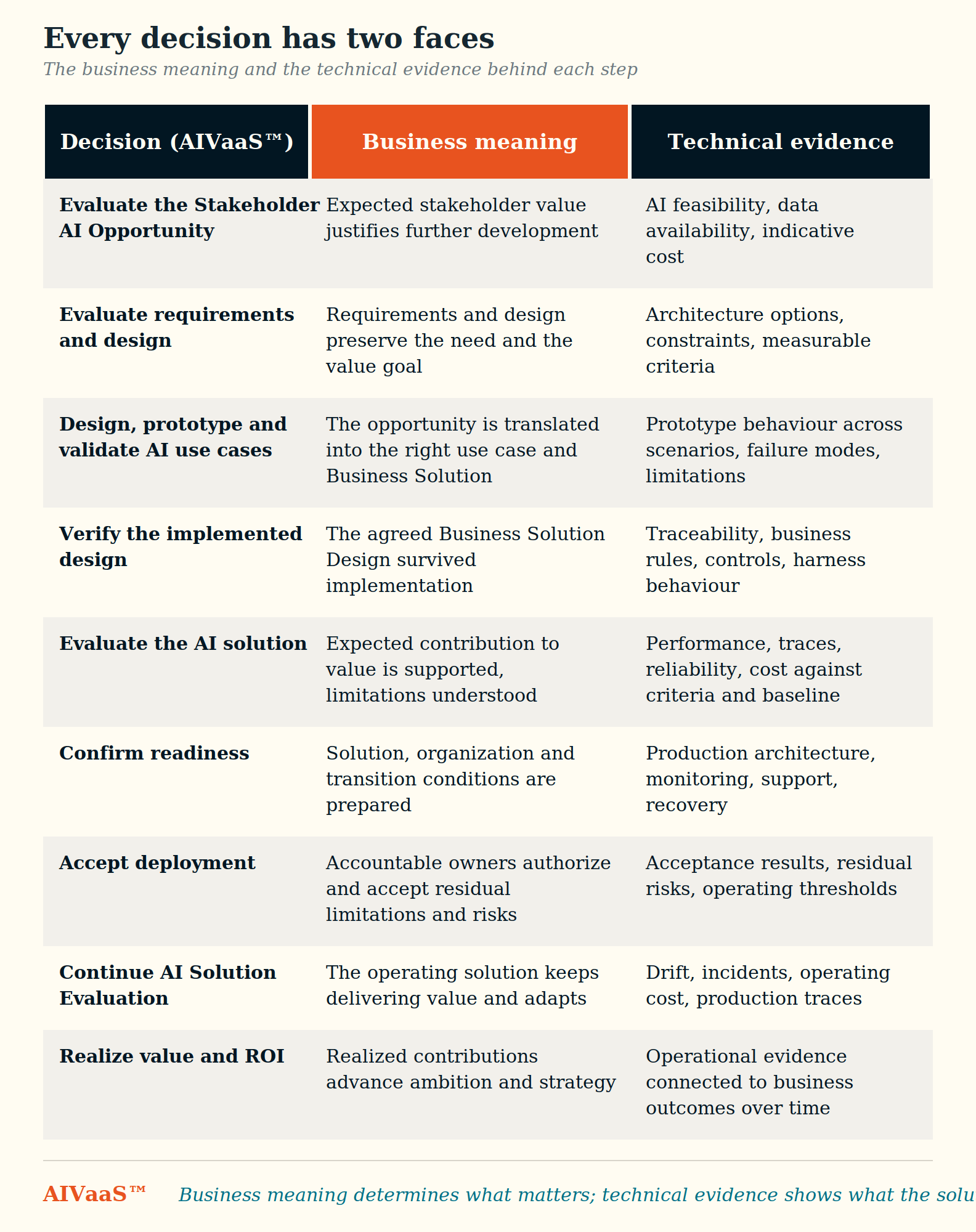
The first seven decisions live inside the pillar and close with it. The last two run beyond it: the operating solution stays under evaluation, and the foundation keeps asking whether realized contributions advance the ambition and the strategy.
Evaluation moves in with the solution
Deployment closes the pillar and changes the context of evaluation. Before it, evidence served the Go decision. After it, the operating solution produces evidence no prototype could: real drift, real incidents, real cost, real behaviour with real customers. Evaluation simply moves in with the solution and keeps working.
The first thing under watch is the transition itself: did the changes around the solution really happen, above all the ones that depend on people? Do the new processes run smoothly? Do customers feel only the positive side of the change?
When those answers weaken, the solution walks back to a new readiness decision. Realized value is the only proof that counts.
Ana is almost there
For Ana, transition requirements are something different. Month eight is what they look like in a life: the room is prepared, the bag waits by the door, the route is tested, and everyone around her knows who does what when it begins.
None of it is the point. She prepares because of the value that is coming, and every item on her list exists only in its name. The day itself will choose its own time; her work is that everything is ready before it.
Organizations rarely stop to ask how much of a realized AI opportunity reaches the customer as value. They should. Ana will be watching more closely than ever, and where her attention ends, her AI agent’s begins.
Ana may forget. Her AI agent will not, and next time it will simply offer her a different choice: someone with a better understanding of her and her new needs.