

If you arrived here directly — welcome. This page is part of The AI Value Boardroom, a publication written across five business dimensions. If you want to understand the full room first, start with About.
Most AI publications live in one dimension. Technology. Or strategy. Or the customer. Each lens sharp within its own frame. Each one blind to what the others see.
The AI Value Boardroom is built where they converge. Not because breadth is a virtue in itself. But because AI value is not produced by any single domain, and an organization that approaches AI through only one lens will consistently fall short of what AI can actually deliver.
Why the intersection matters
AI is the first business force that genuinely crosses all five dimensions at once. It reshapes the economics of competition. It redefines how customers and employees experience organisations. It forces strategic choices that cannot be delegated to IT. And it changes what it means to be human in a working organisation.
An organisation that approaches AI through only one of these lenses, however sharp that lens is, will consistently fall short of what AI can actually deliver. The technology team builds capability that strategy never asked for. The strategy team sets ambition that people are not prepared to carry. The customer team advocates for experience that the capability layer cannot yet support.
This is not a new problem. Every major business transformation in recent decades has suffered from the same fragmentation. But the cost of that fragmentation is higher now than it has ever been, because AI does not wait for the organisation to catch up, and because the lead that well-prepared organisations build compounds quickly.
The multi-dimensional frame is not an academic preference. It is a practical necessity. And it is more necessary now, in the AI era, than at any previous moment in business history, because AI, unlike any technology before it, does not stay in its lane..
The five dimensions
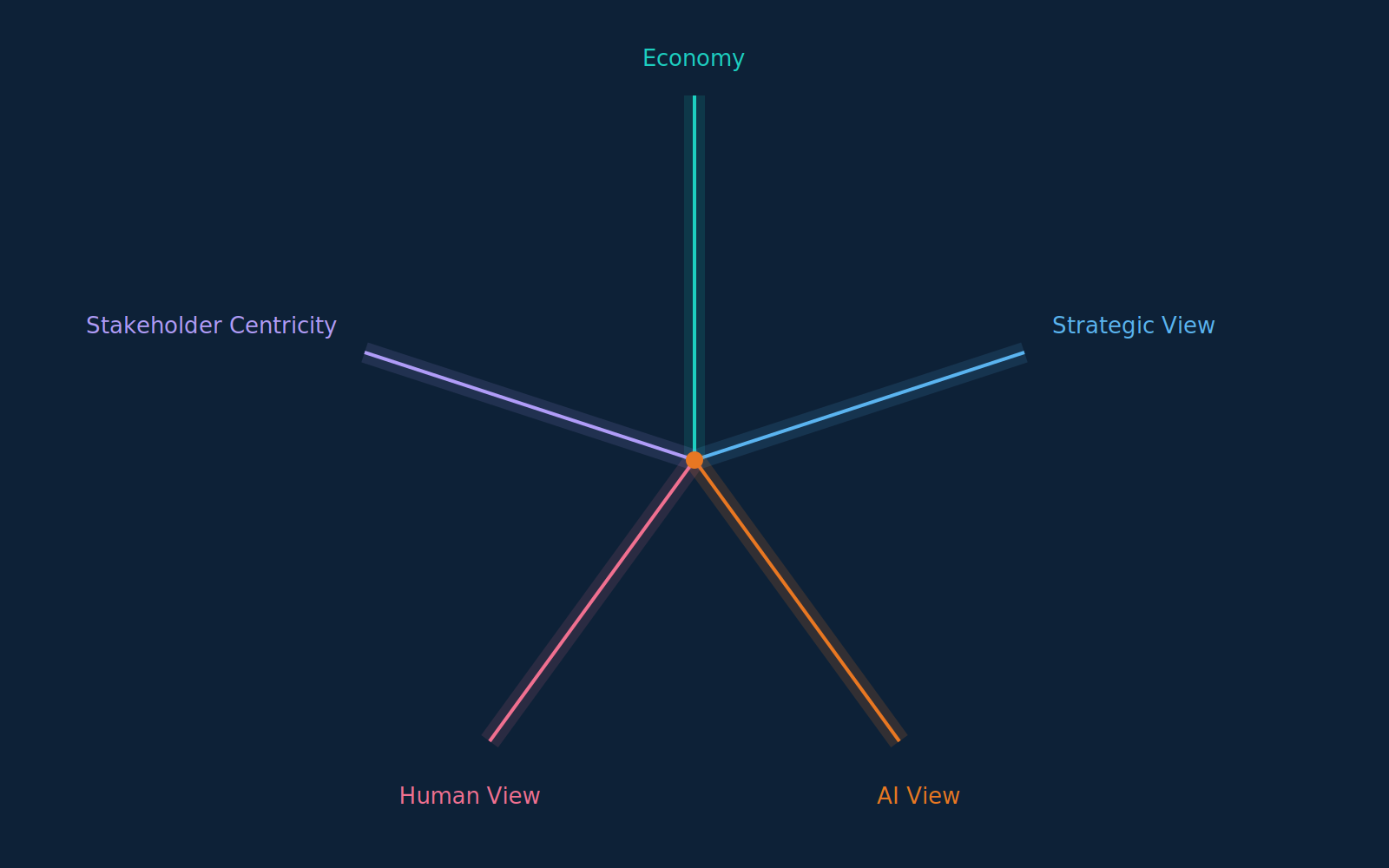
Economy
Two transitions are reshaping the rules of business: from pre-digital to digital economy, and from digital to intelligent economy. What succeeded in the digital economy is a necessary foundation. It is not sufficient for what the intelligent economy requires.
Those who do not recognise this make AI decisions for the economy they came from, not the one they are entering. The right ambition with the wrong playbook. This publication and the AIVaaS™ methodology at its core exist to build a new one.
Stakeholder Centricity
Customer-centricity optimised one relationship: that between the organisation and its direct customers.
Today, that is no longer enough. Customer needs have become too complex for one organisation to meet alone. Creating genuine value requires the involvement of ecosystem stakeholders. These stakeholders deserve the same level of centricity that we bring to customers.
Accordingly, the coordination of customer AI agents and orchestration of agents within a single organisation is insufficient. Stakeholder Centricity demands the orchestration of agents across the entire stakeholder ecosystem.
This publication views this as a natural evolution of ecosystems in the intelligent economy.
Strategic view
AI does not add a new strategy to the table. It changes what business strategy means.
This publication takes a clear position: AI ambition belongs inside integrated business strategy, together with digital and sustainability priorities. Treated as distinct agendas, they fragment. Unified into one strategic logic, AI becomes the DNA of how an organisation competes and creates value.
AI view
Everyone agrees that AI is more than technology. Fewer can say what that “more” actually means in practice.
This publication addresses exactly that: what makes an AI tool, an AI agent, and AI orchestration work, not as technology itself, but business-first. Because each AI initiative needs to be first a stakeholder-value initiative.
Human view
Human needs are the ultimate reason any organisation exists. This remains.
Designing for people means starting with understanding, not with systems. It means covering how organisations serve their customers (CX), engage their employees (EX), and build relationships across their stakeholder ecosystem (SX). This is what Human Service Design stands for.
This publication places the collaboration between humans and AI at the centre. Not orchestration alone, but what that collaboration produces for the people it serves.
Where these dimensions meet
The intersection is not a static diagram. It is a living space where every article sits in a slightly different place, drawing from some dimensions more than others, but always aware that the others are present.
When you read a piece about AI ambition, it is written with the stakeholder dimension in mind. When you read a piece about data readiness, it is written with the human dimension in mind. When you read a story about Ana, all five dimensions are there.
Economy sets the context. Stakeholders define for whom. Strategy sets the direction. Human needs define why. AI shows how. And where all five meet, the real value is created.
That is what makes this publication different.
Not sure yet? Explore further.
→ To find your specific role in the room: For Your Role
→ To meet the full thinking behind this publication: About