


In AIVaaS™, AI governance is not used only in the classical sense. It means the leadership mindset and approach that determine whether AI adoption becomes real business transformation.
The previous article in this series, AI Transformation and the Human Veto, ended where every serious AI transformation sooner or later arrives: at a question of leadership.
This time, though, it came from the employee’s side. The question is not whether the AI tool is useful. It is whether the future being built still has a place for them.
This is where AI governance begins.
Not just another committee. Not a policy archive. Not a control layer added late, once AI initiatives have already begun to spread across the organisation. Those elements may be necessary, but they are not the centre of the matter.
In AIVaaS™, AI governance is the leadership function that decides what the organisation is trying to become with AI, how far AI may go in creating value, who owns the critical calls, whether the vision for AI keeps a place for the people who do the work, and how the AI transformation stays coherent while business strategy, people, processes, and technology all move at once.
That makes governance a leadership decision before it is a control system.
Why the usual view of AI governance is not enough
The classical governance view has a legitimate role. It has to address accountability, transparency, security, privacy, data quality, model behaviour, human oversight, escalation, monitoring, and compliance with the relevant regulation.
As AI becomes more autonomous, that question grows sharper still, because what matters is no longer only what AI says, but also what AI does.
So this part should not be dismissed. It is necessary. The problem is that it is not sufficient.
Why?
Because by the time classical governance gets to work, the larger decision has usually already been made, often without anyone naming it. At that point the organisation has already decided whether AI will mainly support existing work, improve the operating model, reshape the value proposition, or become part of the business strategy itself.
That earlier decision is the deeper governance act.
An organisation can have policies, review boards, model registers, and approval flows, and still govern AI poorly. It can control AI activity while never asking whether that activity belongs to a coherent ambition for both AI and the business. That coherence is what AIVaaS™ calls AI Ambition Fusion. Traditional governance can make AI safer. But does safer AI matter for the business transformation?
This is why AIVaaS™ places governance in the Foundation. It gives every act of AI adoption a frame, and asks not only whether it is allowed, but whether it belongs to the ambition and vision the business has chosen. In that sense, AIVaaS™ AI governance protects coherence.
What AI governance means in AIVaaS™
The AIVaaS™ view of AI governance does not replace the classical one. It absorbs it into a broader transformation logic.
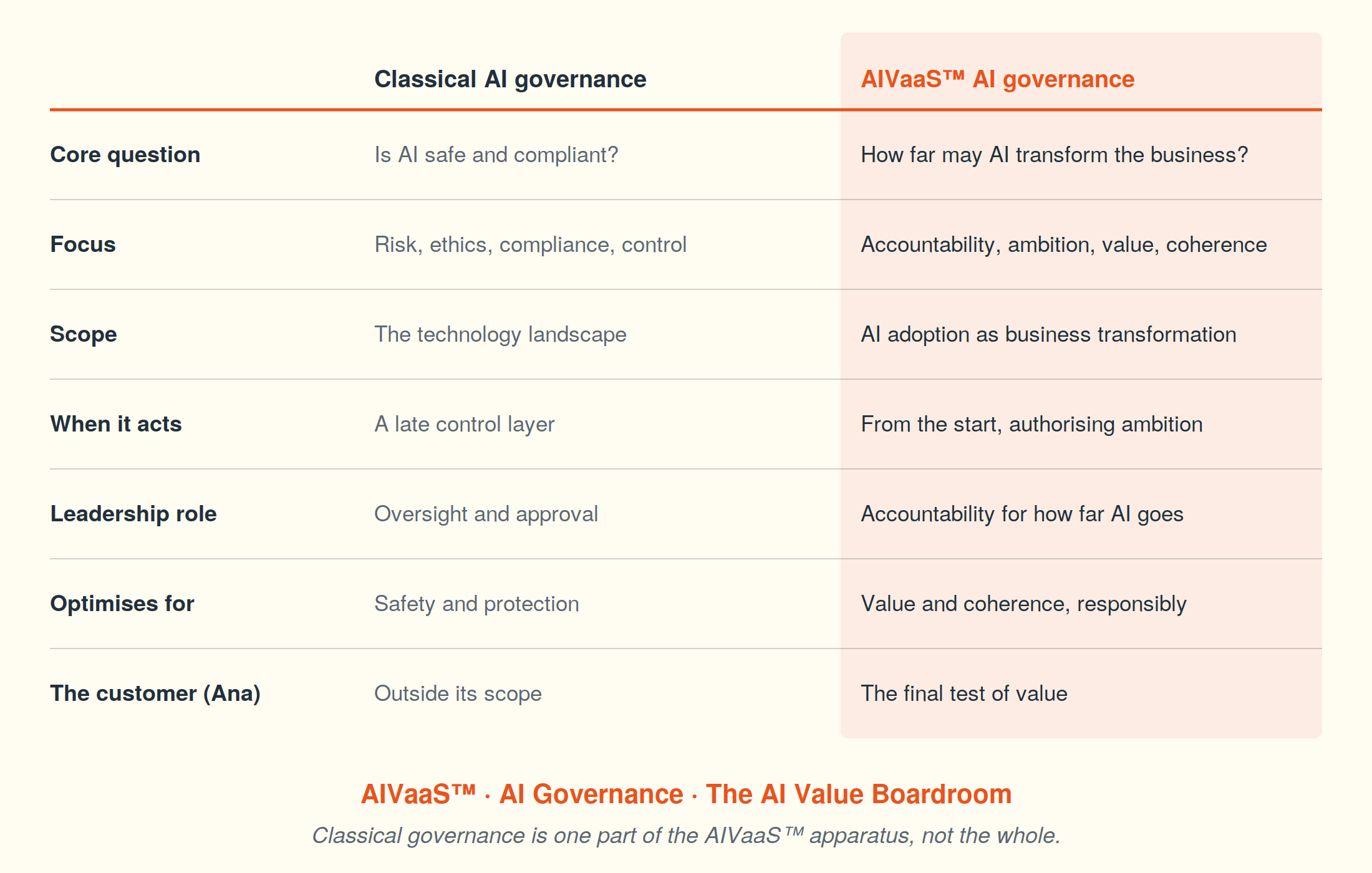
AI still has to be used responsibly, so risk, ethics, compliance, and oversight remain necessary. However, the governance of AI must address a much more important question: what must be governed to ensure the successful adoption of AI as a business transformation?
That is why AIVaaS™ governance has six connected elements.
First, the organisation of governance, which begins with accountability. AI governance is not a separate committee. It sits with leadership in the boardroom. The highest AI governance body is the board itself, extended with the execution roles that make transformation real, the Chief Transformation Officer, the Head of the Strategic Project Office, the Head of Enterprise Architecture, the Lead Business Analyst, and others. Its strategic side decides where AI should take the business and how far the ambition goes. Its execution side turns that ambition into work, capabilities, decisions, and progress.
Second, purpose, which sits deeper than direction. Direction is where the organisation is going; purpose is why it exists at all. Governance has to be clear how AI serves that purpose and the value the organisation owes the people it serves. When purpose is vague, AI activity is easy to launch and hard to judge, and pilots and productivity stories pile up without telling anyone whether the work serves what the organisation is for.
Third, AI ambition and AI vision. AIVaaS™ does not treat the AI vision as a separate technology document beside the business strategy. The vision comes from AI ambition and is fused into the strategy itself, so the organisation does not end up with two worlds, an official business strategy and an unofficial AI agenda looking for room inside it.
Fourth, readiness, captured as Business AI-Ready. Successful adoption is not produced by a tool or a single capability. AIVaaS™ states it as a formula: Business AI-Ready combines Business-Ready, Organisation-Ready, AI-Ready, and Implementation-Ready. Governance has to hold those four states together, because transformation fails when the parts move at different speeds and nobody owns the integration.
Fifth, compliance, ethics, and risk. This is the classical part, and in AIVaaS™ it is one part of the apparatus, not the whole of it. It matters because AI must be trustworthy and controlled, and it becomes too narrow when it defines governance as protection alone.
Sixth, decision ownership and escalation. This is the most neglected part and one of the most important. Governance has to define who has the final word, which criteria guide the call, what is escalated, and when a decision moves from operational management to leadership. Without it, an organisation can look governed while the real decisions stay scattered across functions, projects, and personal interpretation.
Together, these six elements change what governance means. It is no longer a set of constraints around AI use. It becomes the leadership mechanism that keeps AI ambition, business value, organisational readiness, and responsible use connected.
That is why the first governance decision is not a policy. It is ambition.
The first act of AIVaaS™ Governance is authorising ambition
AIVaaS™ introduced four levels of AI ambition earlier in the series. L1 supports people in their existing work. L2 improves the operating model. L3 adds new business models and sharpens differentiation. L4 runs AI through the whole business strategy and disrupts markets.
The critical line sits between L2 and L3.
Below that line, AI mostly improves what already exists. Work becomes faster, cheaper, more consistent, and easier to manage. This matters, because efficiency is a real form of value, and many organisations need that operational discipline before they can move further.
But it is not yet transformation.
Above the line, AI begins to change what the organisation can offer, how value is created, how customers are served, how decisions are made, and what competitors must respond to. The logic moves from better operations to new forms of value.
This leap cannot be delegated to a technology function, and it cannot be left to a portfolio of use cases. It has to be authorised by leadership, because it changes the organisation’s understanding of value, risk, investment, capability, and future advantage.
This does not mean reaching L3 or L4 immediately. Delivery can be gradual, and capabilities, processes, data, roles, governance, and literacy can mature over time.
But the destination has to be authorised early in AI governance.
If the boardroom communicates only an L2 story, the organisation behaves accordingly. Managers search for productivity gains, finance looks for cost reduction, employees hear the threat, and customers see little difference. AI becomes active in many places and transformative in none.
Why managers stop at Level 2
The difference between a manager and an AI leader is not the job title. It is the level of value they look for.
A manager usually sees AI through the operating model. The question is how to make existing work faster, cheaper, more accurate, or easier to control. AI becomes a tool inside the current organisation, placed into current processes, current measures, and current assumptions about how the business works.
This view is completely legitimate, and in many organisations the first responsible one, because operational reality cannot be ignored. L2 can remove friction, improve quality, increase consistency, and create the capacity for the next move.
But the managerial view has a ceiling.
When AI is understood mainly as an operational tool, governance becomes a matter of permission and control. Which tools may be used. Which data may be entered. Which outputs must be reviewed. Which risks must be prevented. The organisation becomes more controlled, but not more valuable to the market.
And the same operational gains are open to everyone. Competitors reach L1 and L2 as well, so efficiency that every rival can copy does not create lasting advantage. AI can make the organisation leaner and safer and still leave its position in the market unchanged. Real transformation asks for more.
The AI leader sees a different horizon.
For the AI leader, AI is not primarily a tool inside the existing business. It is a business power that can change the value the organisation creates. The question is not only where AI can improve the current process. It is what becomes possible for the customer, the employee, the partner, and the owner when AI changes the economics of the work.
This is the move from management to leadership.
Management asks how AI improves what the organisation does.
Leadership asks how far AI should transform the business.
That is a question of vision, and a vision too small to require change will not produce it.
This is also why AI governance cannot be reduced to a delegated function. A CAIO, CDO, CIO, or transformation office can build the machinery. They can coordinate, advise, enable, and execute. But they cannot replace the leadership decision about ambition.
Leaders cannot stand outside the transformation and sponsor it from a distance. The decision about how far AI may go is theirs to make.
Governance without leadership becomes administration.
Leadership without governance becomes aspiration.
AI transformation as business transformation needs both.
Culture is the human in the loop of AI transformation
The culture an organisation has does not stand on its own. It follows from its strategic posture, the character the organisation has already chosen. Strategic Posture Readiness set that character out earlier in the series. The point here is what it does to culture.
A Defender’s instinct produces a culture of control and hierarchy, and a transactional style of leadership that runs on targets, rules, and reward for compliance. A Prospector’s produces a culture of experiment, close to what the competing-values research calls an adhocracy, and a transformational style that works through vision, trust, and the readiness to change the business itself. An Analyzer sits between them, and its leadership has to hold both at once.
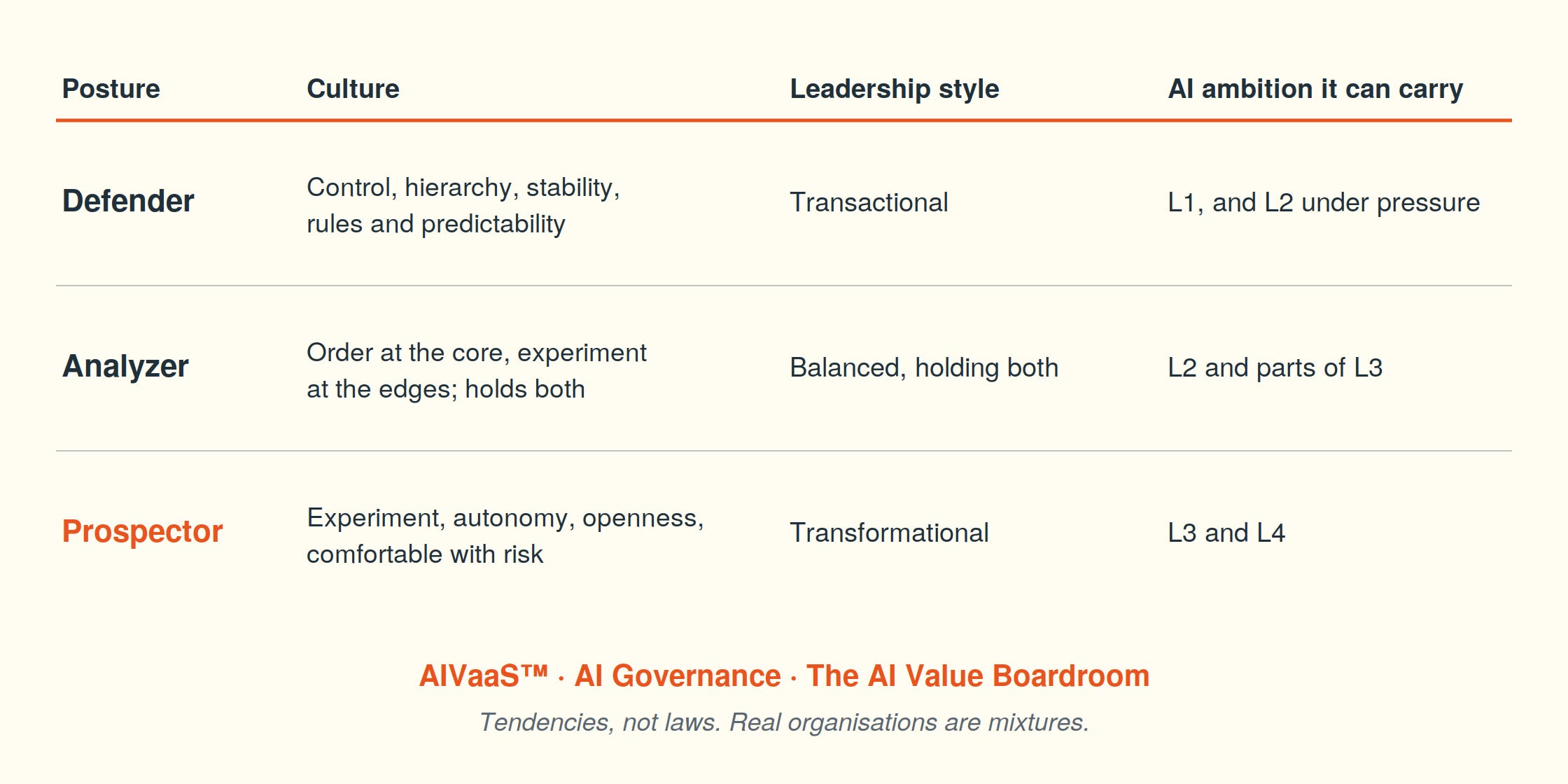
None of this is a law, and real organisations are mixtures. But the tendency is strong enough to matter, because culture is where a higher ambition is either allowed to operate or quietly pulled back. If the ambition says L3 while the culture rewards L2 behaviour, the gap is not motivational. It is structural, and governance has to notice it.
This is why culture, more than the org chart, is the human in the loop of AI transformation.
In AI orchestration, human in the loop describes where people review, approve, or step into what the machine does. The useful lesson is not that a human should be inserted somewhere into the process. It is that human judgement matters only when the human has the context, the authority, and the capability to improve the decision.
A reviewer who does not understand the output is not governance. A reviewer without authority is not governance. A review step that records approval but never disagreement is not governance. It can look like control, but it does not produce judgement.
The same logic applies to the introduction of AI into the business. Leadership and the culture it builds decide what the transformation means, how far it may go, and whether it becomes trusted enough to move.
A culture of trust and experiment is therefore not a soft addition. It is part of the operating conditions for higher AI ambition.
Employees must see that AI is not being introduced only to extract savings from their work. Managers must see that their role is not to protect the old model with new tools. Leaders must show that the transformation is not an efficiency programme disguised as progress.
This is where the human veto returns. Employees do not resist value. They resist a value story in which they carry the cost and someone else receives the gain.
Governance is what keeps that story from becoming the default. Trust does not come from saying AI will help people. It comes when the governance of AI makes that true.
AI literacy is judgement, not tool training
AIVaaS™ places AI literacy in the second pillar, as a readiness of its own. Like the shift from manager to leader, it works at two levels, and only one of them carries transformation.
Many organisations treat AI literacy as a training programme. People learn what generative AI is, how to write prompts, what not to enter into a tool, and how to use approved systems responsibly. This is useful, and for L1 and L2 it is often enough, especially when AI is spreading quickly across everyday work.
But it is too small for leadership.
In AIVaaS™, AI literacy means understanding AI as a business power. It means grasping how AI changes the economy, customer behaviour, competition, operating logic, decision making, and value creation. It means seeing the difference between improving a task and changing a business constraint.
This deeper literacy does not sit on its own. It is closest to AI governance, which sets the ambition it has to understand, and it shapes leadership and culture, because people cannot lead or trust a transformation they cannot read. That is why it belongs in the second pillar while drawing its force from the Foundation.
Employees, in turn, have to know where AI supports them, where it reshapes their role, and where their judgement becomes worth more, not less.
Without this, governance turns formal. People follow rules they do not understand, reviewers approve outputs they cannot weigh, and managers favour use cases that look efficient but do not move the ambition. Leadership mistakes visible AI activity for transformation.
Literacy makes governance real because it lets people judge. The human in the loop has to be able to think.
The manager has to separate efficiency from value. The leadership team has to see whether the portfolio is still trapped at L2 while the market moves to L3.
That is not tool skill. It is strategic literacy for the AI age.
Ana is the final test of governance
There is one test that decides whether AI governance is really working.
Look at Ana.
Not only the process, not only the internal business case, not only the governance dashboard. Look at the customer the organisation exists to serve.
If governance produces a safer organisation that customers cannot feel, it has done only part of the job. If it makes operations more efficient without changing the value Ana receives, it has stayed below the line.
If it produces approvals, policies, and committees but never asks what becomes better for Ana, it has governed AI activity, not AI transformation.
This matters more in the intelligent economy, because Ana is changing too. She no longer chooses on her own.
Increasingly she comes with an agent that compares, filters, remembers, and decides with a discipline ordinary persuasion cannot easily overcome. It is not impressed that a process was automated. It cares whether the value is better, clearer, faster, and more trustworthy.
Ana’s agent raises the standard, and that is why L3 and L4 matter. The customer side of value is getting harder to fake.
Ana also gives employees a reason to believe. When the organisation can show AI is being introduced to create more value for the customer, and not only to cut cost, the transformation gains a different logic.
Through Ana, AI governance, leadership, culture, and AI literacy meet in one place. Governance decides whether AI is allowed to create higher value. Leadership holds that ambition. Culture makes it believable. Literacy makes it understandable. And Ana tests whether it matters.