


A quarterly AI review at a commercial bank opens with good news. Three teams involved in opening accounts for new business clients have each introduced AI, and each reports time saved.
Sales prepares proposals faster. Compliance reviews documents faster. Operations processes account applications faster. Every solution meets the targets set for it.
The chief AI officer (CAIO) has asked what these improvements mean for the client. An AI-assisted analysis brings together process records, costs and client correspondence, following applications from the first enquiry to a working account.
From the client’s side, little has changed. The same information is requested more than once. Applications wait between departments. Each team completes its own tasks faster, but the client still waits just as long.
The CAIO proposes using AI across the process to carry information forward, identify missing documents earlier and reduce repeated work. Realising those gains would also mean changing how the three departments work together.
The department heads listen with interest. Each has a budget, targets and a team already busy with its own improvements. One asks which tool the CAIO would recommend.
Nobody challenges the findings. Yet the discussion ends without agreement on what any department will change. The CAIO has brought a business proposal to the table. The response still treats it mainly as a technology question.
Support for AI becomes more demanding when it requires attention, resources and changes within a leader’s own department. Agreement that AI matters can coexist with little willingness to change established priorities or ways of working.
In IBM’s November 2026 study, only 29% of surveyed CAIOs and equivalent AI leaders said their organisations quickly adjusted decisions and resources when AI performance insights revealed opportunities to improve results.
The bank example also shows how AI strengthens the CAIO’s own contribution. AI helped bring together evidence the teams had examined separately. The CAIO used it to explain where the bank could reduce repeated work and improve the client’s experience.
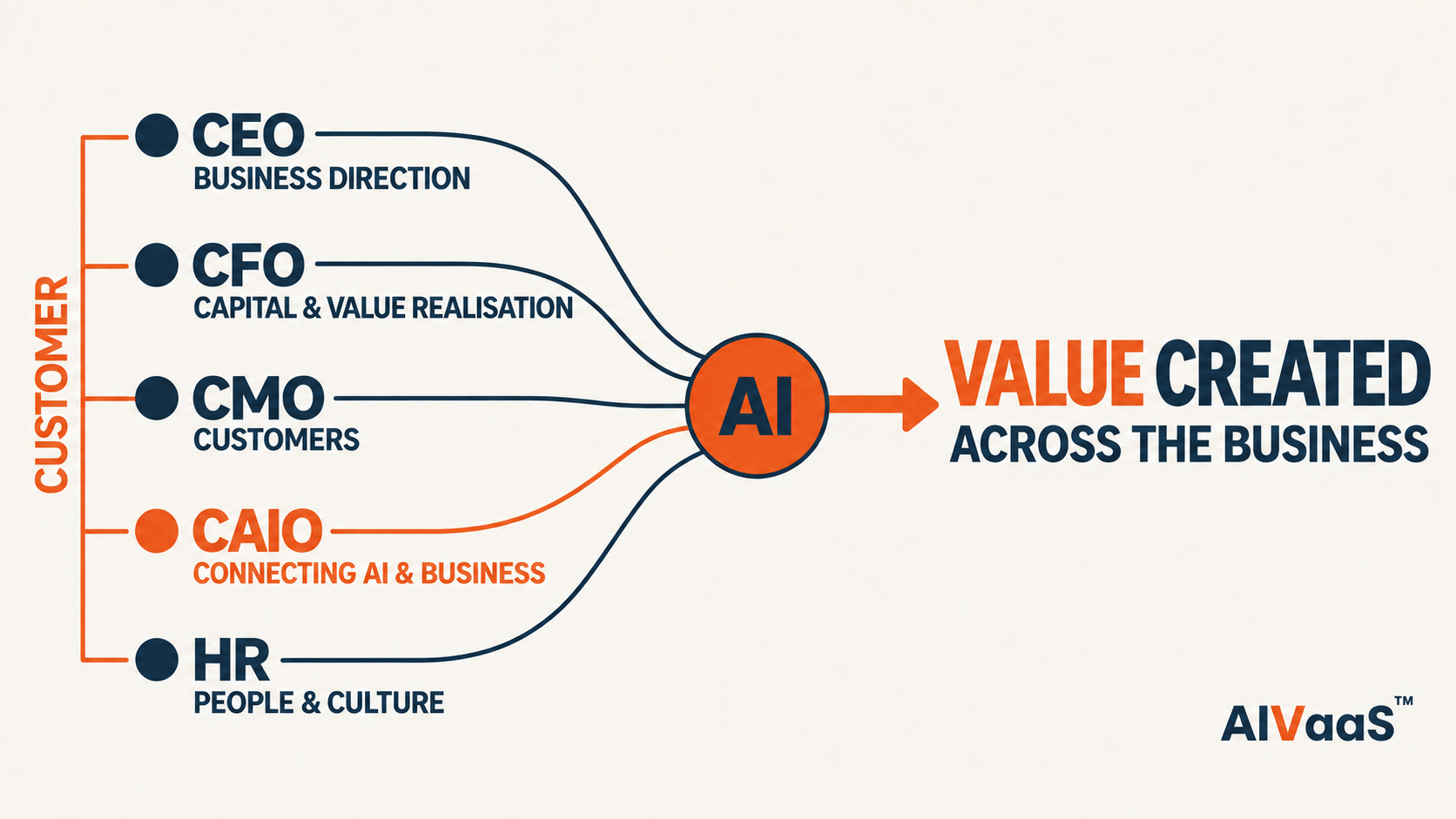
For HR leaders, CFOs and CMOs, AI opens ways to contribute more. The CAIO role exists because of AI, so for the CAIO, AI value is the contribution itself: the value AI helps create for customers and the company. When that value becomes visible, so does the role.
AI created a new leadership responsibility
AI can enter an organisation through a company-wide platform, a departmental project or an employee improving a daily task. Its use can spread before the organisation has a shared understanding of where it could make the greatest difference.
Individual improvements can create real value through lower costs, increased capacity or better quality. Their wider effect depends on how the organisation uses those gains and connects them with its business priorities.
As AI reaches further into the business, the decisions become more consequential. They concern what the organisation offers customers, how work is divided between people and AI, which investments deserve support and how results will be judged.
AI created a growing set of business decisions that cut across existing responsibilities. The CAIO role emerged to give this work a clear focus: connecting what AI makes possible with the decisions, investments and changes needed to create value.
AI VALUE 4 described the CAIO as the leader who connects AI capabilities and solutions with business goals. That connection becomes more convincing when the CAIO can explain what would improve, for whom, what the improvement is worth and what achieving it would require.
For the CAIO, AI value becomes especially visible where functions meet
Every function can create AI value of its own. HR helps people prepare for new ways of working, finance makes better decisions, and marketing understands changing customers. Each can see and report gains in its own work.
Some opportunities depend on changes in several functions. The client in the onboarding review loses time between teams, so no team can remove that loss by improving its own work alone.
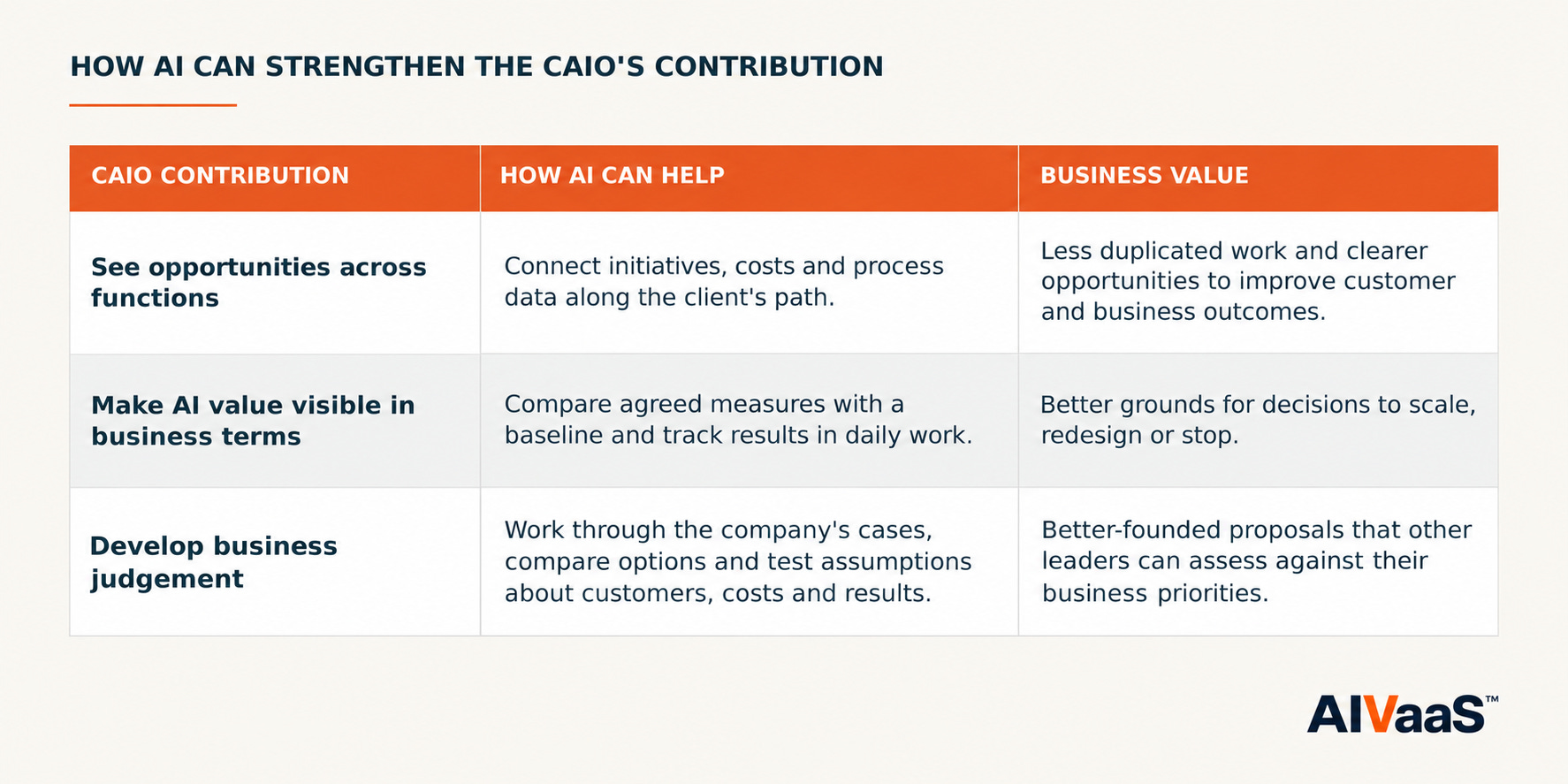
AI helps the CAIO examine initiatives, costs and outcomes together, including connections that separate project reports leave out. This strengthens the CAIO’s ability to explain where the business could gain more and what would have to change.
The AIVaaS™ Value Spectrum places these gains in a wider picture. To the left of the Critical Leap, AI helps the company run its existing business better, through lower costs, shorter cycles and higher productivity.
Beyond the leap, value reaches the company through benefits first realised by a customer, employee or another recipient. Sustaining that value requires connected capabilities: customer insight informing decisions, with data, processes, people and AI supporting delivery.
Those connections can be difficult to fund one department at a time. Each leader may have to commit resources, while the full benefit depends on changes elsewhere. The CAIO can use AI to bring the costs, benefits and dependencies into one business discussion.
Business leaders remain responsible for the outcomes. In AIVaaS™, the recipient is whoever benefits, while the Value Owner is the internal role accountable for ensuring the benefit occurs and is evidenced. The CAIO helps those responsible create value together.
A company can deploy AI widely and still use it mainly to improve the business it already runs. Connected capabilities also make deeper changes possible, including new services and business models. The Critical Leap concerns that change in how value is created and delivered.
Connecting departments does not by itself constitute the leap. Faster account opening can improve the existing business without changing its model. The CEO and leadership team set the ambition; the CAIO helps them understand what reaching it would require.
Technical credibility does not automatically bring business influence
Most CAIOs bring experience in data or technology, and that expertise provides a strong starting point. Business influence also depends on understanding customers, costs and the consequences of change, and making that understanding visible to colleagues.
The CAIO may be invited to explain AI, yet left out when business priorities are set. Colleagues can welcome the analysis without making the proposed changes part of their own plans.
Reports that count users, pilots and agents give colleagues little basis for changing business priorities. They show how widely AI is being used, but leave open what customers and the company will gain.
The gap also runs the other way. Business leaders who understand AI mainly through the tools their own function uses can judge a faster proposal or document check. They may find it harder to assess a different service or way of working that AI could make possible.
If the CAIO’s business understanding remains weak or unrecognised, the role can become confined to tools and technical delivery. The CAIO is consulted about AI but has little influence on the changes needed to realise its value, and the bank’s client keeps waiting.
AI can help both sides close this gap, while giving them a better basis for decisions they must make together.
AI strengthens the CAIO’s business judgement and influence
AI-generated findings need checking with the teams concerned. In the bank, their experience helps establish whether the apparent delays and repeated work are real, and what causes them. That discussion also lets the teams shape the proposed change.
The CAIO can then bring leadership a business finding: where the client loses time, what the delay costs the bank and which changes could remove it. Decisions about the technology can be assessed against that purpose.
Before redesign begins, the CAIO and the three leaders agree how its value will be shown. The baseline could include the time from first request to a working account, repeated requests to the client and the cost of handling an application.
They also agree which results would justify extending the redesign, which would call for changes and which would stop it. AIVaaS™ Value & ROI Realization follows the evidence from early signals to sustained results. AI can help monitor those results continuously.
Stopping belongs to this discipline. The same IBM study found that high-impact CAIOs were about twice as likely as other respondents to report stopping or reducing investment in underperforming initiatives, even when those initiatives had senior sponsorship.
A willingness to stop weak initiatives gives colleagues a reason to take the CAIO’s support for stronger ones seriously. The proposal can be judged against evidence and business priorities, and the CAIO’s influence can grow through that experience.
AI can also serve as a learning partner for the CAIO. In the bank, this could mean exploring how the bank earns income from business clients, what delayed accounts cost in revenue and trust, and how risk is weighed in a compliance decision.
Working with the company’s own information, the CAIO can examine alternatives and test the reasoning with the CFO, the CMO and the business leaders concerned. This develops the judgement behind a proposal and gives colleagues a clearer basis for assessing it.
Learning can run in the other direction too. The CAIO can help colleagues use AI to explore their own business questions, so they see possibilities beyond the tools their function already uses.
AI is also expanding the business questions the CAIO helps leadership address. As agents begin to act, the organisation has to decide where AI may act alone, where a person approves and how an action can be paused or redirected.
An onboarding agent could request a missing document as soon as the gap appears. The bank still has to decide which requests may go out automatically and which need a person, because speed matters to the client and so does trust.
These decisions concern risk, accountability and the client relationship. The CAIO prepares them with the relevant business leaders, compliance and HR. The more AI does on the company’s behalf, the more this work draws on business judgement.
The opportunity is open from both sides
The responsibility can sit with a dedicated CAIO or form part of an existing leader’s mandate. The scope and authority given to it matter more than the title.
Leaders from data and technology bring an understanding of data, systems and AI. Their opportunity lies in adding business depth and demonstrating how that knowledge can improve business results.
Business leaders, experienced business analysts and business architects can bring a strong understanding of customers, processes and how the company creates value. Their opportunity lies in combining that understanding with sound judgement about AI’s capabilities and limitations.
Whichever path someone takes, the role brings together an understanding of value, judgement about technology and the ability to build support for business change. AI can help develop these capabilities when it is used for learning as well as for delivery.
AI value makes the CAIO’s contribution visible
Return to the bank’s next quarterly review. The redesigned onboarding has run with one group of new business clients.
If these clients reach a working account sooner, receive fewer repeated requests and cost less to serve, the three leaders have their own reasons to extend it.
This time the heads of sales, compliance and operations present the result together with the CAIO. Nobody asks which tool was used. The discussion turns to what the results justify: extending the approach, changing it or stopping it.
The leadership team can now see the CAIO’s contribution in a business decision. Alongside the CEO, HR, the CFO and the CMO, the CAIO brings AI understanding and evidence of where it creates value and where it falls short.
The CEO can strengthen this role with a clear mandate: a defined role in decisions about shared AI investments, access to business and client information, and involvement before solutions are chosen. That support helps turn findings into changes across the business.
The CAIO and colleagues can develop their business understanding of AI together. Working on the company’s own questions helps them recognise each other’s contribution and examine the changes a proposal would require.
The AIVaaS™ Academy: The Business Power of AI offers this setting. Its in-house programme works on the organisation’s own challenges, so the CAIO and fellow leaders build a shared understanding of AI value and how to create it together.
When the CAIO uses AI to help create value for customers and the company, that value is the clearest evidence of what AI is worth and of what the role contributes.