


In AIVaaS™, AI is approached as a business transformation, not merely as a technology deployment. The goal is an AI-Infused Business in which AI becomes part of how the organization creates, delivers and captures value.
Deployment feels like the end of the road. The solution is accepted, signed and running in real work. The teams that carried it move to the next one, and the organization counts another AI success.
Two decisions refuse to close with the deployment. The operating solution stays under evaluation, and the AIVaaS™ foundation keeps asking what no deployment can answer.
Was the Stakeholder AI Opportunity realized? Did its value advance the AI ambition, and through it the business strategy?
No pillar can answer that alone. The first defines the value to pursue. The second prepares the organization to pursue it. The third turns the pursuit into working solutions. Confirming what value truly arrived is a different kind of work.
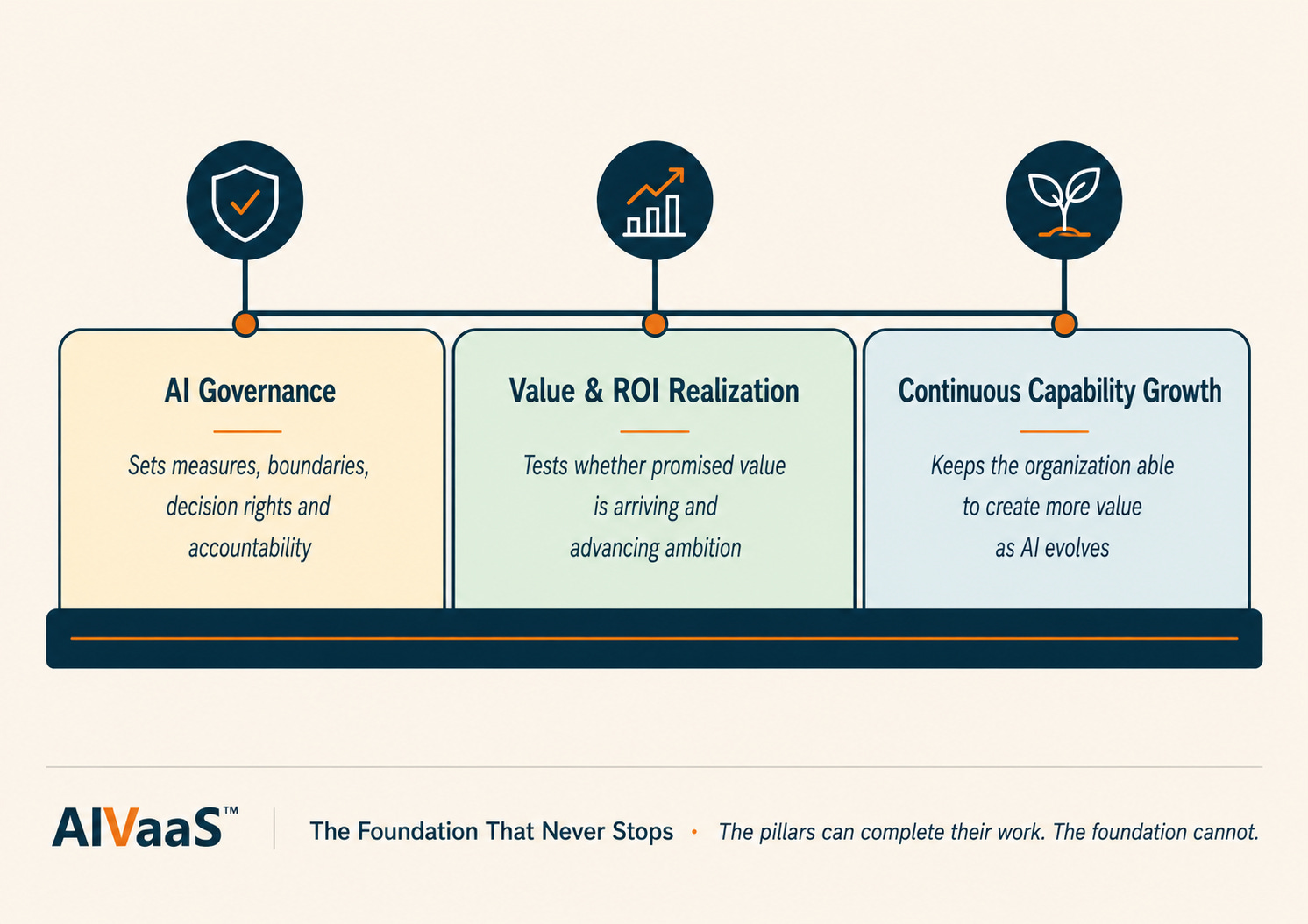
Below the pillars lies the ground they stand on: AI Governance & Value & ROI Realization & Continuous Capability Growth. Every article so far has drawn on it through the element it covered, and governance has had its own chapter. As a whole, the foundation has stayed in the background of the story.
Whatever the pillars build, the proof of its value lives below them.
Three questions that never close
The pillars work as one system. Most of their elements connect, complement and build on one another, and the work returns to earlier elements whenever the transformation demands it. Each element has a moment when its role is complete.
The foundation’s role is fulfilled only by never stopping.
It runs on three questions. Is the promised value truly arriving, and is it moving the ambition and the strategy? Is the organization growing the capabilities to create ever more value, and to keep pace with AI itself? And who holds the measures and the boundaries while the answers keep changing?
The third question belongs to AI Governance, the discipline that decides how far AI may go and holds leadership accountable for the answer. The first two belong to Value & ROI Realization and Continuous Capability Growth, and they begin before any AI solution is designed.
The promise comes first
Value & ROI Realization works through the whole transformation. It asks how value is defined, targeted, evidenced and governed before, during and after AI implementation.
Its first act comes at the moment a Stakeholder AI Opportunity is born.
Every Stakeholder AI Opportunity carries two connected promises: value for named stakeholders and a defined contribution to the AI ambition. Each opportunity is one piece through which that ambition is expected to become real, and it is judged worth the investment on both promises.
That evaluation of expected value happens at the start of the road, and the discipline then follows both promises all the way to the result.
The AIVaaS™ commitment is value for all stakeholders from the start, even when realization unfolds at different times.
If the commitment excludes some stakeholders from the start, resistance can later become the human veto on the transformation.
From promise to result, value matures through three states. It starts as potential value, the promise inside the opportunity. It grows into emerging value when design, prototypes and early use begin to provide evidence that the promise can be fulfilled. It becomes realized value, a result that has arrived and lasts in daily business.
Each transition needs evidence, and evidence needs preparation: a baseline before the change, criteria for the expected value, and an honest view of how much of the result the AI solution may claim.
Technical evidence shows how the solution behaves. ROI can be assessed only when that evidence is connected to business and financial outcomes, across the time lag between deployment and effect.
From contribution to outcome
AI Solution Evaluation determines whether an individual solution is delivering its expected contribution to value. Value & ROI Realization determines whether those contributions are sufficient to realize AI ambition and move the business towards its intended transformation.
In fragmented AI adoption, the gap between the two can stay hidden for a long time. A solution can reach its local goals and still add little to the transformation.
It can stay isolated. It can duplicate capabilities that exist elsewhere. It can improve an activity while the operating model stands still. It can create local savings that serve no chosen ambition, and leave the business model and the strategic position untouched.
That is why a sum of successful AI use cases is not necessarily an AI transformation.
Technical performance is evidence. Solution value is a contribution. Transformation value is the destination.
The AIVaaS™ approach changes this pattern. Every selected Stakeholder AI Opportunity is expected to carry its share of the transformation, local results included.
The Value Creation Matrix shows which form of value each opportunity is expected to create and for whom. What remains open is how the shares interact and what they add up to against the planned value.
More than a sum of returns
Value Realization therefore reads the whole portfolio. Do the contributions reinforce one another, or perhaps even work against each other? Does the portfolio cover the chosen level of AI ambition? Which AI investments deserve to continue, grow, connect or stop?
The portfolio view changes single decisions too. A solution may return less direct ROI than expected while building reusable data, shared AI components and capabilities that later work builds on. This enabling value belongs in the judgement, or the review cuts what the next opportunities need.
Value is also read across stakeholders, because every form of value has an address. Each Stakeholder AI Opportunity is judged with its stakeholders first.
Was their need truly covered? Did the promised value appear, and was it delivered and sustained? Is it compatible with value created for other stakeholders, or does it erode it? And does the combined effect support the business ambition?
All of it flows back to where the road began. Value Realization confirms each opportunity’s contribution to the AI ambition, and through the ambition its contribution to the business strategy. What it learns feeds the next opportunities, the next investments and, when needed, the ambition itself.
The Critical Leap: Where value realization changes its logic
Before value can be realized, leadership must choose what kind of value the organization intends to pursue.
The choices line up on a spectrum, from cost reduction on the left to net positive impact on the right (the Value Spectrum). The spectrum shows a widening scope of value: who receives it, how much the business must change to create it, and how much capability integration is required to sustain it.
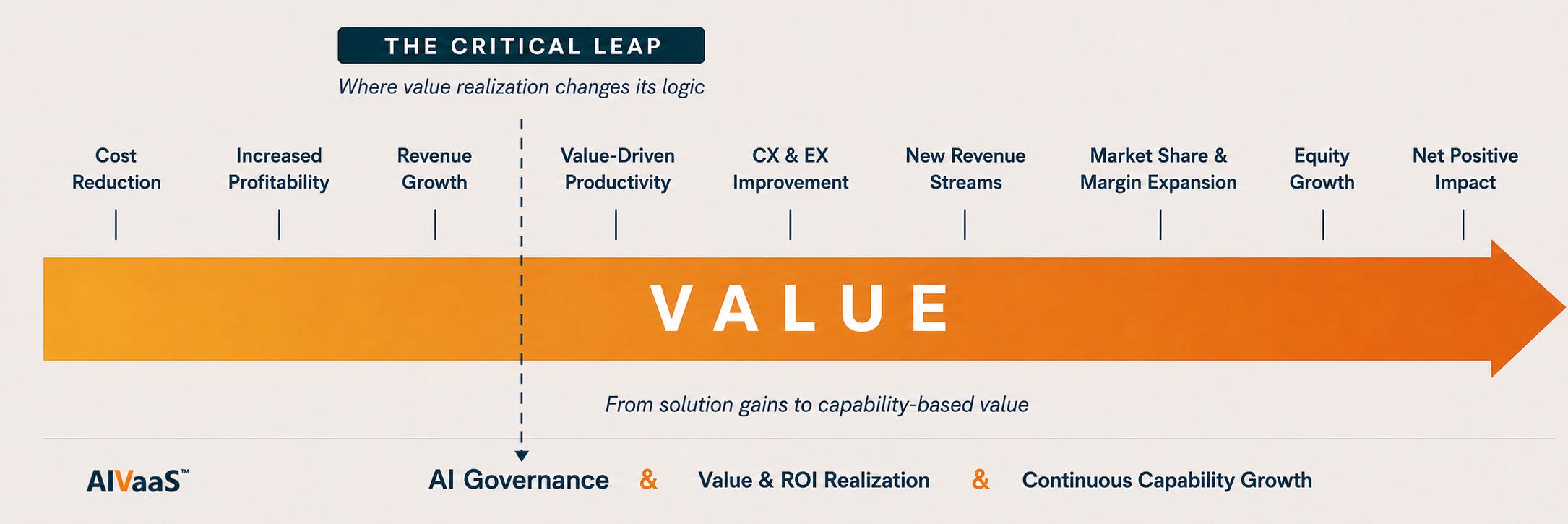
For many organizations, the left side is the natural starting point. Cost reduction, increased profitability and revenue growth can often be reached within AI adoption, sometimes through strong individual AI use cases and sometimes through a disciplined portfolio of them.
The Critical Leap marks the point where that logic changes. To the right of the leap, sustained value realization at scale depends on connected capabilities across solutions, data, processes, decision rights and ways of working.
It aligns with the boundary the AI Ambition Matrix draws between L2 and L3: the move from AI adoption to AI transformation.
What changes is what the organization must be able to do.
Organizations enter the spectrum at different points and may choose to leap. The further right they aim, the more their value realization depends on capabilities that reinforce one another, scale and continue to grow.
Choosing a form of value is therefore a leadership decision before it is a technical one. The chosen form of value, the level of AI ambition and the required capabilities must stay aligned.
An organization cannot remain at L2, build only for adoption and expect right-side value to materialize.
What remains and keeps growing
What the organization must be able to do beyond any single solution has a name in the AIVaaS™ foundation: capability. Continuous Capability Growth is the discipline that builds, preserves and extends it.
Readiness is the state of a specific solution and its environment. Capability is the repeatable organizational ability to create and realize value across solutions.
Readiness is assessed for a specific solution and its deployment context, inside the third pillar. Capability outlives each deployment, which is why it belongs to the foundation.
An organization can be ready for one solution and still be unable to repeat the achievement. Capability makes value creation and realization repeatable, and it must keep growing for two reasons: the forms and scale of value pursued expand, and AI itself keeps evolving.
Capability is easily confused with the assets that support it. Trained people, a centre of excellence, purchased technology and one-off training may support capability. A maturity score may describe it. None of them proves that the capability exists.
Capability becomes real through routines, decision rights, institutional memory and the ability to transfer learning across solutions.
Would this capability survive if its main carrier left the organization today?
Organizations often stumble later, when attention shifts to the next problem before learning from the previous solution has been absorbed and reused.
Every loop left open creates a double loss: unrealized or unconfirmed value, and the capability the solution should have left behind.
That is why capabilities are built alongside solutions and, where the ambition demands it, before them. The capabilities built around a solution are part of its enabling value, and part of what the portfolio view must protect.
Capability is what the organization retains from one solution cycle and can reuse in the next. It makes the next leap faster, more reliable and less costly.
Left of the Critical Leap, capability is an advantage. Right of it, capability is the ground on which sustained value stands.
Who holds the measures
One discipline holds the other two together. AI Governance sets the measures, boundaries, decision rights and accountability within which Value & ROI Realization tests outcomes and Continuous Capability Growth renews the organization’s ability to create them.
Those boundaries travel down to every solution. Business Solution Design translates them into the solution. Where needed, the AI Solution Constitution codifies the non-negotiables, and the harness makes them executable.
Three disciplines, one foundation. Value & ROI Realization confirms what value arrived. Continuous Capability Growth keeps the organization able to create more. AI Governance holds the frame in which both continue.
The pillars build solutions. The foundation keeps value provable, capability growing and decisions governed.
Ana and the life about to begin
Ana is days away. Her life is about to change in a way she could prepare for and cannot yet measure.
The value she has carried for nine months is about to get a face. Everything she has ever counted as valuable will rearrange itself around it, and the meaning of this value will keep growing with the child.
Nine months of growing capabilities were only the beginning. As the child grows, it will keep calling for abilities Ana does not yet have.
Organizations are no different. The value they create will keep asking them to become capable of more. And the customers Ana represents will keep expecting that value to grow with their lives.