


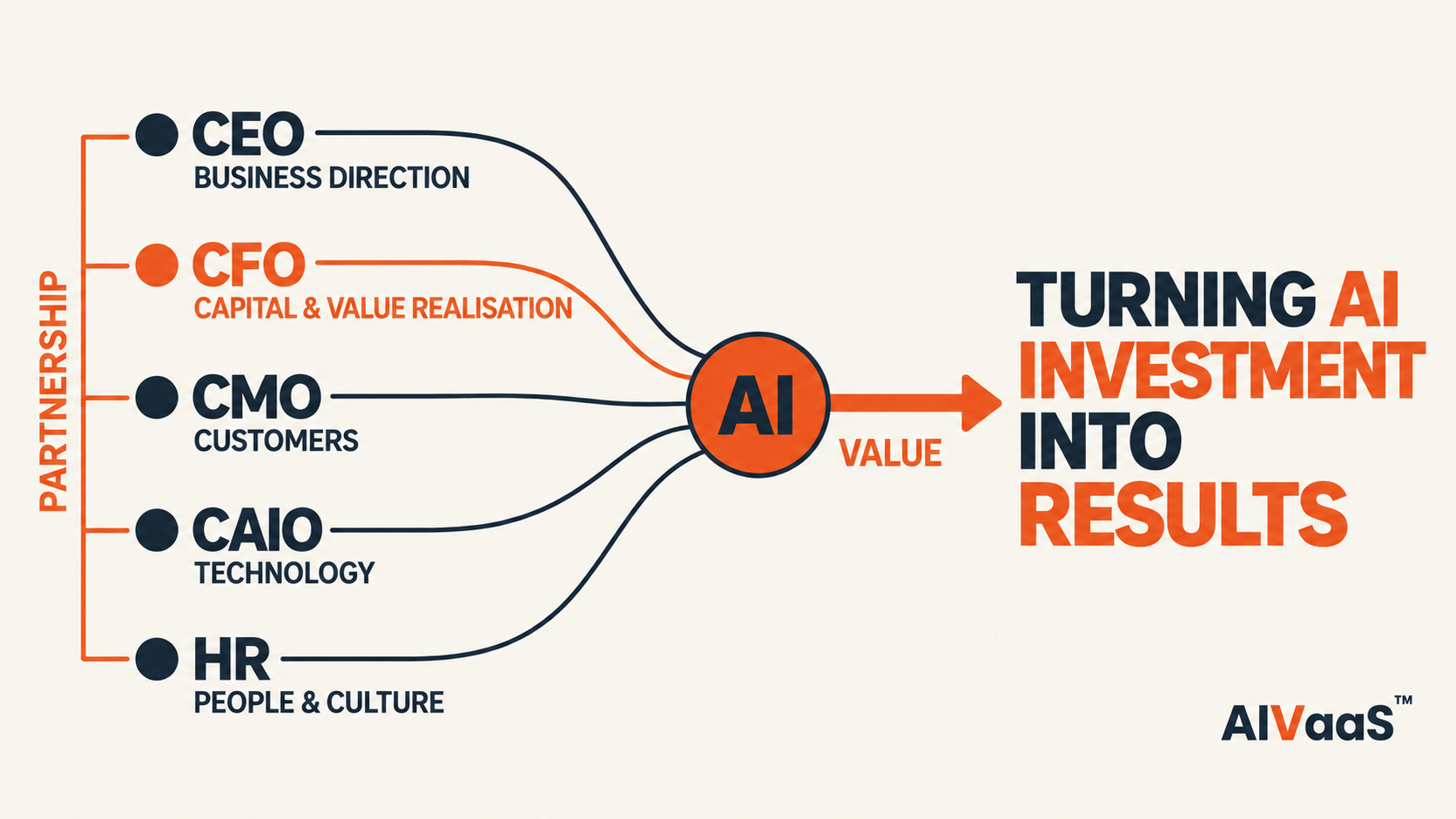
The monthly finance review at a B2B supplier opens with a question about the rising AI bill. Further down the same report, sales are growing while customer payments arrive later.
The cost pressure is real. In Deloitte’s Finance Trends 2027 survey of 1,434 finance leaders, 60% expected AI costs and complexity to rise substantially through 2027.
An AI-assisted review connects orders, delivery records, invoices and dispute correspondence. Finance checks the findings with the teams involved: some payments are held up because the supplier’s records do not match.
The immediate response might be more reminders. Yet customers are spending time resolving errors the supplier created. The CFO brings sales and operations into a discussion about preventing those errors.
Here, improving cash flow begins with removing a problem for the customer. AI has helped finance see an opportunity whose delivery reaches across the business. The CFO’s contribution to AI now includes shaping how that value will be created.
AI gives the CFO a larger role in business value creation
IBM’s 2026 CFO study found that 62% had taken on new leadership responsibilities in enterprise technology or AI.
In the same Deloitte survey, covering companies with at least US$1 billion in annual revenue, 54% led enterprise AI and technology capital allocation.
The opportunity begins before a proposal reaches the investment committee. Working with business leaders, the CFO can examine the need being served, the changes required and the economics of delivering the intended benefit.
When finance enters only after a solution has been chosen, the company may fund a technically workable project without understanding how customers will benefit or what must change to earn a return.
The AIVaaS™ approach connects business ambition, stakeholder value and the capabilities needed to deliver it. The CFO contributes by shaping value choices, funding connected capabilities and steering value realisation.
Business leaders remain accountable for the changes and outcomes in their areas, while the CEO and leadership team hold the overall direction.
Using AI in finance gives the CFO practical experience for this wider contribution. Better financial work and stronger judgement about business value reinforce each other.
AI can improve the decisions finance brings to the business
Finance works across information that arrives at different times and in different forms. AI can connect it, identify patterns and prepare explanations for review. Value appears when the team makes a better decision or acts in time to influence the outcome.
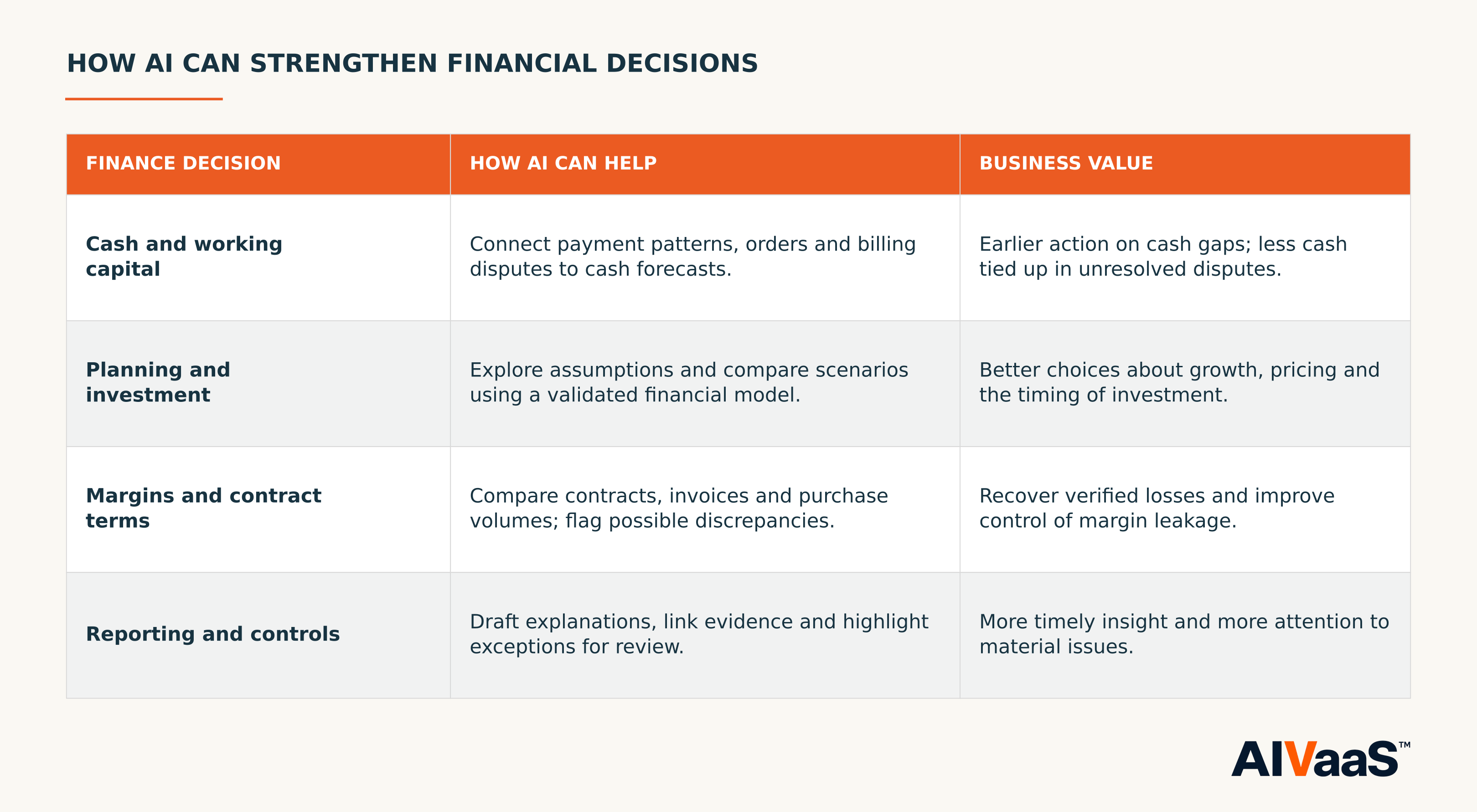
In the billing example, the CFO can compare the cost of repeated collection work with the cost of preventing disputes. The discussion with sales and operations now includes correcting order information, clarifying delivery evidence and assigning responsibility for exceptions.
AI makes it feasible to examine patterns across transactions and correspondence that teams would struggle to review together manually. Finance can bring recurring causes to the discussion earlier, with evidence that sales and operations can test.
For planning, AI can help explore how changing demand, a delayed launch or different payment terms affect an investment. Calculations run through a validated financial model, with assumptions visible to the people deciding.
Contract review offers another direct use. AI can compare invoices with rebate conditions, pricing tiers and cumulative purchases, flagging discrepancies for finance and procurement to investigate.
The team verifies the contractual basis and agrees the action with the supplier. A flagged discrepancy becomes financial value only when a valid correction is secured or a recurring loss is prevented.
A forecast estimates an outcome; an explanation helps people interpret information; an agent may take an authorised action. Finance needs to know which contribution it is relying on and what must be checked.
The billing example makes a wider point. Even a use of AI centred on the CFO’s own cash flow concerns can lead directly to customer value.
The value case extends beyond immediate savings
In AIVaaS™, value has an address: someone whose need is better met. The CFO connects that benefit to the company’s economics. Three of the seven value levers AIVaaS™ works with illustrate the wider view.
Accelerate Value Realization. Resolving billing discrepancies sooner reduces uncertainty and administrative work for the customer and can bring earlier payment for the supplier. Both effects need evidence. Demanding faster payment alone need not improve the customer’s experience.
Stabilize Value Flows. AI-supported maintenance could help an equipment provider offer more reliable availability. The customer gains continuity; the provider may gain recurring service revenue. The CFO assesses delivery costs and the obligations attached to that promise.
Create New Value. AI might make planning support affordable for smaller customers a supplier could not previously serve that way. The CFO works with the business leader to test the need, willingness to pay and economics of providing the service.
Each possibility changes what the business must learn and fund. Understanding who benefits helps the CFO judge which capabilities the investment must make possible.
Funding AI also means funding learning and business change
A new opportunity rarely arrives with every assumption resolved. The CFO can structure an initial commitment around what the company needs to learn. The amount committed and the evidence required should fit the next decision.
The billing initiative could begin with one customer group and a baseline for disputes, resolution times and payment delays. Finance and the process owner agree what improvement would justify expansion and what would require a different approach.
The budget must cover correcting the process and preparing people to work differently. Funding an analysis without the capacity to act on it leaves the cause of the delays in place.
As scope grows, costs include data preparation, integration, evaluation and ongoing support. A cheaper AI model that creates more rework may cost more per completed business transaction. Supplier dependence and the cost of changing direction also matter.
Shared data or a reusable review process may produce limited direct returns while enabling benefits elsewhere. AIVaaS™ brings this enabling value into portfolio judgement. Finance needs to make those dependencies visible and count shared costs and benefits once.
AI VALUE 3 examined how investment criteria influence which forms of value get funded. Here, the CFO takes the next step: turning an approved commitment into a test of whether the intended value can be delivered.
Realised value must change the next decision
AIVaaS™ Value & ROI Realization follows potential value through emerging evidence to results sustained in daily business. The CFO helps establish how financial effects will be recognised and how much can reasonably be attributed to the change.
A better cash forecast does not prove that cash has been released. In the billing test, the team needs to establish whether disputes are resolved sooner, payments arrive earlier and financing needs change.
Customer feedback also matters. It can show whether the process removed a recurring difficulty or merely increased collection pressure. Earlier payment accompanied by more work for the customer tells a different value story.
Finance can compare the test group with similar accounts and check for changes in sales mix or payment terms. That helps distinguish the initiative’s contribution from improvements that would have happened anyway.
Saved time can create capacity, improve service or reduce excessive workloads. A cash saving requires an identifiable reduction in expenditure. The same improvement must not be counted again each time it appears in productivity, profit and cash measures.
When results fall short, the CFO can help diagnose the cause before deciding on further funding. Was the process change funded? Could employees act on the findings? Did the solution perform well enough? The answer determines whether to adapt, expand or stop.
Where agents can change payment terms, approve a write-off or initiate a payment, financial authority, limits, escalation and traceability must be explicit. These rules determine how far AI can act on the company’s behalf.
The CFO shapes these requirements with the chief AI officer (CAIO), or the leader responsible for AI, alongside process owners and technology teams. Their collaboration connects financial judgement with the design of day-to-day decisions.
Finance teams need new ways of working
AI can free finance professionals from parts of information preparation. The CFO needs to decide how their work develops: investigating causes, comparing alternatives with business leaders and following decisions through to their effects.
The CFO can use AI personally as an analytical sparring partner. It can help surface assumptions that could overturn an investment case, explore the economics of a new offer or prepare questions for a technology partner.
Its claims and calculations still need checking, and sensitive information belongs in approved environments. Used this way, AI helps the CFO consider more alternatives and ask better questions.
With HR, the CFO can develop the team’s understanding of customers, processes and AI. AI VALUE 4 explored HR’s contribution to redesigning work and developing human capabilities. Finance gives that partnership a concrete setting in which to apply and assess the changes.
Data owners are part of this work. An order, a completed delivery and recognised revenue need consistent business definitions across the systems and people using them. Otherwise, a convincing explanation can conceal a basic misunderstanding.
Junior colleagues still need opportunities to develop judgement. They can investigate exceptions, compare model outputs with actual outcomes and explain their reasoning to experienced colleagues. Removing a task should not remove the learning it used to provide.
This is AIVaaS™ Continuous Capability Growth in practice. Methods for checking outputs and knowledge of business causes become part of how finance works, supporting the next opportunity after the current project ends.
The CFO’s role in the Critical Leap
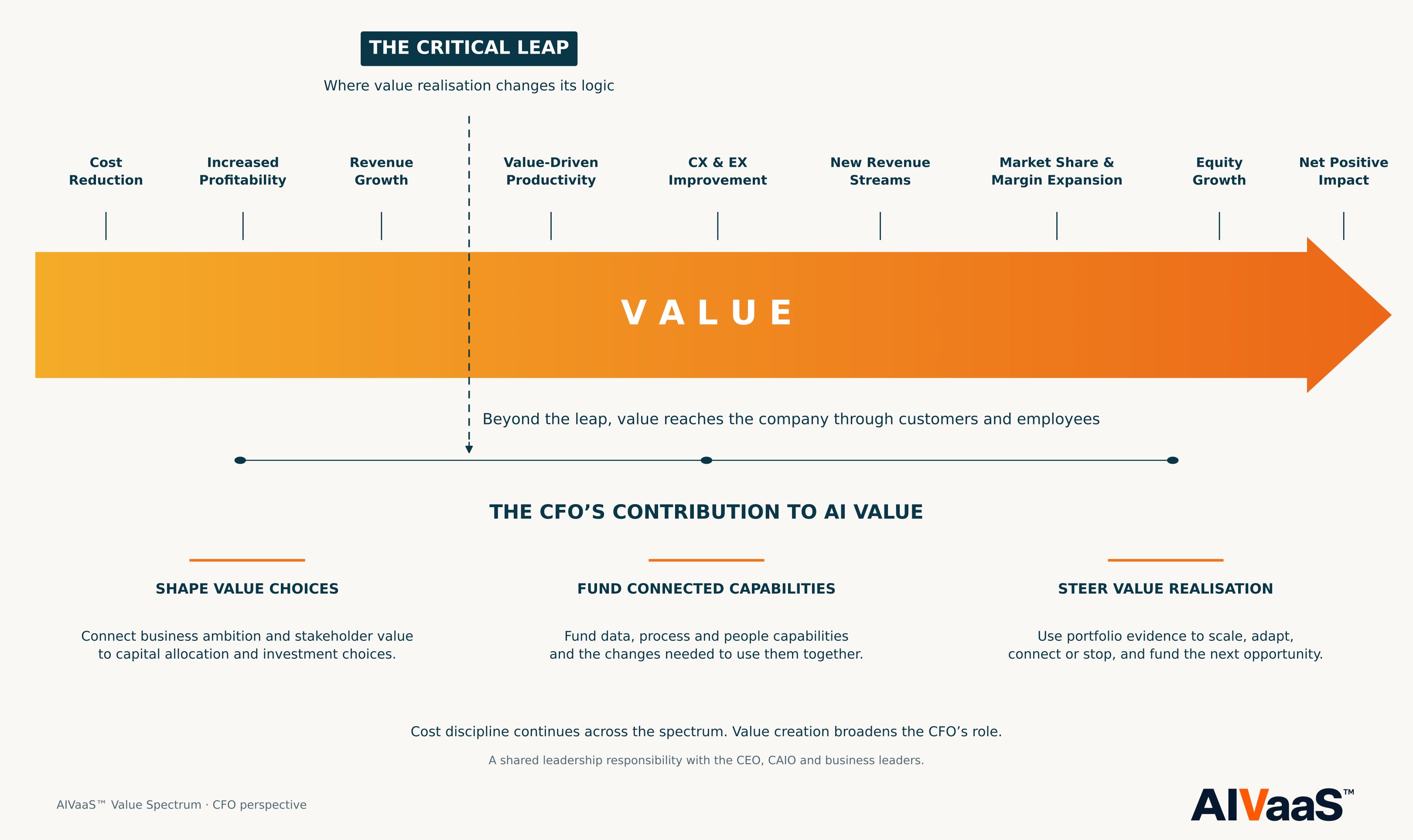
AI VALUE 3 described the Critical Leap through the logic of value realisation. On the left of the AIVaaS™ Value Spectrum, the company improves the business it already has. Beyond the leap, business returns depend on value first reaching a customer, employee or another recipient.
Sustaining that value at scale requires connected capabilities. Customer insight must inform decisions; data, processes and people must support delivery. This explains why funding a collection of AI tools alone cannot produce the change.
For a new AI-enabled service, the CFO connects customers’ willingness to pay with the capabilities needed to deliver it reliably. Designing, testing, rejecting and scaling such offers quickly builds the company’s ability to generate future value.
The billing example reveals this connection, although fixing invoices does not itself constitute the Critical Leap. It gives the CFO a practical starting point for recognising how value for someone else and value for the company depend on each other.
Involving the CFO in shaping AI value is one of the leadership conditions for the leap. Financial discipline continues across the spectrum, extending to the capabilities and future sources of value the company needs.
Return to the supplier’s next review. If the test shows fewer disputes, less work for customers and earlier payments, the CFO can bring that evidence to leadership with a proposal for expansion. If it does not, the evidence should change the proposal.
The leadership team can now see the CFO’s wider contribution in a business decision. Alongside the CEO, CAIO and HR, the CFO brings financial judgement and capital allocation to choices about how the company creates value with AI.
The CEO should expect stronger finance decisions and this broader contribution. Involving the CFO early, providing access to customer and operational information, and supporting development make both possible.
The CFO’s growing value lies in helping the company decide what is worth making possible, committing resources to it and using evidence to shape what happens next. That contribution reaches well beyond the token bill.
The CFO also needs to deepen their understanding of value before it appears in the accounts. Working with the CMO and other customer-facing leaders shows why customers stay, struggle or leave. Learning alongside the CEO, CAIO, HR and business leaders builds a shared basis for those decisions.